
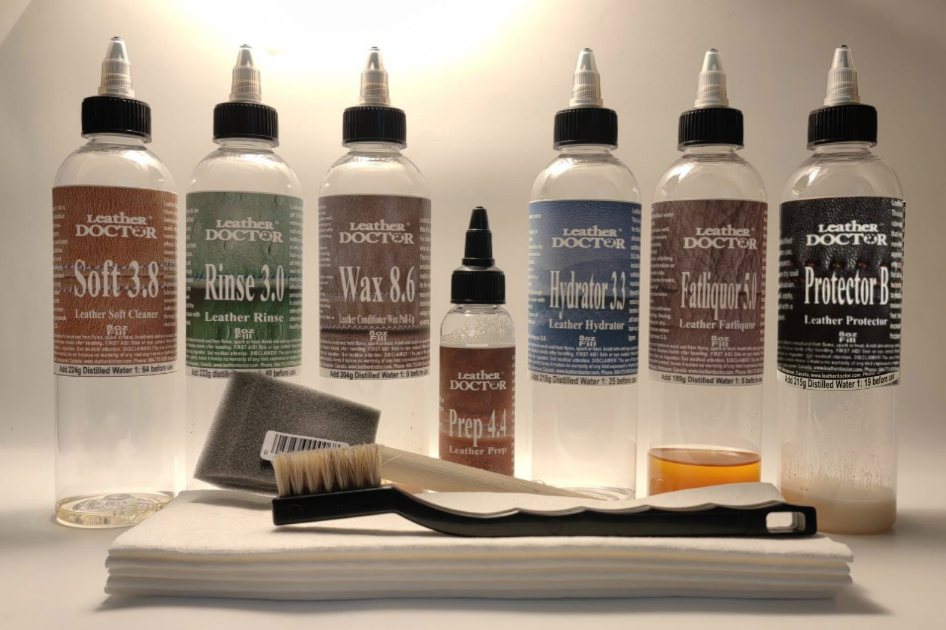



Kit AW3 is formulated for preventive, routine, periodic, and restorative care, this system maintains the natural beauty of wax pull-up leather and delays premature aging from sun exposure, dryness, and wear.

Wax pull-up leather is a full-grain aniline-dyed leather infused with a secondary wax finish that gives it its signature pull-up effect—a lighter tone that emerges when the leather is stretched or creased, and a glossy, slightly rugged look that enhances over time.
This leather type features a dual-conditioning system:
- Fatliquor 5.0 – Restores internal softness, flexibility, and structure-critical lubrication.
- Wax Pull-Up 8.6 – Revives the waxy fashion effect and enhances pull-up contrast and gloss.

- Stretching or pulling reveals a lighter color, which disappears with warmth or massage.
- Fingernail scratches are easily visible on the glossy surface.
- The reverse suede side shows a similar color tone to the grain side, indicating true aniline dye-through leather.

Why Does Color Fade?
- Aniline dyes are UV-sensitive and more prone to fading than pigments.
- Loss of internal fatliquor diminishes color depth and saturation.
Why Does Leather Feel Stiff in Sun-Exposed Areas?
- Heat and UV draw out natural fats and oils, causing fiber dryness and stiffness.
How Does Stiffness Lead to Cracking?
- Without sufficient fatliquor, leather fibers stick together, harden, and crack under pressure or flexing.
- Hydrator 3.3 – Periodically used to relax compressed and stiff fibers.
- Fatliquor 5.0 – Replenishes the essential fat and oil balance to restore flexibility and prevent cracking.
This rejuvenating system strengthens the leather’s internal structure, enhances surface aesthetics, and slows the aging process naturally.
Step 1: Deep Clean & Rinse
- Prep 4.4 – Heavy-duty cleaner for ingrained oils and grime.
- Soft 3.8 – Gentle cleaner for routine maintenance.
- Rinse 3.0 – pH-balanced rinse to neutralize and refresh.
Step 2: Hydrate & Soften
- Hydrator 3.3 – Relaxation agent to open up compressed leather fibers.
- Fatliquor 5.0 – Core fat and oil conditioner that restores suppleness.
Step 3: Revive the Wax Pull-Up Effect
- Wax 8.6 – Restores the natural pull-up effect and rich finish.
Step 4: Final Protection
- Protector B – A non-stick, rub-resistant conditioner to protect against daily friction, wear, and stains.
Leather Doctor® Kit AW3 - For those who appreciate luxurious leather that ages with grace—this system brings back softness, strength, and timeless beauty to your wax pull-up leather. Because when leather is cared for properly, it doesn't just last—it evolves.

Kit AW3 concentrates contents require 1276g (1.4 quarts) distilled water to be mixed and filled before use with these selected leather-safe products:

Click the links for details:
✅ Prep 4.4 (2oz ready-to-use)
✅ Soft 3.8 (8oz concentrate)
✅ Rinse 3.0 (8oz concentrate)
✅ Hydrator 3.3 (8oz concentrate)
✅ Fatliquor 5.0 (8oz concentrate)
✅ Wax 8.6 (8oz concentrate)
✅ Protector B (8oz concentrate)
✅ Brush 1 (horsehair detail brush)
✅ Foam 2 (polyfoam applicator brush)
✅ Towel 5 (lint-free, reusable towel)

Distilled Water Mixing Instructions (Before Use):
This Kit AW3 requires 1276g (1.4 quarts) of distilled water, to be mixed with the concentrates.
- Fill each 8oz bottle to approximately 250g or 1.5 inches below the top.
- Shake well to fully activate the solution before use.

- Apply thinly using Foam 2.
- Let dwell for 5 minutes to 1 hour, depending on the level of soiling.
- Allow to dwell if needed for deeper penetration, lubrication, and soil suspension.

- Apply over Prep 4.4.
- Agitate with Brush 1.
- Use Towel 5 to extract suspended soiling.
- Repeat with clean sides of the towel until no visible soil remains.

- Apply evenly and agitate again with Brush 1.
- Extract residue with Towel 5, folding to a clean side each time.
- Continue until the leather feels clean and squeaky.

- Apply and spread using Foam 2 until the surface darkens evenly.
- While the leather is saturated: Gently massage, flex, and stake to relax stiffness, creases, and restore shape.
- Continue until leather feels relaxed and ready for fatliquoring.

- Apply to fully saturate the leather and let it air dry naturally.
- Reapply after each drying cycle, as water evaporates, leaving behind essential fats and oils.
- Repeat until the leather absorbs no more.
- As it approaches full dryness, massage, flex, and stake again to restore soft suppleness—this preps the leather for the pull-up revival stage.

- Apply evenly to achieve a uniform darkening effect.
- Let the wax absorb and dry naturally.
- A cloudy crystalline film will form on the surface—this is normal.
- Heat-activate with hot hair dryer or gentle heat to melt the wax into a glossy pull-up sheen.

- Apply and spread a light coat using a lint-free cloth.
- Let it air dry.
- Leather is now conditioned, protected, and ready for use.

- Always test each product on a hidden area first.
- Use only distilled water to avoid mineral contamination.
- Work in sections for large items to ensure even results.
- Avoid exposing treated leather to direct sunlight or heat until fully dried and conditioned.

- What is a Leather Systematic Cycle of Care?"
- What is a Leather Preventive Care System?
- What is a Leather Routine Care System?
- What is a Leather Periodic Care System?
- What is a Leather Restorative Care System?
1. What is a Leather Systematic Cycle of Care?
- A leather systematic cycle of care includes preventive, routine, periodic, and restorative levels of care to bring suppleness, and appearance at all times high.
2. What is a Leather Preventive Care System?
- A leather preventive care system is a nonstick, rub-resistant conditioning to increase the leather's resistance to wet and dry rubs, thus reducing stretch, scuff, and abrasion with Protector W.
3. What is a Leather Routine Care System?
- A routine care system includes dust cleaning, conditioning, and attending to spots and stains as required.
- Rinse 3.0 routinely neutralizing perspiration soiling prevents the leather from denaturing into tackiness.
- Sanitizer 3.9 routinely sanitizing keeps a hygienic bacteria-free surface.
- Deodorizer 4.5 routinely deodorizing keeps the leather free of unwanted odors.
- Protector W routinely conditioning keeps the leather nonsticky and reduces friction wear.
4. What is a Leather Periodic Care System?
- A periodic care system is recommended before soiling causes damage to the leather finishing.
- It requires attention to body contact surfaces like the headrest and armrest with most soiling from body oil, grease, and sweat.
- Cleaner 3.8 and Rinse 3.0 cleans and rinse periodically keeping the leather clean and healthy, at all times.
- Hydrator 3.3 and Fatliquor 5.0 to relax and soften the leather periodically keeping it free from dryness and stiffness with suppleness.
- Wax Pull-up 8.6 periodic revival keeps the fashion pull-up effects fresh and lively.
5. What is a Leather Restorative Care System?
- A leather restorative care system is the ultimate salvage system that removes unwanted accumulated soiling and aged conditioners.
- It requires a preparatory cleaning product such as Prep 4.4, to work in sequence with Cleaner 3.8 followed by the Rinse 3.0 system.
- Gloss 76 to restore topcoat wear and damage is an option.

Stain identification is crucial for effective treatment and is based on six key factors:
Appearance, Odor, Color, Feel-of-Hand, Location, and Buildup or Absorption.
Appearance
- Observing how the stain looks can indicate whether it is a spill, rub-on, penetration, or surface deposit.
- Some stains may cause dye or finish damage, revealing changes in the leather’s color or texture.
Odor
- Smelling the stain can help identify its source.
- Common odors include:
- Moldy (fungal growth)
- Smoke (fire or cigarette exposure)
- Putrid (decaying organic matter)
- Ammonia (urine contamination)
Color
- Color provides a clue to the staining substance but can change over time due to oxidation.
- The leather’s natural color may also influence how the stain appears.
- Red stains: Could be from wine, blood, lipstick, nail polish, or beverages.
- Blood stains: Can oxidize and shift from red to tan, then to black.
Feel-of-Hand
- Touching the stain helps determine its type:
- Sticky: Likely from candy, beverages, or sugary substances.
- Brittle and stiff: Could be nail polish, paint, or shellac.
- Greasy smear: Often caused by lipstick, oils, or butter.
Location
- The stain’s location on the leather provides hints about its origin.
- Headrests & armrests: Usually stained by body oil, sweat, and grease.
- Seat cushions: Often show food or beverage spills.
Buildup or Absorbed
- Stains can be surface-level (built-up) or deeply absorbed into the leather.
- Built-up stains (common on pigmented leather) include paint, food residue, and ink.
- Absorbed stains (common on nubuck, aniline, and unfinished leather) include wine, tea, and coffee.
- Combination stains: Some stains contain both absorbed and surface elements, such as lipstick, ink, and mustard.
- Protein-based stains: Examples include blood, dairy, and egg-based spills.
- Oil-based stains: Often come from grease, butter, and lotions.
- Colloidal stains: May require specialized treatments.
Additional Considerations
- Sweat stains can chemically alter leather, causing tackiness (when dry) or sliminess (when wet).
- Dye stains may show up when wiping with a white towel—this indicates color crocking.
- Fatliquor leaching (spew) appears as a milky film and causes leather to become stiff and prone to cracking.
By carefully identifying stains, you can apply the appropriate Leather Doctor® solutions to restore leather to its original beauty.
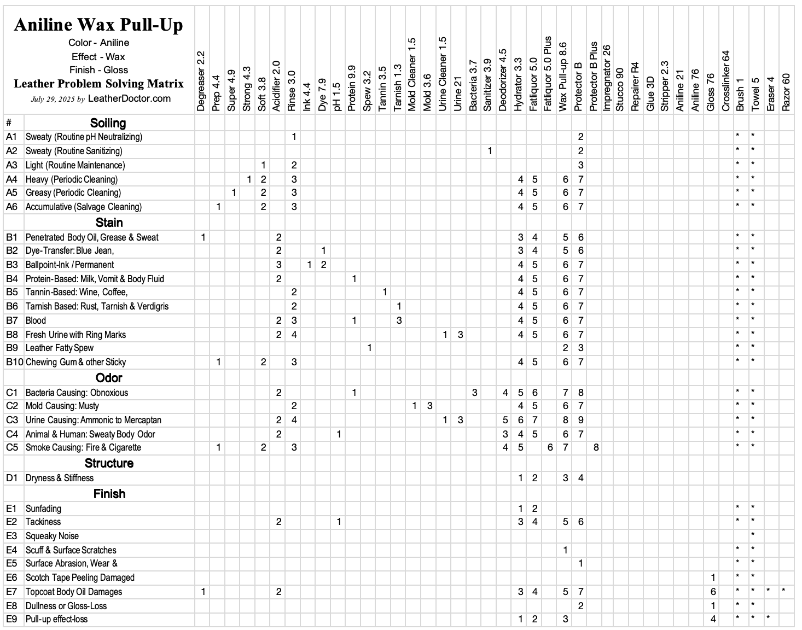

- This matrix categorizes common issues with Vachetta into five groups:
- Soil, Stain, Odor, Structure, and Finish (listed in the left column).
- Corresponding recommended products are displayed across the top row.
- Each number within the matrix indicates the steps required to address the problem holistically.
For example:
If a leather issue involves an unknown compound that combines soil, stain, and odor, follow the sequence across the matrix, combining necessary steps from each category.
The process should always conclude with:
- Hydrator 3.3 to rehydrate and relax the leather.
- Fatliquor 5.0 to replenish lost fats and oils, restoring suppleness.
- Protector B conditioning the leather for ongoing durability.

Updated: December 20, 2024,| April 9, 2025 | July 29, 2025 | August 17, 2025 by Roger Koh.