


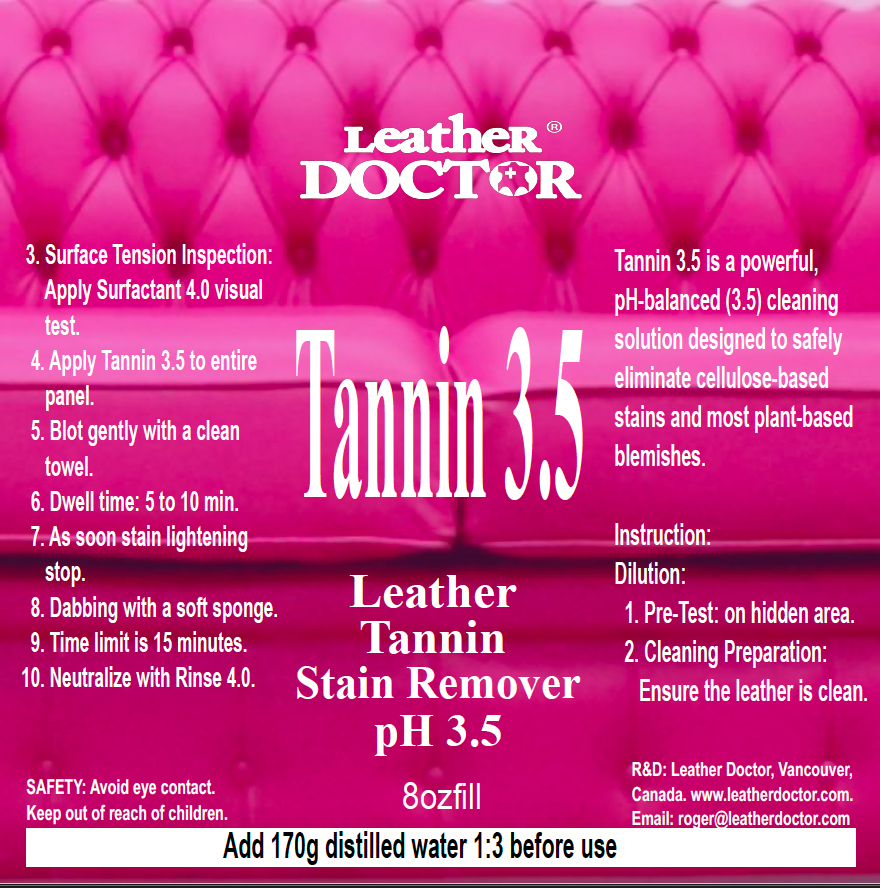
 Leather Tannin Stain Remover pH 3.5 (Tannin 3.5) by Leather Doctor® is a professional Leather-Safe™ cleaning solution formulated to safely remove cellulose-based tannin stains such as coffee, tea, wine, cola, grass, plant residue, and certain dye transfers from leather.
The formula is carefully balanced at pH 3.5, which allows it to dissolve tannin discoloration while remaining within the safe acidic range required to protect leather’s collagen fiber structure.
Tannin 3.5 is particularly effective on Vachetta, Aniline, Semi-Aniline, and Vegetable-Tanned leathers, where organic stains tend to penetrate deeply into the grain structure.
 What is a Tannin Stain?
A tannin stain on leather is a dark discoloration caused by plant-based organic compounds reacting within the leather structure.
These stains may originate from external organic liquids or from the leather’s own tannins migrating when exposed to moisture.
 Common Causes of Tannin Stains
1️⃣ Organic Liquids
Common beverages and plant-based materials contain natural tannins that can penetrate leather.
Typical sources include:
• Coffee
• Tea
• Wine
• Cola and soft drinks
• Grass and plant sap
• Fruit juices
When these liquids dry, they often leave dark rings or uneven patches embedded in the grain.
2️⃣ Water Migration (Tide Marks)
When leather becomes wet, internal tannins and oils may migrate within the fiber structure.
As the moisture evaporates, these compounds concentrate along the drying edge, creating visible rings known as tide marks.
This occurs most often with:
• Aniline leather
• Vegetable-tanned leather
• Highly absorbent natural leather finishes
3️⃣ Metal Reactions
Tannins may chemically react with certain metals, especially iron.
When wet leather contacts iron particles or steel objects, it can form iron-tannate discoloration,
Producing dark blue-black stains similar to historical iron gall ink.
These stains are treated using Tarnish 1.0, which breaks the metal-tannin bond.
 Characteristics of Tannin Stains
Appearance
• Brown stains
• Blue-black discoloration
• Gray rings or tide marks
Most Susceptible Leather
Vegetable-tanned leather contains high concentrations of plant tannins and is therefore more vulnerable.
Chrome-tanned leather is generally more resistant but may still show discoloration when organic stains penetrate deeply.
 Usage Instructions
Dilution
Dilute concentrate with distilled water at:
1 part Tannin 3.5 : 3 parts water
Pre-Test
Always test on a hidden area first.
Allow the test area to dry completely before proceeding.
Cleaning Preparation
Ensure the leather is clean before stain removal.
For older or complex stains:
- Perform a general cleaning first
- Allow the leather surface to dry
Surface Tension Inspection
Before applying Tannin 3.5, ensure the surface is free of tension.
Apply a light mist of Surfactant 4.0 to evaluate absorption and confirm even wetting across the panel.
The Global Pre-Wetting Technique (Important)
Vachetta and Aniline leather is extremely absorbent.
Treating only the stained area can create water rings or tide marks.
Seam-to-Seam Humidification
Lightly dampen the entire leather panel using Surfactant 4.0 and a clean sponge.
The leather should appear:
• evenly darkened
• cool to the touch
• damp but not dripping
Why This Matters
If only the stain is wetted, cleaning salts migrate toward dry edges during evaporation.
This creates a visible demarcation line (tide mark).
Pre-wetting ensures the solution diffuses uniformly through the fiber structure.
Application
Apply diluted Tannin 3.5 directly to the stained area.
Blot gently with a clean absorbent towel to lift the discoloration.
Repeat blotting until stain transfer stops.
Dwell Time
Allow the solution to dwell for:
5 – 10 minutes
Visual Monitoring
Aniline leather reacts quickly.
Once the stain lightens sufficiently, do not wait for the full dwell time.
Prevent Drying
The treated area must remain damp during treatment.
If the solution dries prematurely, salts may crystallize inside the fibers, causing:
• stiffness
• white chalky residue
Mechanical Assistance
During dwell time, gently dab the area with a sponge to improve penetration and stain release.
Counter-Neutralization
Once treatment is complete, immediately rinse using:
Rinse 4.0 (pH 4.0)
This step neutralizes the cleaning salts and stabilizes the leather within its natural pH range of 3–5.
Post-Cleaning Leather Restoration
After stain removal, the leather structure should be restored using the Leather Doctor® system.
Hydrating with Hydrator 3.3
Hydrator 3.3 relaxes and reopens collapsed leather fibers.
Benefits include:
• restoring proper pH balance
• flushing residual contaminants
• preparing the fibers for conditioning
This step also restores the positive ionic charge necessary for proper fatliquor bonding.
Fatliquoring with Fatliquor 5.0
Fatliquor 5.0 replenishes essential fats and oils that maintain leather flexibility.
Benefits include:
• restoring suppleness
• improving tensile strength
• lubricating individual fibers
• restoring fullness and resilience
Because Fatliquor 5.0 carries a negative ionic charge, it bonds strongly with fibers prepared by Hydrator 3.3.
This ensures long-lasting conditioning inside the leather structure.
Drying Massage (Breaking the Fibers)
As leather dries, collagen fibers may adhere together and cause stiffness.
A gentle drying massage restores flexibility.
When to Begin
Start when leather is approximately 80% dry.
The leather should feel cool but begin returning to its original color.
Technique
• Stretch leather gently lengthwise and widthwise
• Flex and twist lightly to loosen fibers
• Rub grain-to-grain with circular motions
For larger panels, a wooden roller may be used lightly.
Repeat every 30 minutes until fully dry.
Precautions
• Always work with clean hands
• Avoid stretching damp seams excessively
• Handle delicate aniline leather gently
Result
When properly restored using the Leather Doctor® Leather-Safe™ system, the leather will regain its:
• natural softness
• structural strength
• healthy squeaky tactile feel
Updated: February 9, 2025 |April 14,2025|March 6 by Roger Koh.