


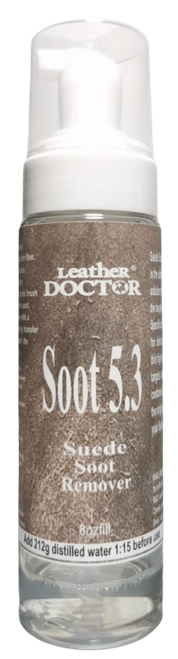
Eliminate soot safely: The power of pH 5.3
- Give your Nubuck and Suede items a new lease of life after contaminated with soot.
What is Smoke and Soot?
Smoke is a Gas (The Odor)
What it is:
Smoke is a collection of airborne gases, vaporized oils, and tiny invisible particles released by a fire.
The Problem:
It travels anywhere air can go.
It easily penetrates deeply into porous materials like Nubuck and Suede.
How to fix it:
Because smoke carries the smell, you need Smoke 3.7 to break down and neutralize the oily, alkaline odor molecules trapped in Nubuck and Suede.
Soot is a Solid (The Stain)
What it is:
Soot is the black, powdery or sticky ash residue left behind when something does not burn completely.
The Problem:
It is a physical carbon deposit that clings tightly to Nubuck and Suede.
It can be greasy, chalky, or smeared easily if you wipe it with water alone.
How to fix it:
Because soot is an oily solid, you need Soot 3.5 to lift the black particles off the surface so they can be wiped away without smearing.
Why choose the Soot 5.3?
pH Neutral Technology for Nubuck and Suede :
Scientifically formulated with an exact pH of 5.3 to match the natural chemistry of suede.
Maximum efficiency :
Instantly dissolves and lifts soot particles and odors.
Respect for materials :
Cleans thoroughly without drying, discoloring or hardening the suede.
Professional quality :
The trusted formula used by disaster restoration experts .
Why Soot 5.3 handles both:
Soot 5.3 is smart because it tackles both problems at once: the plant-based Glucoside grabs and lifts the solid black soot, while the souring neutralizes the airborne smell.
Chemical Archetype Formulation
The Aqueous Foundation:
Pure, demineralized water acts as a completely fluid vehicle, preventing any mineral spotting or streaking on clean surfaces.
The Heavy-Duty Plant-Based Degreaser:
An exceptionally high concentration of this premium, plant-based surfactant. Because soot is a sticky, oily, carbon-based solid, this surfactant binds to the soot particles on a molecular level, lifting them cleanly away so they can be wiped up without smearing.
The Vapor Neutralizer Plant-Based Souring:
Smoke is an alkaline gas that deeply penetrates porous surfaces. The natural acidity chemically targets, neutralizes, and completely destroys airborne and surface-bound smoke molecules instead of simply covering them up.
The Product Safeguard:
A premium, eco-friendly, broad-spectrum preservative that prevents bacteria and mold growth within the bottle, providing an extended shelf-life.
Core Target Performance
Soot Destruction (The Stain):
It actively breaks the static bond between greasy, black carbon ash and its surfaces so they wipe away cleanly.
Smoke Elimination (The Odor):
It neutralizes localized odors originating from wildfires, tobacco, firewood, or kitchen flare-ups.
What Soot 5.3 Do
1. It Lifts and Erases Heavy Soot (The Stain)
How it works:
Soot 5.3 contains a massive concentration of plant-based Glucoside.
The result:
This Glucoside surrounds the microscopic, oily soot particles, breaks their grip on the surface, and traps them so you can wipe them away completely streak-free.
2. It Neutralizes and Destroys Smoke (The Odor)
Smoke is an alkaline gas made of vaporized oils that sinks deep leaving behind a permanent, stale smell.
How it works:
Soot 5.3 uses plant derive souring balanced to a precise 5.3 pH.
The result:
The natural acid instantly binds to alkaline smoke molecules, chemically changing them to neutralize the odor at the source rather than covering it up with artificial fragrances.
Why Soot 5.3 is Different
1. True Molecular Elimination vs. Fragrance Masking
2. High-Concentration Surfactant vs. Diluted Fillers
The Difference:
- Soot 5.3 features a massive concentration of premium, plant-based Glucoside.
- This dense concentration instantly breaks the static and oily bond that holds carbon ash to surfaces, trapping the soot particles inside the liquid so they wipe away cleanly without streaking or scratching.
3. Precision pH Engineering (The “5.3” Advantage)
4. Eco-Friendly Professional Power
- It delivers industrial-grade fire remediation results without relying on harsh solvents, synthetic dyes, volatile organic compounds (VOCs), or petroleum products.
- It is biodegradable, powered by plant-derived chemistry, and preserved safely with an eco-certified Geogard stabilizer.
Why “Soot 5.3” Fits Here
Deep-Level Acid Odor Fixation:
While Stage 3 (pH 3.7) offers superficial aromatic purification, alkaline smoke molecules that have deeply penetrated into the core of the material require a stronger acid environment (pH 5.3) to be fully neutralized and locked down.
Synergy with the Hydrator:
At pH 5.3, the chemistry begins to gently prepare the tight fiber structures for the deep wetting and opening action performed by the Hydrator at pH 3.3.
 Complete your Soot 5.3 with a Dovetailing Holistic Leather-Safe™ System
Step 1: Decontamination
Suede Foam Soot Remover 5.3 (Soot 5.3)
Complete with comprehensive system related products:
↓
Step 2: Stabilization
Suede Rinse 3.0 (Rinse 3.0)
↓
Step 3: Deodorization
Suede Smoke Deodorizer 3.7 (Smoke 3.7)
↓
Step 4: Hydrating
Suede Hydrator 3.3 (Hydrator 3.3)
↓
Step 5: Fatliquoring
Suede Fatliquor 5.0+ (Fatliquor 5.0+)
↓
Step 6: Conditioning
Suede Conditioner 3.4+ (Conditioner 3.4+)
Click the link:
Suede Smoke & Soot, Sanitizing & Deodorizing Kit S3.so (6-Step pH System)
- Stage 1 (pH 5.3): Safely cleans and resets the surface at a natural leather pH.
- Stage 2
- Stage 3 & 4 (pH 4.7 down to 3.3): Gradually re-opens the fibers to inject deep hydration.
- Stage 5 & 6 (pH 5.0 down to 3.2): Feeds the deep layers with lipids and seals the surface tight.
- Tactile Assessment: Feel the suede surface. If it feels sticky, slick, or soapy, a heavy surfactant film remains. Perform one more dry microfiber blotting pass before proceeding.
- Visual Inspection: Ensure no visible black streaks or loose carbon ash remain on the surface. If streaks are visible, spot-treat immediately with a light mist of Remover 5.3, blot, and extract before moving to Phase 3.
[pH 5.3: Relaxed Suede] ───(Apply Acid Rinse 3.0)───► [pH 3.0: Tightened/Stabilized Suede]
- Atomization Tuning: Set your spray nozzle to a fine, consistent mist (atomized cloud). Avoid heavy stream settings that saturate or flood the suede.
- Cross-Hatch Mist Application: Hold the Acid Rinse 3.0 bottle roughly 10–12 inches (25–30 cm) away from the surface. Apply a light, even coat using a cross-hatch pattern (horizontal passes followed by vertical passes).
- Chemical Penetration: Allow the Acid Rinse 3.0 to dwell on the damp suede for 2 to 3 minutes. During this time, the acid actively neutralizes the alkaline smoke salts and locks down water-soluble dyes/tannins.
- Resetting the Corium Nap: While the suede is still damp from the Acid Rinse, take a clean, dry, stiff-bristle suede brush and gently groom the nap back up. Brush against the natural lay of the fibers to ensure the acid penetrates the roots evenly.
- Final Moisture Control: Blot the entire surface one last time with a fresh white microfiber towel to remove any neutralized alkaline salts and excess moisture.
- Dye Bleeding / Color Transfer: If you notice color bleeding onto your white microfiber cloth during the Acid Rinse application, immediately stop. This means the leather's original dye is highly unstable. Lightly mist the area with Acid Rinse 3.0 again without rubbing, blot instantly with a dry towel, and force-dry the area with a cold-air blower to lock the dye in place.
- Fiber Stiffening: If the suede feels stiff right after applying the Acid Rinse, the pH drop occurred too rapidly due to leftover alkaline ash deep in the leather. Do not scrub. Proceed directly to Stage 3 (Smoke Sanitizer & Deodorizer - pH 4.7) or Stage 4 (Hydrator 3.3) to re-relax and open the fibers safely.
- Draft the Technical Data Sheet (TDS) layout for the Acid Rinse 3.0.
- Detail the drying times and environmental conditions (humidity/temperature) required before moving to Stage 3.