Aniline Waxy Matte Leather Dye Refinishing Kit AM7.cl by Leather Doctor degrease, acidify, clean, rinse, hydrate, fatliquor, dye, seal, and condition waxed leather.
 Aniline Waxy Matte Leather is a full-grain chrome-tanned leather known for its soft hand and transparent aniline-dyed color that enhances its natural beauty. The dye penetrates through to the reverse suede side, creating a rich, natural look with a subtle Sauvage effect. Its fine waxy matte finish is achieved through an emulsion topcoat, which is further protected with a non-stick, rub-resistant conditioner to minimize finish wear.
 As an amphoteric material, Aniline Waxy Matte Leather is pH-sensitive, requiring leather-safe products with a pH between 3 and 5 to prevent potential damage. If exposed to alkaline substances, it must be pH-balanced back to its neutral state (iso-electric point or pI) to maintain its integrity. Additionally, aniline leathers are more UV-sensitive, making periodic hydration and fatliquoring essential for preventing dryness, reviving color vibrancy, and maintaining suppleness to avoid stiffness and cracking.
 Sequence of Steps for Refinishing Waxy Matte Aniline Leather
The refinishing process for Waxy Matte Aniline Leather consists of four key stages:
- Cleaning, Hydrating & Fatliquoring, Dyeing & Sealing, and Conditioning.
- Each stage is essential for restoring the leather’s appearance, suppleness, and durability.
 Cleaning (Removes Soiling and Prepares Leather Surface)
A 4-product system is used to remove body oils, grease, sweat, and general soiling while maintaining the leather’s pH integrity:
- Degreaser 2.2 – Breaks down and emulsifies body oils and grease.
- Soft 3.8 – Removes general soiling and residual buildup.
- Rinse 3.0 – Final rinse to remove cleaner residues and return the leather to its optimal pH.
- Acidifier 2.0 – Neutralizes alkalinity and stabilizes the leather’s pH balance.
 Hydrating & Fatliquoring (Restores Leather Softness and Strength)
A 2-product system replenishes lost moisture and fatliquor to maintain the leather’s suppleness:
- Hydrator 3.3 – Rehydrates leather fibers, helping to relax stiffness and improve color saturation.
- Fatliquor 5.0 – Restores essential fats and oils to prevent cracking and maintain leather flexibility.
 Dyeing & Sealing (Restores Color and Enhances Appearance)
A 4-product system is used to restore color intensity and ensure a natural matte finish:
- Aniline 21 – A staining dye.
- Adhesor 73 – A prep and enhance adhesion before color coating.
- Dye 21 – A next-generation transparent surface coating dyestuff.
- Matte 21 – A waxy matte topcoat to seal and protect the dyed surface while maintaining its original finish.
 Conditioning (Preserves and Enhances Leather Durability)
A 1-product system creates a non-stick, rub-resistant barrier to reduce wear and prolong the leather’s lifespan:
- Protector W or Protector W Plus – A waxy-feel conditioner that enhances resistance to scuffing, abrasion, and soiling, with the Plus version offering a leather scent.
 Kit AM3.cl requires 1435g (1.6 quarts) of distilled waterto be mixed and filled before use, and products are available individually as refills to complete your project.
 Kit AM3.cl Product Summary Includes:
Click Link for Details:
✅ Degreaser 2.2
✅ Soft 3.8
✅ Rinse 3.0
✅ Acidifier 2.0
✅ Hydrator 3.3
✅ Dye 21
✅ Fatliquor 5.0
✅ Primer 73
✅ Dye 50
✅ Matte 50
✅ Conditioner W
✅ Brush 1
✅ Foam 2
✅ Towel 5
✅ Eraser 4
✅ Sand 2000
 Step-by-Step Application Guide
 SEQUENCE 1 – CLEANING (Surface & structural decontamination - wet-process begins)
1️⃣ Degreaser 2.2 (dissolve oils & grease)
- Brush onto greasy/stained areas.
- Agitate gently and allow 10–30 minutes dwell.
- Wipe off emulsified contamination, and continue cleaning.
2️⃣ Soft 3.8 (remove residual soiling)
- Apply by sponge or brush.
- Work with brush for thorough overall cleaning.
- Towel off soiling, and continue rinsing
3️⃣ Rinse 3.0 (rinsing)
- Sponge-apply evenly.
- Wipe clean; ensure no residue remains.
- Towel off soiling, and continue acidifying.
4️⃣ Acidifier 2.0 (pH balance, stabilize)
- Apply onto areas treated above.
- Brush or pad evenly.
- Wipe off dissolved residues.
- Check for a healthy squeaky clean, and continue hydrating.
SEQUENCE 2 – HYDRATING
5️⃣ Hydrator 3.3 (rehydrate & relax structure)
- Saturate leather until evenly moist.
- Allow several hours (or overnight) consistency moist for deep penetration to activate dormant dyestuff, and continue stain dyeing.
SEQUENCE 3 – STAIN DYEING
6️⃣ Dye 21 (aniline dye staining)
- Lightly sponge or spray.
- Blend in circular motion for uniformity.
- Even out with Hydrator 3.3, and continue with fatliquoring.
SEQUENCE 4 – SOFTENING (fatliquoring - wet-process ends)
7️⃣ Fatliquor 5.0 (replenishing fat and oil)
- Apply while leather is still damp.
- Multiple light applications, allowing absorption between coats, until desired suppleness is achieved.
- Let dry completely before proceeding
SEQUENCE 5 – DRY-PROCESS (begins with inspection, stretching, surface soiling is removed by eraser, sanding, or dry stripping)
- Inspect for soiling condition
- Remove by Eraser 4 (inspect for satisfaction)
- Remove by Sanding 1000 to 2000 grit (inspect for satisfaction)
- Stripping by Leather Razor 60
SEQUENCE 6 – PRIMING
8️⃣ Primer 73 (adhesion promotion)
- Apply evenly and scrub with 3M white scotch pad to remove deteriorating finishes and even out appearance.
- Let dry naturally or with light air flow.
SEQUENCE 7 – RE-DYING
9️⃣ Dye 50 (dye coating)
- Apply thin, even layers by airbrush or sponge.
- Allow each coat to dry before layering additional coats for desired depth of color.
SEQUENCE 8 – TOPCOATING
 Matte 50 (protective topcoat)
- Apply evenly by airbrush or sponge.
- Build up layers as needed for desired gloss intensity.
- Let cure thoroughly.
SEQUENCE 9 – CONDITIONING (Final protection)
1️⃣1️⃣ Conditioner W (non-stick, waxy feel)
- Apply and spread with soft towel or applicator.
- Buff gently for even protection.
 Important Tips
 Always test on a hidden area first for color compatibility.
Maintain pH integrity at each step—never skip Acidifier 2.0 after rinsing!
Allow sufficient drying/curing between stages to ensure lasting results.
 How to Identify Leather Stains?
Stain identification is crucial for effective treatment and is based on six key factors:
Appearance, Odor, Color, Feel-of-Hand, Location, and Buildup or Absorption.
Appearance
- Observing how the stain looks can indicate whether it is a spill, rub-on, penetration, or surface deposit.
- Some stains may cause dye or finish damage, revealing changes in the leather’s color or texture.
Odor
- Smelling the stain can help identify its source.
- Common odors include:
- Moldy (fungal growth)
- Smoke (fire or cigarette exposure)
- Putrid (decaying organic matter)
- Ammonia (urine contamination)
Color
- Color provides a clue to the staining substance but can change over time due to oxidation.
- The leather’s natural color may also influence how the stain appears.
- Red stains: Could be from wine, blood, lipstick, nail polish, or beverages.
- Blood stains: Can oxidize and shift from red to tan, then to black.
Feel-of-Hand
- Touching the stain helps determine its type:
- Sticky: Likely from candy, beverages, or sugary substances.
- Brittle and stiff: Could be nail polish, paint, or shellac.
- Greasy smear: Often caused by lipstick, oils, or butter.
Location
- The stain’s location on the leather provides hints about its origin.
- Headrests & armrests: Usually stained by body oil, sweat, and grease.
- Seat cushions: Often show food or beverage spills.
Buildup or Absorbed
- Stains can be surface-level (built-up) or deeply absorbed into the leather.
- Built-up stains (common on pigmented leather) include paint, food residue, and ink.
- Absorbed stains (common on nubuck, aniline, and unfinished leather) include wine, tea, and coffee.
- Combination stains: Some stains contain both absorbed and surface elements, such as lipstick, ink, and mustard.
- Protein-based stains: Examples include blood, dairy, and egg-based spills.
- Oil-based stains: Often come from grease, butter, and lotions.
- Colloidal stains: May require specialized treatments.
Additional Considerations
- Sweat stains can chemically alter leather, causing tackiness (when dry) or sliminess (when wet).
- Dye stains may show up when wiping with a white towel—this indicates color crocking.
- Fatliquor leaching (spew) appears as a milky film and causes leather to become stiff and prone to cracking.
By carefully identifying stains, you can apply the appropriate Leather Doctor® solutions to restore leather to its original beauty.
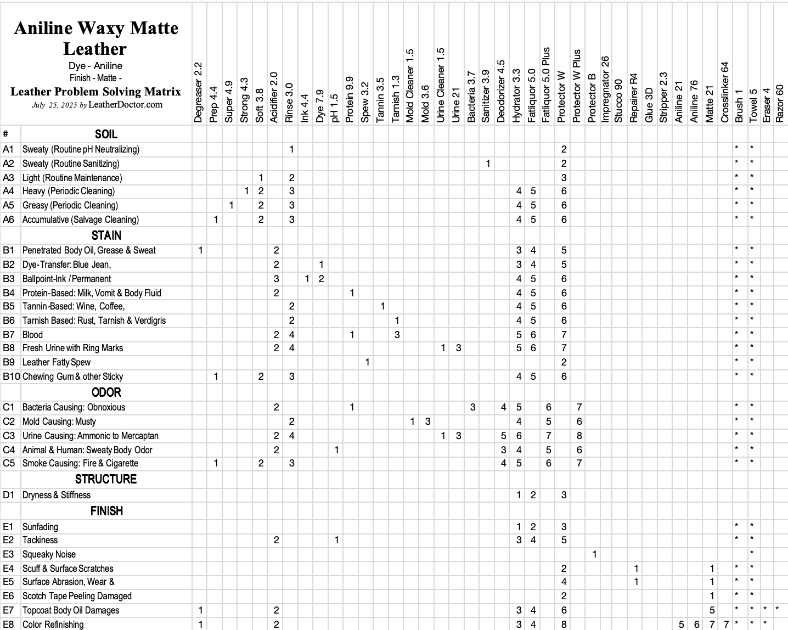
 How to Use this Leather Problem-Solving Matrix?
- This matrix categorizes common issues with Vachetta into five groups:
- Soil, Stain, Odor, Structure, and Finish (listed in the left column).
- Corresponding recommended products are displayed across the top row.
- Each number within the matrix indicates the steps required to address the problem holistically.
For example:
If a leather issue involves an unknown compound that combines soil, stain, and odor, follow the sequence across the matrix, combining necessary steps from each category.
The process should always conclude with:
- Hydrator 3.3 to rehydrate and relax the leather.
- Fatliquor 5.0 to replenish lost fats and oils, restoring suppleness.
- Protector W conditioning the leather for ongoing durability.
 Technical Help and Support?
 Your opinions, insights and review are precious and will help us to solve your leather problem more efficiently.
Edited: March 16, 2025 |July 31, 2025 by Roger Koh.