


1️⃣ Deep Cleaning & pH Balancing
Restore the leather’s pH integrity and prep it for refinishing:
- Degreaser 2.2: Targets and emulsifies embedded body oils, perspiration, and greasy contaminants with a powerful yet leather-safe formula.
- Soft 3.8: A pH-balanced mild cleaner that lifts surface soiling without damaging delicate aniline finishes.
- Rinse 3.0: Neutralizes and rinse suspended residues and reestablishes the optimal pH level (3.0 - 5.0) for safe handling of protein fiber leather.
- Acidifier 2.0: Strengthens the ionic bonding within the collagen matrix and combats alkaline overexposure that leads to dryness and cracking.
- Hydrator 3.3: Rehydrates and relaxes compacted, stiff, or shriveled leather fibers to restore softness and readiness for structural restoration.
2️⃣ Structural Dye Penetration
Restore depth of color with transparent staining dyes:
- Dye 21: A water-based, tannery-grade penetrating dye that enhances the natural grain and character of the leather without masking its beauty. Designed to soak in and form a chemical bond with the leather’s protein structure.
3️⃣ Fatliquoring – Restoring Original Suppleness
Replenish natural oils lost through use and cleaning:
- Fatliquor 5.0: A pH 5.0 anionic emulsion of fat, oil, and water that nourishes the fiber structure from within. Restores suppleness, prevents cracking, and brings back the tactile comfort of luxurious leather.
4️⃣ Pull-Up Effect Restoration
Reintroduce the classic tonal shift of wax pull-up leathers:
- Wax 8.6: Reinstates the signature pull-up lightening effect when stretched or creased, while conditioning the leather with protective waxes that deepen richness and resist aging.
5️⃣ Priming for Adhesion
Seal the grain and create a bonding base for dye coating:
- Primer 73: A compact resin primer that levels the surface, tightens the grain, and ensures optimal adhesion of subsequent color coatings.
6️⃣ Surface Dye Coating
Rebuild the color with vivid brilliance:
- Dye 76: A high-performance water-based transparent coating dye that reinforces color vibrancy while preserving the transparency of the aniline finish. Designed to enhance depth and clarity with a refined gloss.
7️⃣ Topcoating – Protective Finish Layer
Lock in the color and finish with long-lasting protection:
- Gloss 76: A durable, flexible gloss topcoat that seals in the color, restores the original showroom sheen, and protects against abrasion, scuffing, and fading.
8️⃣ Conditioning & Protection
Finish with a tactile enhancement and stain resistance:
- Conditioner B: A pH 3.2 rub-resistant, non-stick conditioner that enhances tactile softness while protecting against frictional wear, dye transfer, and everyday soiling.

Kit AW7.cl is ideal for:
- Faded or worn aniline wax pull-up leather jackets, bags, or upholstery
- Restoring pull-up effect and color depth lost through sun exposure or alkaline cleaners
- Conditioning leather to prevent cracking and stiffening
- Clients seeking full restoration back to a vibrant, glossy showroom finish


Click the links for details:
✅ Degreaser 2.2 - 4oz
✅ Soft 3.8 - 8oz
✅ Rinse 3.0 - 8oz
✅ Acidifier 2.0 - 8oz
✅ Hydrator 3.3 - 8oz
✅ Dye 21 - 4oz
✅ Fatliquor 5.0 - 8oz
✅ Wax 8.6 - 8oz
✅ Primer 73 - 4oz
✅ Dye 76 - 4oz
✅ Gloss 76 - 4oz
✅ Conditioner B - 8oz
✅ Brush 1
✅ Foam 2
✅ Towel 5
✅ Eraser 4
✅ Sand 2000

1️⃣ Degreasing with Degreaser 2.2
- Degreaser 2.2 is shaken well to coagulate.
- It is saturated to reach penetrated soiling with appropriate brushes and erasers and extracted with Towel 5 or equivalent until it shows clean.
- It is reapplied and allowed to dwell 3 to 30 minutes or before it dries for a complete soiling suspension and extracted until it shows clean.
2️⃣ Cleaning with Soft 3.8
- Before use, the Soft 3.8 concentrate, a ratio of 1 to 64, is mixed with 224g distilled water, or 1.5 inches from the top of the 8oz bottle.
- It is mixed well, applied, and brushed with Brush 1, Eraser 4 and towel extract until the towel shows clean.
3️⃣ Rinsing with Rinse 3.0
- Before use, the Rinse 3.0 concentrate, a ratio of 1 to 40, is mixed with 222g distilled water, or 1.5 inches from the top of the 8oz bottle.
- It is mixed, applied, and brushed with Brush 1, Eraser 4 and extracted with a towel until it shows clean and the leather takes a squeaky, healthy feel.
4️⃣ Acidifying with Acidifier 2.0
- Before use, the Acidifier 2.0 concentrate, a ratio of 1 to 25, is mixed with 224g distilled water, or 1.5 inches from the top of the 8oz bottle.
- It is applied directly, brushed, and extracted with Towel 5 until clean.
- It is kept for 3 to 30 minutes to control dye bleeding or surface tackiness.
- Treatment is complete with a test for a healthy squeaky feel.
5️⃣ Hydrating with Hydrator 3.3
- Before use, the Hydrator 3.3 concentrate, a ratio of 1 to 25, is mixed with 218g of distilled water, or 1.5 inches from the top of the 8oz bottle.
- It is applied from the surface or accelerates saturation by working on the reverse side for a quick darkening effect.
- A 3 minutes to 72 hours dwell to activate dormant dyestuff to resurface for an effective relaxing results.
- Creases, wrinkles, or shrinkage is stake, massage, and stretch to dimension ready for fatliquoring.
- Leaving overnight for long dwell, Leather Mold Odor Killer 3.6 may be needed to control potential mold growth.
6️⃣ Dye Staining with Dye 21
- Before use, the Dye 21 concentrate, a ratio of 1 to 9, is mixed with 51g of distilled water, or 1 inches from the top of the 4oz bottle.
- It is stain dyed with lint-free paper towels, plush, foam, or high-quality varnishing brushes to even out appearance.
- Fast dry with an air blower and the surface is inspected for evenness or correction until satisfaction.
7️⃣ Softening with Fatliquor 5.0
- Before use, the Fatliquor 5.0 concentrate, a ratio of 1 to 5, is mixed with 189g warm distilled water, or 1.5 inches from the top of the 8oz bottle.
- It is applied and redistributed with appropriate brushes or pads until the thickness of the leather is saturated.
- The application is repeated each time water content evaporates, until it absorbs no more.
- Sticky residue is further driven into the leather structure or rinsed off with Hydrator 3.3.
- Fatliquored leather is left to dry naturally for extra softness.
- Fatliquored leather is further staked, massaged, flexed or stretched accordingly with a little wet back with Hydrator 3.3 until dry for extra suppleness.
- Surface tension is also inspected with Hydrator 3.3 using a folded towel to check for even absorbency, ready for dye refinishing.
8️⃣ Effecting with Wax 8.6
- Before use, the Wax 8.6 concentrate, a ratio of 1 to 9, is mixed with 204g warm distilled water, or 1.5 inches from the top of the 8oz bottle.
- Apply and spread to saturate sufficiently with Brush 1 evenly to produce a darkening effect.
- Allow up to 8 hours of natural drying time or until crystalline is apparent.
- Activate the crystalline wax deposit with a heat blower or hairdryer to a natural gloss.
9️⃣ Priming with Primer 73
- Before use, the Primer 73 concentrate, a ratio of 1 to 1, is mixed with 28g of distilled water, or 1 inches from the top of the 4oz bottle.
- Apply Primer 73 evenly using Brush 1 or a white 3M scouring pad.
- Work it into grooves and worn areas.
- Wipe off excess until a lint-free towel shows clean.
- Allow to dry naturally or speed dry.
- For darkening areas, stretch gently with a spatula or spoon to lighten out appearance.
 Dyeing with Dye 76
- Before use, the Dye 76 concentrate, a ratio of 1 to 1, is mixed with 57g distilled water, or 1 inches mark from the top of the 4oz bottle.
- Check for surface tension with Hydrator 3.3 to ensure free of surface grease to avoid poor adhesion.
- It is applied onto the surface by Foam 2, folded Towel 5, or airbrushing for the desired result.
1️⃣1️⃣ Sealing with Gloss 76
- Before use, the Gloss 76 concentrate, a ratio of 1 to 2, is mixed with 76 g distilled water, or 1 inches mark from the top of the 4oz bottle.
- Use a lint-free cloth for padding, a varnishing brush, or an airbrush for the most professional finish.
- Allow each layer to dry completely before applying the next coat for optimal results.
1️⃣2️⃣ Conditioning with Conditioner B
- Before use, Conditioner B concentrate, a ratio of 1 to 19, is mixed with 215g distilled water, or 1.5 inches from the top of the 8oz bottle.
- It is mixed, applied, and spread with a Foam 2 or folded Towel 5 and is ready to use when dry.

Stain identification is crucial for effective treatment and is based on six key factors:
✅ Appearance
- Observing how the stain looks can indicate whether it is a spill, rub-on, penetration, or surface deposit.
- Some stains may cause dye or finish damage, revealing changes in the leather’s color or texture.
✅ Odor
- Smelling the stain can help identify its source.
- Common odors include:
- Moldy (fungal growth)
- Smoke (fire or cigarette exposure)
- Putrid (decaying organic matter)
- Ammonia (urine contamination)
✅ Color
- Color provides a clue to the staining substance but can change over time due to oxidation.
- The leather’s natural color may also influence how the stain appears.
- Red stains: Could be from wine, blood, lipstick, nail polish, or beverages.
- Blood stains: Can oxidize and shift from red to tan, then to black.
✅ Feel-of-Hand
- Touching the stain helps determine its type:
- Sticky: Likely from candy, beverages, or sugary substances.
- Brittle and stiff: Could be nail polish, paint, or shellac.
- Greasy smear: Often caused by lipstick, oils, or butter.
✅ Location
- The stain’s location on the leather provides hints about its origin.
- Headrests & armrests: Usually stained by body oil, sweat, and grease.
- Seat cushions: Often show food or beverage spills.
✅ Buildup or Absorbed
- Stains can be surface-level (built-up) or deeply absorbed into the leather.
- Built-up stains (common on pigmented leather) include paint, food residue, and ink.
- Absorbed stains (common on nubuck, aniline, and unfinished leather) include wine, tea, and coffee.
- Combination stains: Some stains contain both absorbed and surface elements, such as lipstick, ink, and mustard.
- Protein-based stains: Examples include blood, dairy, and egg-based spills.
- Oil-based stains: Often come from grease, butter, and lotions.
- Colloidal stains: May require specialized treatments.
✅ Additional Considerations
- Sweat stains can chemically alter leather, causing tackiness (when dry) or sliminess (when wet).
- Dye stains may show up when wiping with a white towel—this indicates color crocking.
- Fatliquor leaching (spew) appears as a milky film and causes leather to become stiff and prone to cracking.
By carefully identifying stains, you can apply the appropriate Leather Doctor® solutions to restore leather to its original beauty.
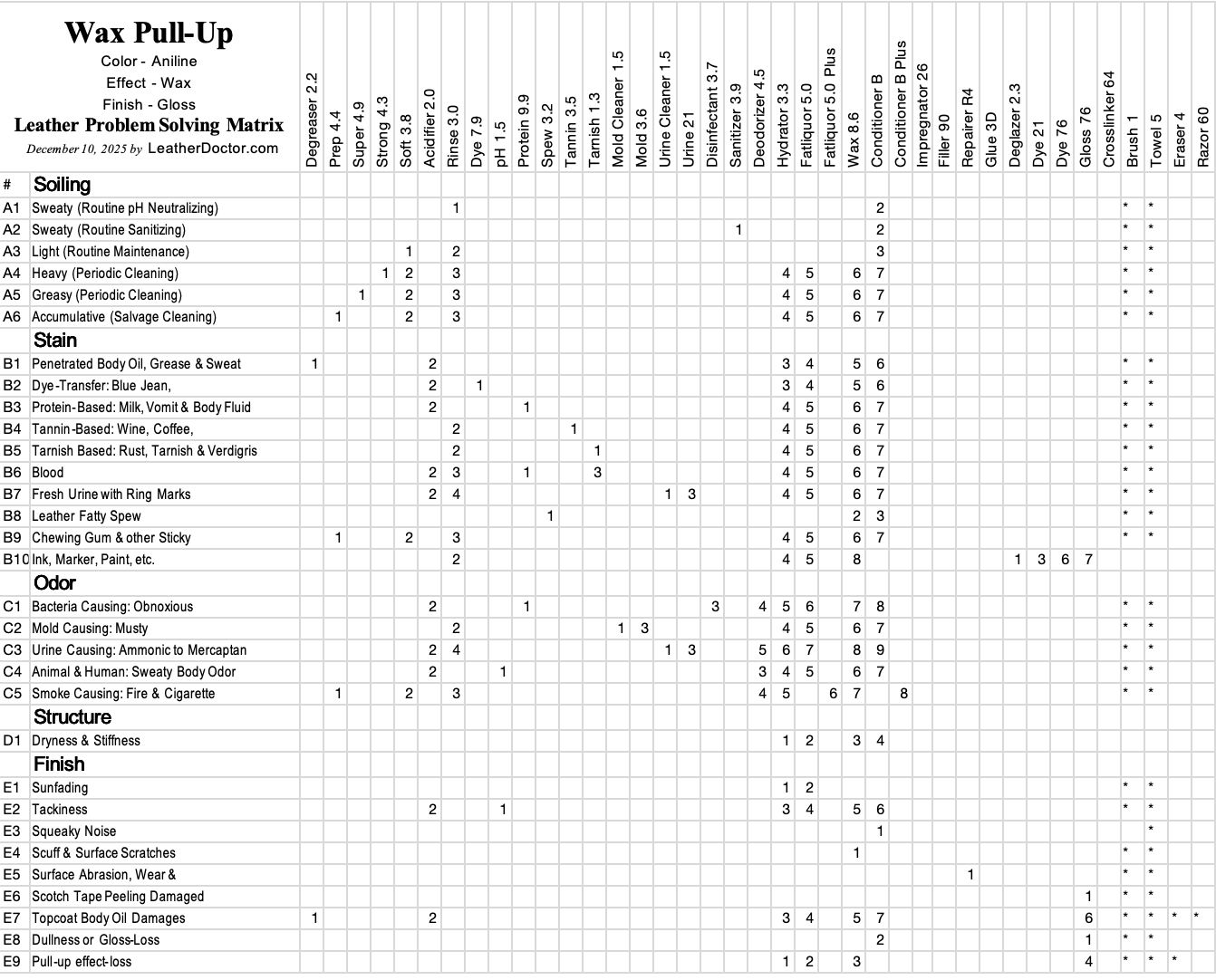

- This matrix categorizes common issues with Vachetta into five groups:
- Soil, Stain, Odor, Structure, and Finish (listed in the left column).
- Corresponding recommended products are displayed across the top row.
- Each number within the matrix indicates the steps required to address the problem holistically.
For example:
If a leather issue involves an unknown compound that combines soil, stain, and odor, follow the sequence across the matrix, combining necessary steps from each category.
The process should always conclude with:
- Hydrator 3.3 to rehydrate and relax the leather.
- Fatliquor 5.0 to replenish lost fats and oils, restoring suppleness.
- Conditioner B conditioning the leather for ongoing durability.

Upgraded July 29, 2025 | August 19, 2025 | December 10, 2025 by Roger Koh.