

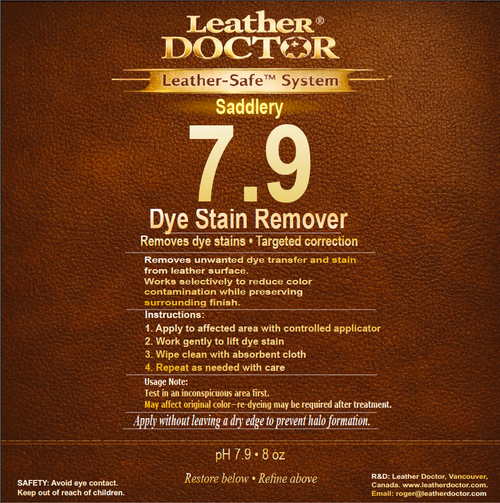
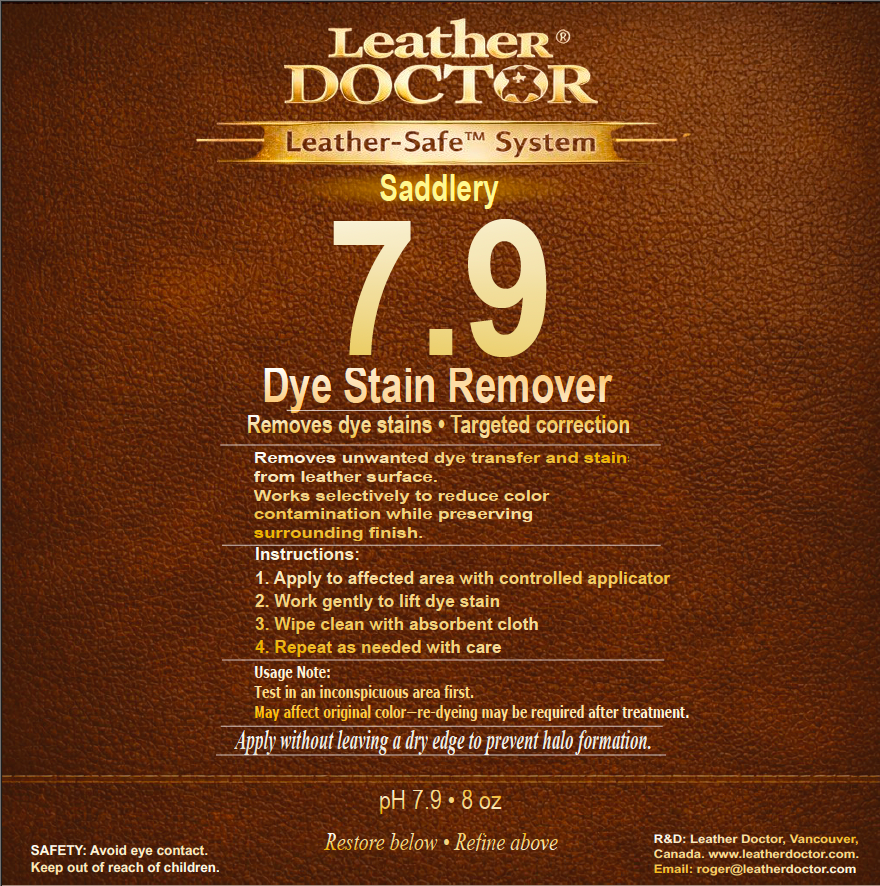
 Saddlery Dye Transfer Stain Remover 7.9 (Dye 7.9) is a professional Leather-Safe™ high-viscosity stain remover formulated to eliminate dye transfer and rub-off stains from leather saddles without excessive rubbing or finish damage.
Dye stains on saddlery are commonly caused by the migration of loose color particles from riding apparel, chaps, gloves, saddle blankets, or unstable leather finishes into the leather pores through friction, heat, pressure, sweat, and moisture exposure.
Using an innovative Reverse Transfer™ technology, Dye 7.9 penetrates, suspends, and lifts transferred dyestuff upward and away from the leather structure—rather than driving it deeper into the grain.
When used sequentially with Saddlery Rinse 3.0, and Acidifier 2.0 (pH 2.0), the leather is safely restored to its natural pH balance of 3–5 as part of the holistic Leather-Safe™ System.
 Why Choose Saddlery Dye 7.9?
✔ Removes Dye Transfer Without Aggressive Scrubbing
Helps prevent unnecessary abrasion, finish wear, and grain damage.
✔ Reverse Transfer™ Technology
Suspends and transfers loose dyestuff upward into an absorbent towel or applicator.
✔ High-Viscosity Controlled Action
Allows targeted stain removal while minimizing runaway absorption into leather fibers.
✔ Safe for Multiple Saddlery Leather Types
Suitable for:
- Veg-Tan Finished saddlery leather
- Aniline saddlery leather
- Nubuck and suede tack components
✔ Scientifically Balanced Leather-Safe™ System
Corrects staining while preserving the leather’s structural integrity, flexibility, and natural feel.
 Common Saddlery Dye Transfer Sources
Dye transfer may originate from:
- Riding breeches and jeans
- Half chaps and tall boots
- Saddle pads and blankets
- Unstable leather dyes or finishes
- Excessive oiling or improper conditioners
- Sweat, heat, and friction during riding
These contaminants migrate progressively into leather pores if not corrected properly.
 How Saddlery Dye 7.9 Works
1️⃣ Finished Pigmented Saddlery Leather
(Most modern saddles and tack)
Reverse Transfer Method
- Place an absorbent towel (Towel 5) over the stained area.
- Apply Dye 7.9 onto the towel to saturate the affected area beneath.
- Press gently to eliminate trapped air pockets.
- Allow overnight dwell time for suspended dye migration into the towel.
- Inspect and repeat if necessary.
Post-Treatment Neutralization
- Rinse with Rinse 3.0
- Restore leather pH balance using Acidifier 2.0
No excessive rubbing required.
2️⃣ Absorbent Veg-Tan & Aniline Saddlery Leather
- Apply Dye 7.9 onto a lightly damp cotton bud or applicator pad.
- Lightly agitate the stain area.
- Observe transferred dye onto the applicator.
- Rotate to a clean section and repeat progressively.
Post-Treatment
- Rinse with Rinse 3.0
- Balance pH using Acidifier 2.0
3️⃣ Nubuck & Suede Tack Components
- Apply sparingly using a lightly damp applicator.
- Use quick, controlled agitation to avoid over-wetting.
- Change applicator sections frequently as dye transfers.
- Repeat carefully until satisfactory.
Post-Treatment
- Rinse with Rinse 3.0
- Restore pH with Acidifier 2.0
 Prevent Future Saddlery Dye Transfer
- Friction, sweat salts, dryness, and surface drag contribute heavily to recurring dye transfer on saddlery leather.
- After corrective stain removal, rub-resistant refinement is recommended with:
Saddlery Conditioner B
or the luxury upgrade:
Saddlery Conditioner B+
by Leather Doctor® | pH 3.2 A Leather-Safe™, buttery feel, non-stick, rub-resistant conditioner scientifically formulated to:
- reduce friction wear,
- improve surface glide,
- minimize future dye transfer,
- preserve leather flexibility,
- and maintain saddlery durability under riding conditions.
The B+ version additionally leaves a luxurious leather scent while maintaining natural breathability.
 Complete Leather-Safe™ Saddlery System
Remove → Rinse → pH Balance → Prevent
- Dye 7.9
- Rinse 3.0
- Acidifier 2.0
- Conditioner B or B Plus
 Restore Your Saddle Professionally
Professional restoration through intelligent Leather-Safe™ chemistry.
Updated: March 29, 2025 | June 24, 2025 | September 18, 2025 | February 16, 2026 by Roger Koh.