
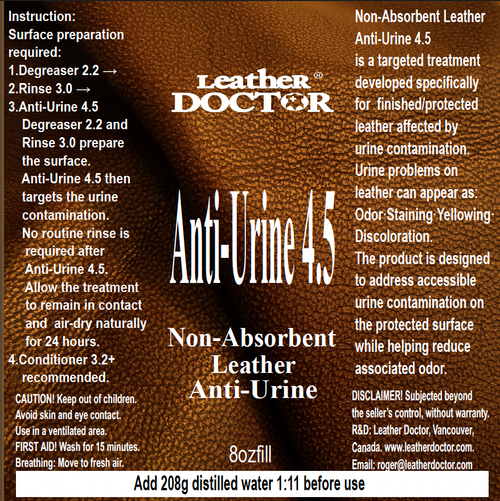
Non-Absorbent Leather Anti-Urine 4.5
- Urine Neutralizer & Deodorizer for Non-Absorbent Leather
Treat the urine problem—not just the smell.
Non-Absorbent Leather Anti-Urine 4.5 is a targeted treatment developed for finished, non-absorbent leather affected by urine contamination.
Urine contamination on leather may appear as:
- Odor · Staining · Yellowing · Discoloration · Residue
Leather Doctor® Non-Absorbent Leather Anti-Urine 4.5 is designed to address accessible urine contamination on the non-absorbent surface while helping reduce associated odor.
- Not simply a deodorizer. Anti-Urine 4.5 is a targeted non-absorbent-leather urine treatment.
Developed for Non-Absorbent Leather
Non-Absorbent Leather Anti-Urine 4.5 is intended for finished leather with a functioning protective surface that limits liquid penetration.
Common applications include:
- Leather sofas
- Chairs and recliners
- Automotive leather interiors
- Office seating
- Finished leather furniture
- Other non-absorbent leather surfaces
Before treatment, always identify the leather and evaluate the actual condition of the affected area.
An older leather may have originally been manufactured as non-absorbent but may no longer behave that way where the topcoat has deteriorated.
When Non-Absorbent Leather Becomes Absorbent
- Age, use, flexing, and repeated cleaning may cause deterioration of the protective surface.
Micro-crazing, creases, cracks, and topcoat deterioration can create pathways through the surface and allow urine to penetrate into the leather below.
- When the affected area has become absorbent, the treatment should no longer follow the surface-treatment pathway.
Instead, use:
with the absorbent-leather deep-treatment system.
The present condition of the affected leather determines the treatment pathway—not simply its original classification.
Why “Anti-Urine”?
- Anti-Urine Describes the Problem — Not Just the Symptom
- A product called a Urine Deodorizer focuses attention primarily on odor.
- Urine contamination can involve much more than smell.
It may leave:
- Odor · Staining · Residue · Yellowing · Surface Discoloration
The term Anti-Urine identifies the broader contamination problem.
The descriptor explains the function:
- Urine Neutralizer & Deodorizer for Non-Absorbent Leather
- The objective is to treat accessible urine contamination while controlling the associated odor.
Same Core Anti-Urine Action, Adapted for Non-Absorbent Leather
- Non-Absorbent Leather Anti-Urine 4.5 and Absorbent Leather Anti-Urine 4.2 use the same basic odor-neutralizing and urine-destroying chemistry, with each formulation adapted to the way the leather accepts treatment.
Absorbent Leather Anti-Urine 4.2
- Deep penetration into absorbent leather
Non-Absorbent Leather Anti-Urine 4.5
- Controlled surface treatment of non-absorbent leather
The difference is not simply the pH.
- It is the formulation purpose, penetration behavior, and treatment technique required by the leather.
- Both formulations are designed within the Leather-Safe™ Zone of pH 3.0–5.0.
Leather-Safe™ pH 4.5
Non-Absorbent Leather Anti-Urine 4.5 is formulated at pH 4.5, within Leather Doctor®'s Leather-Safe™ Zone of pH 3.0–5.0.
The formulation is designed to provide urine-neutralizing and urine-destroying action while maintaining a more leather-compatible treatment environment.
Before Anti-Urine 4.5:
1. Water Absorbency Test:
- Perform the Water Absorbency Test directly on the urine-affected area.
- Do not rely solely on an unaffected area.
A normally non-absorbent leather surface may become absorbent through:
- Urine contamination
- Micro-crazing
- Creases
- Cracks
- Topcoat deterioration
- A previous treatment attempt
The affected area should be evaluated according to how the leather behaves now.
If the affected area has become absorbent, use the Absorbent Leather Anti-Urine 4.2 pathway instead.
2. Wet Hand Test:
Check the affected surface for:
- Tackiness · Stickiness · Sliminess
These conditions may indicate adverse effects associated with urine contamination or deterioration of the leather texture or topcoat.
When tackiness, stickiness, or sliminess is present, Acidifier 2.0 may be required as a condition-dependent step before continuing with the Anti-Urine treatment.
Acidifier 2.0 is not automatically required for every urine treatment.
3. Check Surface Sheen:
Compare the affected area with an unaffected area of the same leather.
A noticeable loss of sheen may indicate deterioration or alteration of the original topcoat
When required, a matching topcoat should be applied after successful urine decontamination and before Conditioner 3.2+.
Prepare the Surface:
- Urine contamination may occur together with body oils, grease, old conditioner, pet residue, and other surface contamination.
For non-absorbent leather, use:
- Degreaser 7.5 → Rinse 5.0
- The Degreaser 7.5 performs the required cleaning function on the non-absorbent surface.
- Rinse 5.0 then completes the preparation stage.
- Prepare the surface first. Anti-Urine 4.5 then addresses the urine contamination.
Inspect the Complete Urine Path:
- Do not assume that the strongest odor location is the complete contamination area.
Urine may travel through:
- Entry point → seams → crevices → cushion edges → underside → internal upholstery materials
For upholstered furniture
- Inspect cushion seams and edges.
- Check crevices.
- Check the underside of cushions.
- Inspect the bottom of the sofa or chair.
- Where practical, lift or remove the dust cloth.
- Inspect the wooden frame or moving structural rail.
- Use a UV black light to help reveal fluorescent traces associated with urine contamination.
Follow the urine path. Reach the last trace.
Designed for Targeted Surface Treatment:
- Anti-Urine 4.5 is intended for controlled treatment of the accessible non-absorbent surface.
- It is not intended to saturate the entire sofa.
- Apply the treatment to the urine-affected surface and its immediate contamination path, using the prescribed application technique.
- Avoid unnecessary flooding of the non-absorbent leather.
- If the affected leather accepts moisture and has become absorbent because of topcoat deterioration, switch to the Absorbent Leather Anti-Urine 4.2 deep-treatment pathway.
24-Hour Treatment
After preparation and application:
- Prepare → Apply → Remain in Contact → Air-Dry 24 Hours → Evaluate
- Allow the treatment to remain in contact with the affected surface and air-dry naturally for 24 hours.
- Do not force-dry with direct heat.
After the surface is completely dry, evaluate:
- Odor
- Residue
- Staining
- Yellowing
- Discoloration
- Surface condition
- Remaining contamination along the urine pathway
Do not automatically apply more product without first determining what remains.
What Anti-Urine 4.5 Can Address:
- Anti-Urine 4.5 is designed to help:
- Treat accessible urine contamination
- Reduce urine-related odor
- Address accessible urine residues
- Treat contamination around accessible seams and creases
- Support odor control with its deodorizing formulation
- Treat localized urine contamination on non-absorbent leather
Results depend on the:
- Age of contamination
- Amount of urine
- Location
- Depth
- Distribution
- Previous treatment history
- Condition of the leather and topcoat
What Anti-Urine 4.5 Does Not Do
- Anti-Urine 4.5 is not a bleaching treatment.
- It does not contain a bleaching ingredient specifically intended to remove established urochrome yellowing.
- Established yellow coloration may remain when urine-related colorants have become set or when the leather or protective finish has been permanently altered.
Where established discoloration remains after successful decontamination, determine whether the remaining appearance is:
- Residual contamination → Established coloration → Topcoat deterioration → Permanent alteration
- Then select the appropriate corrective or refinishing procedure.
- Anti-Urine 4.5 should also not be expected to eliminate contamination originating deep inside cushion foam, padding, or other internal upholstery materials.
Where the urine has traveled into these materials, they may require separate treatment.
Can Non-Absorbent Leather Require the 4.2 Pathway?
- Yes.
An older non-absorbent leather may develop:
Micro-crazing → Creases → Cracks → Topcoat deterioration → Increased absorbency
- Once the affected area becomes absorbent and urine has penetrated through the surface, the treatment must follow the deep-penetration pathway.
Use:
Absorbent Leather Anti-Urine 4.2
with:
Degreaser 4.4 → Rinse 4.4 → Absorbent Leather Anti-Urine 4.2 → Hydrator 3.3 → Fatliquor 5.0+ → Matching Topcoat, when required → Conditioner 3.2+
Do not choose the treatment according only to what the leather was originally classified as. Test the affected area as it exists now.
Cat-Safety Precaution:
- Anti-Urine 4.5 contains botanical components including Tea Tree and Eucalyptus.
- Keep cats away from the treated area during application and throughout the 24-hour drying period.
- After the treated surface is completely dry, a clean, slightly damp cloth may be used before returning the furniture to cat contact.
- This wipe is solely a pet-safety precaution.
- It is not a leather-rinsing step and is not required for the leather treatment itself.
- Protect the leather. Protect the animal.
When Odor Remains:
If odor remains after correctly treating the non-absorbent leather, inspect the complete urine pathway again.
The remaining source may be:
- A seam or crevice
- The underside of the furniture
- Dust cloth
- Cushion foam
- Batting
- Backing
- Wooden structural components
- Other absorbent upholstery materials
The leather may have been successfully treated while another contaminated material continues to release odor.
The treatment has to follow the path of the urine—not simply the surface of the leather.
Treatment Sequence:
Non-Absorbent Leather
- Degreaser 7.5 → Rinse 5.0 → Non-Absorbent Leather Anti-Urine 4.5 → Matching Topcoat, when required → Conditioner 3.2+
Important:
Acidifier 2.0 — When Required:
- Use Acidifier 2.0 only when the affected leather shows tackiness, stickiness, or sliminess indicating that acidification is required.
Technical Specifications:
- Mix-Before-Use with Distilled Water 1: 11
- 4oz - add 104g
- 8oz - add 208g
- 16oz - add 418g
- 32oz - add 832g
pH Value:
- 4.5
Action:
- Odor Neutralizer • Urine Destroyer
Compatibility:
- Non-absorbent leather
- For older finished leather that has become absorbent in the affected area, use Absorbent Leather Anti-Urine 4.2 instead.
- The formulation is designed for urine treatment and odor control on non-absorbent leather.
Formulation:
Designed with a Leather-Safe™ pH of 4.5.
Part of the Leather Doctor® Anti-Urine System:
Absorbent Leather:
- Degreaser 4.4 → Rinse 4.4 → Absorbent Leather Anti-Urine 4.2 → Hydrator 3.3 → Fatliquor 5.0+ → Matching Topcoat, when required → Conditioner 3.2+
Non-Absorbent Leather:
- Degreaser 7.5 → Rinse 5.0 → Non-Absorbent Leather Anti-Urine 4.5 → Matching Topcoat, when required → Conditioner 3.2+
Absorbency determines the Anti-Urine formulation. Surface condition determines whether Acidifier 2.0 is required.
Related Leather Doctor® Resources:
Leather Urine Decontamination — Leather-Safe™ Anti-Urine System
- Learn how urine travels through leather and upholstery, how to determine absorbency, and how to select the correct Anti-Urine treatment.
Leather Urine Decontamination — Leather-Safe™ Treatment Instructions
- Follow the complete treatment procedure for absorbent and non-absorbent leather.
Leather Urine Decontamination FAQ — Leather-Safe™ Anti-Urine System
- Find answers to common questions about urine odor, absorbency, treatment volume, discoloration, topcoat deterioration, deep contamination, and the difference between Anti-Urine 4.2 and 4.5.
The Leather Doctor® Difference
- Leather Doctor® treats leather as an engineered material—not simply a surface to be cleaned.
- Identify the leather.
- Test the affected area.
- Find where the contamination has gone.
- Prepare the surface when necessary.
- Treat the urine according to the leather's present absorbency.
- Allow the treatment to remain in contact and air-dry naturally.
- Evaluate before applying more product.
- Treat the contamination. Control the odor.