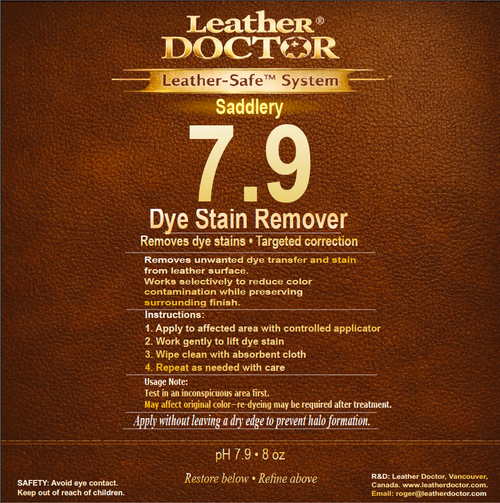

Leather Doctor® Nappa Leather Dye Remover 7.0 (Dye 7.0) represents the pinnacle of advanced leather care technology.
Engineered specifically for premium, fine-grain Nappa leather.
This professional-grade formula targets and extracts stubborn dye transfers, and deep-set discoloration without compromising the material's natural suppleness and is Leather-Safe™ in sequence with the second step Nappa Leather Stabilizing Rinse 5.0.
Key Benefits
Advanced Molecular Extraction:
Dislodges deeply embedded denim dye and newsprint ink.
Nappa-Safe Chemistry:
Preserves the delicate, unprotected topcoat of premium leather.
Zero Resurface Damage:
Cleans effectively without stripping original factory finishes.
Moisture-Lock Protection:
Hydrates fibers during application to prevent drying or cracking.
Product Features
Penetration Depth Technology
Dye 7.0 uses a specialized slow-evaporating gel base.
This allows the active ingredients to safely dwell on the surface, drawing stains upward out of the pores rather than pushing them deeper into the hide.
Chemical Synergy:
- If the leather remained at a pH of 7.0, the fibers would remain swollen and vulnerable to abrasion, water, and future stains.
- Immediate application of Stabilizing Rinse 5.0 acts like a "chemical switch".
- It instantly returns the leather to its natural acidity, tightens its molecular structure, and re-locks the original ( OEM ) protective barrier.
Precision Gel Viscosity
- The thick, non-runny consistency ensures maximum control during localized spot treatments.
- It stays exactly where you apply it, preventing accidental runoff onto adjacent stitching or different materials.
Specifications
- Size: 4oz, 8oz, 16oz, & 32oz.
- Type: Mix and fill with distilled water before use.
- Container: Precision-tip squeeze bottle
- Consistency: Medium-viscosity clear gel
- Compatibility: Nappa, Merino, and Semi-Aniline leathers
- Origin: Made in Canada.
Instruction:
1. Prep:
Vacuum the area thoroughly to remove loose dirt and debris.
2. Test:
Apply a small droplet to an inconspicuous area to check colorfastness.
3. Apply:
Dab a thin layer of Formula 7.0 directly onto the stained surface.
4. Dwell:
Allow the gel to sit for 3 to 5 minutes, depending on stain severity.
5. Agitate:
Gently massage with a soft-bristled horsehair brush if required.
6. Wipe:
Wipe away completely using a clean, damp microfiber towel.
7. Rinse:
Immediately apply Stabilizing Rinse 5.0 onto the exposed area,
8. Extract:
Extract and wipe with a dry microfiber cloth to tighten the fibers and relock the original ( OEM ) color.
Advanced Instructions:
The Reverse Transfer Technique
1. Prepare the interface:
Lightly dampen Towel 5 or absorbent paper.
2. Place the Support:
Apply the damp towel directly and flat onto the stain.
3. Saturate through the Towel:
Apply Dye Remover 7.0 directly to the top of the towel, just above the stained area.
Allow the liquid to saturate the fabric so that it slowly migrates downwards to the leather interface.
4. Contact Time (Dwell Time):
Leave for 12 to 24 hours .
During this time, the pH 7.0 solvent will emulsify the embedded dyestuffs.
Through continuous capillary action, the absorbent towel will draw in and trap the released dyestuffs.
5. Peel and Reveal:
Gently peel off the towel.
The emulsified stain will detach with the fabric, revealing a clean surface without any mechanical friction.
6. Fix and neutralize (Crucial):
Immediately apply Stabilizing Rinse 5.0 onto the exposed area, then extract and wipe with a dry microfiber cloth to tighten the fibers and relock the original ( OEM ) color.
Zero Mechanical Action:
No risk of wearing down or scratching the original finishes of the leather through excessive friction.
Deep extraction:
The prolonged contact time (12-24h) dislodges hydrophobic dyestuffs that have migrated deep beneath the surface.
Molecular Safety:
Thanks to the neutral pH of 7.0 of the surfactant, the leather tolerates this prolonged contact without chemical alteration, provided it is immediately stabilized in the next step with Stabilizing Rinse 5.0.
⏱️ Time stages (At room temperature / 20-22°C)
- 15 to 20 minutes (Recent/Light Stains) : This is the minimum time for Sepimax Zen and the 5.0% surfactant to create the necessary moisture to soften the polish ( top coat ) and initiate capillary action towards the towel.
- 30 minutes (Recommended time for reverse transfer) : The perfect balance point. The blue T-shirt pigments migrate massively towards the damp towel without the surfactant having time to attack the underlying cream paint.
- 45 minutes (Absolute maximum limit) [2]: Beyond this point, the distilled water begins to evaporate from the gel. The 5.0% surfactant then concentrates massively on the leather and begins to saturate the binders of the factory polyurethane varnish.
⚠️ The critical factor: The cabin temperature
The 45-minute rule only applies if the vehicle is parked in the shade and the leather is at room temperature.
If you apply this poultice in a car parked in direct sunlight (where the seats can easily reach 50°C to 60°C):
- The maximum contact time must be divided by three, i.e. a maximum of 15 minutes .
- At high temperatures, the chemical kinetics accelerate: the surfactant becomes much more aggressive towards the varnish and the gel risks drying too quickly, which would permanently trap the soot or ink in the pores of the leather.
��️ Reminder of the exit protocol (Rinsing)
Once the time is up (30 to 45 minutes), quickly remove the towel and immediately apply your Nappa Stabilizing Rinse (pH 4.5 or 5.0) . The acidity of the rinse will stop the action of the Caprylyl/Capryl Glucoside and instantly tighten the pores of the Nappa polish.