


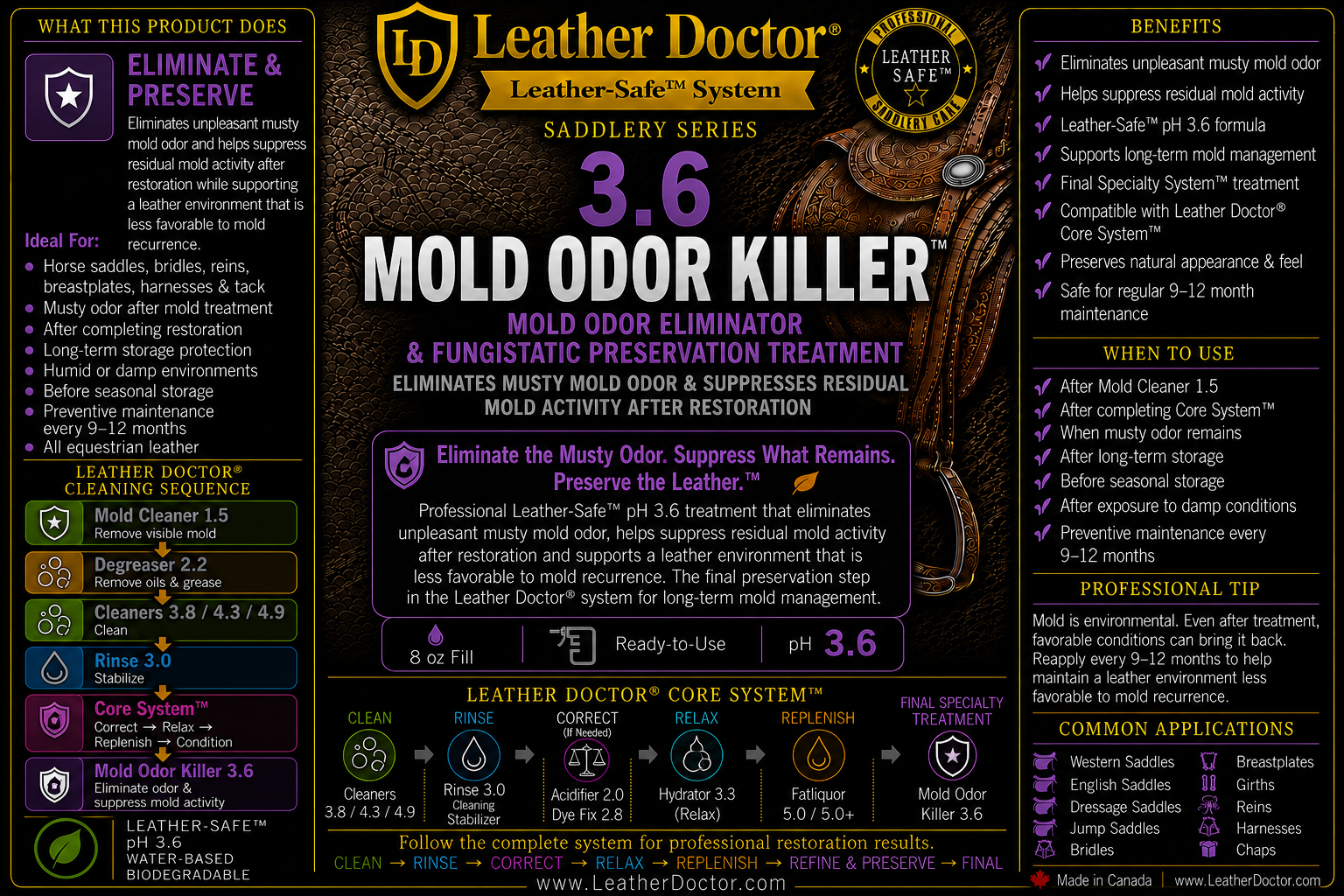
 Saddlery Mold Odor Killer 3.6 (Mold 3.6) by Leather Doctor®
- Mold Odor Eliminator & Fungistatic Preservation Treatment
- Professional Leather-Safe™ pH 3.6 treatment for saddles, tack & mold-contaminated leather
- Kill What You Cannot See. Preserve What You Value.™
Even after visible mold has been removed, unpleasant musty odor and residual mold activity may still remain within the leather environment. Saddlery leather is especially vulnerable because it is often exposed to humidity, perspiration, damp tack rooms, trailers, barns, and long-term storage conditions that encourage mold recurrence.
Saddlery Mold Odor Killer 3.6 by Leather Doctor® is a professional Leather-Safe™ pH 3.6 fungistatic preservation treatment developed to neutralize musty mold odor and help suppress residual mold activity after restoration.
- It is the final preservation step in the Leather Doctor® saddlery mold route.
What This Product Does
Core Function
Neutralizes unpleasant musty mold odor and helps suppress residual mold activity after visible mold has been removed and the leather restored.Deeper Function
Supports a leather environment less favorable to mold recurrence in saddlery exposed to humidity, damp storage, microbial contamination, and long-term environmental mold risk.Mold Odor Killer 3.6 is specifically developed to:
- eliminate the characteristic musty mold odor left behind after contamination
- help suppress residual mold activity after cleaning and restoration
- support a leather environment less favorable to recurring mold
- complete the mold preservation route after the leather has been properly restored
Benefits
- Neutralizes unpleasant musty mold odor
- Helps suppress residual mold activity after restoration
- Leather-Safe™ pH 3.6 fungistatic treatment
- Final preservation step in the saddlery mold route
- Supports long-term mold management
- Helps maintain a leather environment less favorable to mold recurrence
- Safe for regular 9–12 month maintenance
- Compatible with Leather Doctor® Core System™
Why Saddlery Leather Is More Susceptible to Mold
- Horse saddlery naturally presents conditions that encourage mold development when improperly maintained or stored.
Traditional stuffing oils
- Vegetable-tanned saddlery often contains oils, waxes, and conditioning residues that can contribute to a mold-favorable environment when combined with moisture and contamination.
Outdoor exposure
- Rain, perspiration, mud, humidity, and environmental soiling repeatedly introduce moisture and organic contamination.
Dense leather structure
- Heavy saddlery leather has a dense fiber structure with deep stitching, tooling, layers, and crevices where contamination can accumulate and drying after environmental wetting may take longer than on thinner leather articles.
- This refers to environmental wetting such as rain, flooding, perspiration, or damp storage — not to Leather Doctor® restoration products.
Storage conditions
- Warm, dark, poorly ventilated tack rooms, barns, trailers, and enclosed storage spaces provide ideal conditions for mold development.
Mold or Spew? Why the Nose Matters
- Not every white, cloudy, dusty, or pale surface change on saddlery leather is mold.
- In practice, mold contamination and leather spew are often mistaken for one another during visual inspection, because both can appear as patchy, pale, or surface-level changes on leather.
- But they do not come from the same source, and they do not require the same treatment.
Mold
- Mold is microbial contamination encouraged by humidity, damp storage, poor ventilation, and organic contamination.
- It is often accompanied by a characteristic musty or moldy odor because active microbial contamination produces odor as part of its activity.
Spew / Bloom
- Spew is not microbial.
- It is the movement of fat, oil, or wax-related matter to the leather surface, often caused by temperature fluctuation, stuffing oils, wax buildup, or internal imbalance.
- Spew may look similar to mold, but it does not carry the same characteristic mold odor signature.
Leather Doctor® Diagnostic Rule
If there is musty odor → suspect mold
- Proceed with the mold route:
- Mold Cleaner 1.5 → Rinse 3.0 → Mold Odor Killer 3.6
Proceed with the Leather Doctor® Saddlery Wax & Bloom Diagnostic Ladder:
- Level 1 — Spew Remover 3.2 → Rinse 3.0
- Level 2 — Degreaser 2.2 → Rinse 3.0
- Level 3 — Wax Remover 4.2 → Rinse 3.0
- Level 4 — Crazy Horse Wax 8.6 → Conditioner Wax 9.6
That one distinction helps prevent the most common mistake in saddlery leather care:
treating mold contamination as simple spew, or treating spew as mold.
When To Use
Use Saddlery Mold Odor Killer 3.6:
- after Mold Cleaner 1.5
- after completing the appropriate restoration route
- when musty mold odor remains
- after long-term storage contamination
- before seasonal storage
- after exposure to damp or humid conditions
- as a preventive maintenance treatment every 9–12 months
How To Use
Step 1 — Remove visible mold
- Clean the leather with Saddlery Mold Cleaner 1.5 → Rinse 3.0 to remove visible mold growth.
Step 2 — Restore the leather if needed
- If the leather is contaminated, dry, or structurally depleted, complete the appropriate restoration route:
- Cleaner 3.8 / 4.3 / 4.9 → Rinse 3.0 → Acidifier 2.0 (if needed) → Hydrator 3.3 → Fatliquor 5.0 → Conditioner 3.2
Step 3 — Apply Mold Odor Killer 3.6
- Apply evenly over the restored leather using Leather Brush 1 or an appropriate applicator.
Step 4 — Allow to dry naturally
Do not rinse.
Step 5 — Repeat periodically where conditions favor mold
Reapply every 9–12 months whenever storage or environmental conditions favor mold recurrence.
Professional Tip
- Mold and spew can look similar, but they do not smell the same.
- If the leather has a characteristic musty mold odor, treat it as mold.
- If there is no mold odor, the white or cloudy appearance may instead be spew, stuffing oil bloom, wax buildup, or depleted Crazy Horse character.
- Musty odor = Mold route
- No mold odor = Wax & Bloom Diagnostic Ladder
Important Distinction
- Mold Odor Killer 3.6 is not a cleaner.
- Visible mold should first be removed with Mold Cleaner 1.5 → Rinse 3.0.
- The leather should then be restored through the appropriate Leather Doctor® system route if needed.
- Mold Odor Killer 3.6 is the final fungistatic preservation treatment that neutralizes musty odor and helps suppress residual mold activity.
Expected Results
After proper treatment:
- musty mold odor neutralized
- residual mold activity suppressed
- restored leather stabilized for continued preservation
- reduced likelihood of recurrence when combined with environmental management
- leather prepared for long-term maintenance
Leather Doctor® Saddlery Mold Route
Step 1 — Remove visible mold
- Saddlery Mold Cleaner 1.5 → Rinse 3.0
Step 2 — Clean and stabilize as needed
Soft Cleaner 3.8 / Strong Cleaner 4.3 / Super Cleaner 4.9 → Rinse 3.0
Step 3 — Correct and restore if needed
Acidifier 2.0 → Hydrator 3.3 → Fatliquor 5.0 → Conditioner 3.2
Step 4 — Final mold preservation
Saddlery Mold Odor Killer 3.6
Alternative Path When Odor Is Absent
- If the white or cloudy appearance has no musty mold odor, it may not be mold at all.
- Use the Leather Doctor® Saddlery Wax & Bloom Diagnostic Ladder instead:
Level 1 — Saddlery Spew Remover 3.2 → Rinse 3.0
- Classic fat & oil spew
Level 2 — Saddlery Degreaser 2.2 → Rinse 3.0
- Stuffing oil spew
Level 3 — Saddlery Wax Remover 4.2 → Rinse 3.0
Conventional wax buildup bloom
Level 4 — Saddlery Crazy Horse Wax 8.6
Depleted Crazy Horse / wax pull-up effect
Final Preservation — Saddlery Conditioner Wax 9.6
Wax-rich refining & preservation conditioner
Related Products / Saddlery Mold & Bloom Routes
For mold contamination
- Saddlery Mold Cleaner 1.5 → Rinse 3.0 — removes visible mold growth
- Saddlery Mold Odor Killer 3.6 — neutralizes musty mold odor and helps suppress residual mold activity
For mold-related restoration when needed
- Saddlery Soft Cleaner 3.8 / Strong Cleaner 4.3 / Super Cleaner 4.9 — cleaning by contamination level
- Saddlery Rinse 3.0 — stabilizes the cleaning stage
- Saddlery Acidifier 2.0 — corrects alkaline imbalance if needed
- Saddlery Hydrator 3.3 — relaxes the fiber structure before replenishment
- Saddlery Fatliquor 5.0 — replenishes internal fat and oil
- Saddlery Conditioner 3.2 — refines and preserves the restored surface
For non-mold bloom / spew / wax issues
- Saddlery Spew Remover 3.2 → Rinse 3.0 — classic fat & oil spew
- Saddlery Degreaser 2.2 → Rinse 3.0 — stuffing oil contamination
- Saddlery Wax Remover 4.2 → Rinse 3.0 — conventional wax buildup bloom
- Saddlery Crazy Horse Wax 8.6 — replenishes depleted Crazy Horse effect
- Saddlery Conditioner Wax 9.6 — final wax-rich preservation for the Crazy Horse route
FAQ
Does Mold Odor Killer 3.6 remove visible mold?
No. Visible mold should first be removed with Saddlery Mold Cleaner 1.5.
What is Mold Odor Killer 3.6 designed to do?
It is specifically developed to neutralize unpleasant musty mold odor and help suppress residual mold activity after restoration.
How do I tell mold from spew?
The quickest clue is odor.
Musty mold odor = mold route
No mold odor = diagnose spew / bloom
How often should it be reapplied?
Every 9–12 months where humidity, damp storage, or environmental conditions favor mold recurrence.
Specifications
- Product: Saddlery Mold Odor Killer 3.6
- Category: Mold Odor Eliminator & Fungistatic Preservation Treatment
- pH: 3.6
- Dilution: 1:9 Distilled Water
- System: Leather Doctor® Saddlery Mold Route
- Use: Ready-to-use
Leather Doctor® Preservation Principle
- Remove the Growth. Restore the Leather. Preserve the Future.™
Successful saddlery mold restoration combines:
- visible mold removal
- musty odor neutralization
- suppression of residual mold activity
- restoration of leather structure where needed
- environmental management
- periodic fungistatic maintenance
Together, these steps help preserve leather, reduce recurrence, and extend the useful service life of saddlery.
 April 11, 2026 | July 2, 2026 by Roger Koh


