


Nubuck Blood Iron Remover 1.0 (Blood Chelate 1.0) by Leather Doctor® is a Nubuck-Safe™ System component designed to remove dark iron discoloration caused by blood contamination in absorbent Nubuck.
It works in sequence with:
Blood Digest 10 → Rinse 4.0 → Blood Chelate 1.0 → Rinse 4.0
This two-stage chemical process first digests blood proteins, then chelates iron residues responsible for dark discoloration.
 Why Blood Causes Dark Discoloration in Nubuck?
Blood stains behave differently from most organic stains because they contain both proteins and iron.
When blood penetrates porous Nubuck, several chemical reactions occur.
1. Iron–Tannin Reaction (Ink Formation)
Nubuck contain chrome tannins.
Blood contains hemoglobin, which carries iron.
When iron contacts chrome tannins, it forms iron gallate compounds.
These compounds are historically used to make permanent iron-gall ink.
Result
The blood effectively becomes a dye within the leather fibers, producing deep blue-black or brown discoloration.
2. Oxidation
Fresh blood appears bright red because iron is oxygenated.
As the blood ages:
• iron oxidizes
• the color darkens
• the stain shifts from red → brown → black
The longer the oxidation process continues, the more stable the discoloration becomes.
3. Protein Coagulation
Blood contains approximately 80% proteins, primarily albumin.
As blood dries:
• proteins coagulate
• they bind tightly to leather fibrils
• iron particles become trapped within the fiber structure
This often causes Nubuck to feel:
• stiff
• crusty
• hardened in the affected area
4. High Porosity of Nubuck
Nubuck have no protective finish.
Blood is rapidly drawn into the Nubuck through capillary action, penetrating deeply into the fiber structure.
If water is applied incorrectly, the stain can wick outward, spreading contamination deeper into the Nubuck.
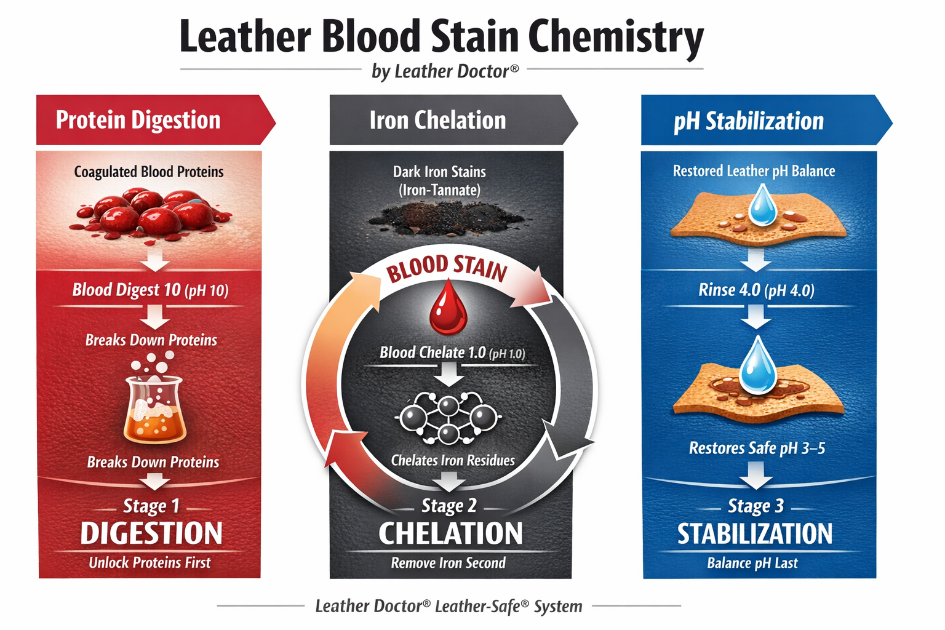
Nubuck-Safe™ Treatment Sequence
Blood stains must be treated using a two-stage chemical approach.
| Stage | Product | Function |
|---|---|---|
| Digestion | Blood Digest 10 (pH 10) | Unlocks coagulated blood proteins |
| Intermediate Rinse | Rinse 4.0 (pH 4.0) | Removes residues and neutralizes alkalinity |
| Chelation | Blood Chelate 1.0 (pH 1.0) | Chelates iron causing dark discoloration |
| Stabilization | Rinse 4.0 (pH 4.0) | Restores leather pH stability |
 Why Precision Counter-Neutralization Matters
Nubuck collagen fibers are stable within a pH range of 3.0 – 5.0.
Extreme pH conditions can destabilize the tanning system.
Rinse 4.0 (pH 4.0) performs several critical functions:
• restores the Nubuck's natural acidic balance
• tightens fiber structure
• stabilizes tanning agents
• prepares the Nubuck for hydration and fatliquoring
If the pH remains too acidic (near pH 1), tannins may detach from the collagen fibers, weakening the Nubuck.
Stabilizing the Nubuck around pH 3 – 5 ensures optimal conditions for:
• Hydration (~pH 3.3)
• Fatliquoring (~pH 5.0)
 Core Principle
Digest proteins first — chelate iron second.
Skipping the digestion stage can trap iron within coagulated protein residues and reduce the effectiveness of chelation.
Chemical Mechanism
Protein Digestion
Blood Digest 10 creates a controlled alkaline environment that:
• unlocks coagulated blood proteins
• breaks down protein adhesion to Nubuck fibers
• suspends contaminants for removal during rinsing
Iron Chelation
After protein removal, iron residues remain within the Nubuck.
These residues react with tannins, producing dark iron-tannate discoloration.
Blood Chelate 1.0 chelates iron ions and breaks down these complexes, allowing discoloration to be safely reduced.
pH Stabilization
Following digestion and chelation, Rinse 4.0 restores the Nubuck to its stable pH range of 3.0 – 5.0, preventing fiber stress and maintaining long-term Nubuck integrity.
Recommended Dwell Time
Proper dwell time ensures effective stain removal while maintaining Nubuck safety.
Step 1 — Digestion
Blood Digest 10 (pH 10)
Time: 10 – 30 minutes
- Apply and monitor closely working within the stain (avoid wetting outside the stain).
- Keep area moist.
- Do not allow solution to dry.
- Work with a bamboo skewers to agitate out the stain and extract until towel shows clean.
- Repeat until the stain is exhausted and futher extraction shows a clean towel.
- Proceed to the next step once the stain begins to lighten.
Do not exceed the recommended time, as strong acidity may weaken collagen fibers.
Step 2 — Intermediate Rinse
Rinse 4.0 (pH 4.0)
Time: Immediate
- Apply using sponge
- Blot with clean white absorbent cloth
- Removes released protein residues
White cloths allow monitoring of residue removal and prevent dye transfer.
Step 3 — Chelation
Blood Chelate 1.0 (pH 1.0)
Time: 3 – 5 minutes
Maximum: 10 minutes
- Apply and monitor closely working within the stain (avoid wetting outside the stain).
- Keep area moist.
- Do not allow solution to dry.
- Work with a bamboo skewers to agitate out the stain and extract until towel shows clean.
- Repeat until the stain is exhausted and futher extraction shows a clean towel.
- Proceed to stabilization once discoloration begins to lighten
Do not exceed recommended dwell time, as strong acidity may weaken collagen fibers.
Step 4 — Stabilization
Rinse 4.0 (pH 4.0)
Time: 1 – 2 minutes
• Thoroughly rinse treated area
• Allow Nubuck to dry naturally
This step restores Nubuckto its stable pH range (3.0 – 5.0).
Treatment Time Summary
| Stage | Product | Time |
|---|---|---|
| Digestion | Blood Digest 10 | 10–30 minutes |
| Rinse | Rinse 4.0 | Immediate |
| Chelation | Blood Chelate 1.0 | 3–5 minutes |
| Stabilization | Rinse 4.0 | 10–30 minutes |
Total active treatment time:
approximately 15 – 45 minutes
Strict control of acid exposure is essential to prevent fiber damage.
Blood Stain Troubleshooting Guide
Blood stains vary depending on age, oxidation, and contamination.
Correct diagnosis ensures the most effective treatment sequence.
1. Fresh Blood
Appearance
• bright red
• slightly moist
• minimal penetration
Treatment
Blot immediately → Blood Digest 10 → Rinse 4.0 → (Optional) Blood Chelate 1.0 → Rinse 4.0
Fresh stains are easiest to remove before iron oxidation occurs.
2. Dried or Aging Blood
Appearance
• dark brown or black
• crusted residue
• embedded contamination
Treatment
Blood Digest 10 → Rinse 4.0 → Blood Chelate 1.0 → Rinse 4.0
Older stains may require multiple digestion cycles.
3. Iron-Tannate Staining
Appearance
• blue-black discoloration
• resembles ink
• no visible residue
Treatment
Blood Digest 10 → Rinse 4.0 → Blood Chelate 1.0 → Rinse 4.0
Repeated chelation may gradually lighten discoloration.
4. Blood Mixed with Body Oils
Appearance
• dark stain with greasy halo
• uneven penetration
Treatment
Degreaser 2.2 → Rinse 3.0 → Blood Digest 10 → Rinse 4.0 → Blood Chelate 1.0 → Rinse 4.0
Oil contamination can block chemical penetration.
5. Blood on Nubuck or Suede
Appearance
• dark spot
• stiffened fibers
• flattened nap
Treatment
Blood Digest 10 → Rinse 4.0 → Blood Chelate 1.0 (if needed) → Rinse 4.0 → brush nap after drying
Avoid excessive rubbing to prevent fiber damage.
6. Ghost Stain After Cleaning
Appearance
• faint shadow
• slight dullness
Cause
• residual iron
• uneven moisture absorption
• minor dye displacement
Treatment
Blood Chelate 1.0 (short dwell) → Rinse 4.0
Ghost stains often fade further after complete drying.
Blood Stain Diagnostic Chart
| Stain Appearance | Likely Cause | Leather Condition | Recommended Treatment |
|---|---|---|---|
| Bright red | Fresh blood protein | Surface contamination | Blot → Blood Digest 10 → Rinse 4.0 → (Optional) Blood Chelate 1.0 → Rinse 4.0 |
| Dark brown crust | Oxidized blood | Embedded protein and iron | Blood Digest 10 → Rinse 4.0 → Blood Chelate 1.0 → Rinse 4.0 |
| Blue-black stain | Iron-tannate reaction | Iron bonded to tannins | Blood Digest 10 → Rinse 4.0 → Blood Chelate 1.0 → Rinse 4.0 |
| Dark stain with halo | Blood + body oils | Combination contamination. | Degreaser 2.2 → Blood Digest 10 → Rinse 4.0 → Blood Chelate 1.0 → Rinse 4.0 |
| Stiff nubuck spot | Protein coagulation | Fiber matting | Blood Digest 10 → Rinse 4.0 → Blood Chelate 1.0 → Rinse 4.0 → Brush nap |
| Faint shadow | Residual iron | Minor discoloration | Blood Chelate 1.0 → Rinse 4.0 |
Quick Visual Guide
Red stain → protein contamination → start with Blood Digest 10
Black stain → oxidized iron → follow with Blood Chelate 1.0
Greasy halo → oil contamination → start with Degreaser 2.2
Leather Safety Reminder
Always restore Nubuck to its natural pH range of 3.0 – 5.0 using Rinse 4.0 after alkaline or acidic treatments.
This prevents:
• fiber swelling
• pH shock
• long-term collagen damage