



Replenish. Soften. Strengthen.
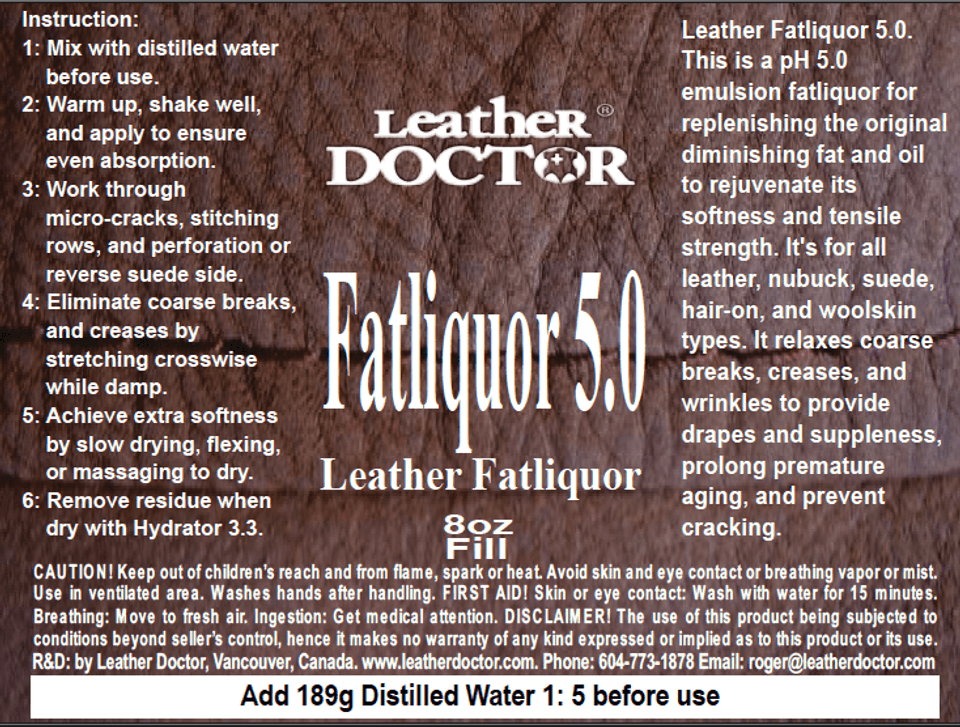
Bring your leather back to life with a conditioning treatment that restores suppleness and leaves behind a clean leather scent.

- Micro-Emulsion Formula
- Fat, oil & water blend deeply bonds leather fibers for lasting softness.
- Natural Leather Scent
- Lightly fragranced for a fresh, revitalized aroma.
- Crack & Dry Rot Prevention
- Prevents premature aging, stiffness, and fiber damage.
- Restores Strength & Flexibility
- Enhances stretchability, compressibility & tensile strength.
- Safe for All Types
- Works on full grain, suede, nubuck, and hair-on-hide.
 How It Works
- Ionic Bonding Technology
- Carries a negative (-ve) charge to hydrogen bond with the positive (+ve) leather fibers, improving breathability.
- Water-Evaporating Suspension
- 83.33% water evaporates after bonding, leaving fat and oil behind.
- Fat Content
- Plumps leather fibers, helping them resist creases and collapse.
- Oil Content
- Lubricates fibers for smooth, hinge-like movement and softness.

Step 1: Relax with Hydrator 3.3
- Loosens and opens up fibrous structure for better absorption.
Step 2: Soften with Fatliquor 5.0+
- Apply until leather feels damp but not over-saturated.
Recommended Ratio
- Hydrator 3.3 : Fatliquor 5.0+ = 2 : 1
- Example: 160g Hydrator + 80g Fatliquor for 100g dry leather.
Dry Leather Indicator
- Moisture content <7% signals readiness for fatliquoring.
Target Fatliquor Content
- Restore leather to ~14% fat & oil by dry weight (typical tannery level).

- Pre-clean surface using:
- Eraser 4 for leather/nubuck
- Eraser 5 for suede
☀️ Avoid heat drying—air dry naturally in shade for even results.
✋ Leather may darken if pre-existing soil resurfaces; stretch lightly to reduce appearance.

 Why Hydrator 3.3 Comes Before Fatliquor 5.0
Hydrator 3.3 prepares the leather; Fatliquor 5.0 replenishes its internal lubrication.
-
Hydrator 3.3 — Temporary Hydration and Fiber Relaxation: Temporarily hydrates and relaxes the leather fiber structure, preparing it to receive Fatliquor 5.0. It serves as a preparatory medium rather than a permanent source of internal lubrication.
-
Fatliquor 5.0 — Internal Fat and Oil Replenishment: Replenishes the internal fats and oils that lubricate the leather fibers, helping maintain or restore softness, suppleness, and flexibility.
When Should Fatliquor 5.0 Be Applied?
Use a wet-on-wet application sequence during leather rejuvenation. Apply Fatliquor 5.0 after Hydrator 3.3 has sufficiently hydrated and relaxed the leather, while the leather remains appropriately moist and receptive to absorption.
The application window is determined by the leather's condition, not a fixed waiting time:
-
Apply Hydrator 3.3 to the absorbent leather as directed, allowing it to penetrate and relax the fiber structure.
-
Apply Fatliquor 5.0 while the leather remains appropriately hydrated. Do not wait for the leather to dry completely between these stages.
-
If the leather has dried before fatliquoring, reassess its condition and follow the recommended procedure for rehydration before proceeding, if necessary.
Work in controlled applications, allowing each product to penetrate without saturating the leather or leaving excessive liquid on the surface. Avoid applying additional solution when the leather is already too wet to absorb it effectively.
Are Both Products Always Necessary?
Not for every cleaning or maintenance task. When absorbent leather requires rejuvenation because of dryness, stiffness, or reduced suppleness, Hydrator 3.3 and Fatliquor 5.0 perform complementary functions. Hydrator temporarily relaxes the fiber structure; Fatliquor replenishes the internal fats and oils.
Remember: Hydrator 3.3 prepares the leather, and Fatliquor 5.0 replenishes its internal lubrication. Apply wet-on-wet while the leather remains appropriately hydrated and receptive—not after complete drying.
 Instruction:
1️⃣ Concentrate is mixed well before adding distilled water 1:5 before use.
2️⃣ Apply and redistribute with appropriate brushes or pads until structure is saturated.
3️⃣ Repeat each cycle water contents evaporate leaving behind only the fat and oil content.
4️⃣ Allow natural drying for extra softness.
5️⃣ The desired suppleness is further staked and massaged, accordingly with a little wet back with Hydrator 3.3 until dry.

- Why Hydrate Before Fatliquoring?
- What is the usage ratio between Hydrator 3.3 and Fatliquor 5.0?
- How to Inspect for Leather Surface Tension with Hydrator 3.3?
- How to Remove Fatliquor Surface Residue with Hydrator 3.3?
- What is Leather Stiffness?
- What is an Unnatural Crease in Leather?
- How to Restore an Unnatural Crease with Hydrator 3.3?
- When should you begin Fatliquoring after working out the Unnatural Crease?
- When should you clean up Fatliquor Surface Residue?
- How to Soften Drying Leathers after Fatliquoring?
- What is Leather Structure Cleaning with Hydrator 3.3?
- How does Leather Structural Cleaning Work with Hydrator 3.3?
- How to Remove Deep Suspended Soiling with Hydrator 3.3?
- When to Begin Fatliquoring after Leather Structural Cleaning?
- How is fatliquoring done on Damp Leather?
- How to Remove Fatliquor Surface Residue with Hydrator 3.3?
- How to Soften Drying Leather after Cleaning up with Hydrator 3.3?
- How to Restore Sun-Fading Leather with Hydrator 3.3 + Fatliquor 5.0?
- How to Reverse Transfer Penetrated Suspended Soiling with Hydrator 3.3?
- How the Reverse-Transfer Technique Works?
- How to Remove Fatliquor Residue from the Leather Surface?
- How to Restore Water-Damaged Shrinkage in Leather with Hydrator 3.3 + Fatliquor 5.0?

- Fatliquor
- Fatliquor Principle.
- Fatliquoring Chrome-Tanned vs Vegetable-Tanned Leathers.
- Fatliquor Softening and Lubricating Properties.
- The Effects of Fatliquor on Leather Drying.

- What is Fatliquor?
- How does Fatliquor Work?
- Why Does Fatliquor Work?
- When Does Fatliquor Work?
- What is the Purpose of Using Fatliquor?
- What is the Purpose of Fatliquor?
- What is the Original Percentage of Fatliquor Content from the Tannery?
- How does the Fatliquor Content of Fat and Oil Diminish?
- How to Determine the Percentage of Fatliquor Required by the Leather?
- How to Calculate the Percentage of Fatliquor Required?
- Why Hydrator 3.3 Before Fatliquor 5.0?
- What is the Ratio Usage between Hydrator 3.3 and Fatliquor 5.0?
- How to Lighten Leather Appearance after Drying from Fatliquoring on a Chanel Diamond Quilted Pattern Lambskin Bag?
- Tips:
Product Reviews - Posted by Larry Bauman on 31st Jul 2017 -
The Lazarus Effect https://leatherdoctor.com/sheepskin-care-kit-sr3/#product-reviews
This product revived my 40-year-old Sheepskin coat that cracked at the touch of it after applying another company's 'Restoration' product. That other product ruined my coat, and I was about to throw it away but took a chance on the Leather Doctor. After applying Hydrator 3.3, I saw an immediate change. I then continued with the Fatliquor 5.0 and was shocked to see the change. My coat is now as soft and supple as it was when I purchased it in 1975! Don't even take a chance on valuable leathers with other companies' products, this one will amaze you with its results.

Edited: October 5, 2024 | Updated April 14, 2025 | May 11, 2025 | June 28, 2025 | December 14, 2025 | April 28, 2026 by Roger Koh