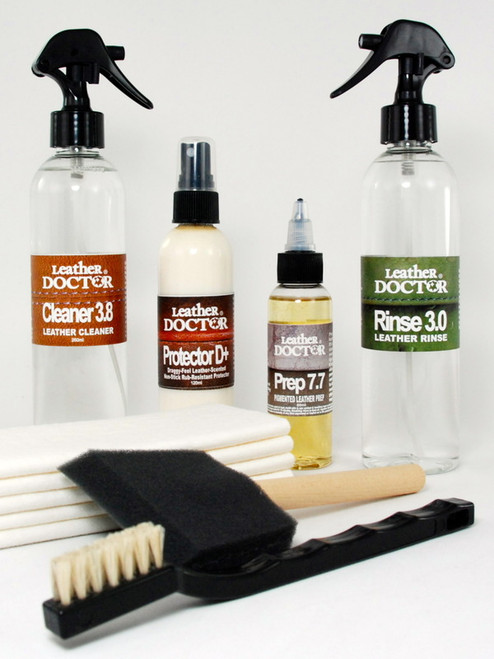

 Bicast Leather Sticky Care System™ (B2 → B3 → B7)
Bicast leather stickiness is a progressive condition, not a one-time problem.
Leather Doctor® solves it through a 3-level modular system, based on severity:
Level 1 – Prevention & Early Stickiness
 B2 Cleaning System
Level 2 – Active Deterioration
 B3 Degreasing System
Level 3 – Structural Breakdown (Hydrolysis)
 B7 Refinishing System
 How the System Works (Cycle of Care)
B2 maintains → prevents buildup
B3 corrects → stops deterioration
B7 restores → rebuilds structure
Then returns to:
 B2 for maintenance
 Key Understanding (Very Important Positioning)
Sticky Bicast is not dirt — it is polyurethane failure.
Each system targets a different stage:
| Condition | Feel | Required System |
|---|---|---|
| Light tackiness | Slight drag | B2 |
| Noticeable stickiness | Grippy / dull | B3 |
| Soft / spongy / gummy | Surface deforms | B7 |
Bicast Leather Sticky Degreasing Kit B3
B3 is designed to stop active deterioration caused by oil and sweat penetration.
✅ When to Use:
- Noticeable stickiness
- Dull, slightly rough feel
- Recurring tackiness after cleaning
✅ What It Does:
- Removes embedded oils and grease
- Neutralizes chemical imbalance
- Stabilizes the polyurethane layer
 3-Step System
Step 1 – Degreaser 2.2
Deep extraction of oils and sweat
Step 2 – Acidifier 2.0
Restores pH balance and stops chemical reaction
Step 3 – Conditioner B
Returns smooth, non-stick feel
 Upgrade Trigger
If surface:
- Feels soft or spongy
- Remains sticky after treatment
- Shows uneven texture
 Upgrade to B7 Refinishing System
Bicast Leather Sticky Degreasing (Kit B3) by Leather Doctor® is a Leather-Safe™ innovative system developed to degrease and pH balance Bicast leather from sticky deterioration.
 Why Bicast Leather Develops a Sticky Problem?
Polyurethane (PU) Degradation:
- It is the PU layer that is the problem.
- Unlike genuine leather, which breathes, this plastic layer traps substances on its surface.
Oils, Grease and Sweat Reaction:
- This is one of the most common factors.
- Oils, Grease and Sweat penetrate the protective film and trigger polymer degradation, which makes the finish sticky.
Alkaline Cleaners:
- This is a crucial point.
- Overly aggressive cleaners (often alkaline) can strip away the protective agents of the PU,
- Thus accelerating its oxidation.
Hydrolysis:
- The reaction of polyurethane with ambient humidity.
- Atmospheric moisture chemically breaks down the plastic molecules,
- Creating this irreversible "gummy" texture.
Plasticizers Migration:
- The stickiness is often due to softening agents (plasticizers) which "rise"
- To the surface of the plastic film over time or under the effect of heat, creating a sticky residue.
 What are the Solution to Sticky Bicast:
Here are the solutions, ranked by level of severity:
1. Cleaning - B2 system
This keeps becoming sticky.
 How to Correct Sticky Bicast Leather?
Step 1 Degreaser 2.2
- A professional Leather-Safe™, pH-balanced (2.2) water-based degreaser
- That removes body oils, sweat, and grease from leather surfaces.
Step 2 Acidifier 2.0:
- A professional-grade, Leather-Safe™, pH balanced (2.0) acidifying rinse conditioner
- Scientifically designed to restore and maintain leather’s natural pH balance.
Step 3 Conditioner B:
- A Leather-Safe™ pH-balanced, (3.2) buttery feel, non-yellowing, non-stick, rub-resistant conditioner
- Scientifically formulated to enhance durability, prevent friction wear, and protect all smooth leather surfaces.
 How to Restore Sticky Bicast Leather?
 Kit Contents
Add distilled water accordingly before use.
Click links for details:
 Simplified Instruction Flow
1️⃣ Degreasing
- Apply Degreaser 2.2 (ready-to-use)
- Brush with horsehair Brush 1 and work with Eraser 4
- Remove surface soiling and debris
- Towel extract until the towel shows clean
2️⃣ Rinsing
- Apply Acidifier 2.0 (1:25 dilution)
- Brush with horsehair Brush 1
- Remove surface soiling
- Towel extract until the towel shows clean
- Repeat and inspect until tackiness is gone.
- Otherwise upgrade to Refinishing B7 system
5️⃣ Conditioning
- Apply Conditioner B (1:19 dilution)
- Allow to dry to a smooth, non-stick finish
Updated July 3, 2024 | March 20, 2026 by Roger Koh