

Absorbent Leather Pre-Urine Cleaner 7.5
Leather Doctor® Absorbent Leather Pre-Urine Cleaner 7.5 (Pre-Urine 7.5) is an excellent choice for a leather urine pre-cleaner because it is an ultra-mild, plant-derived non-ionic surfactant.
- It breaks down the lipid and protein components of the urine without stripping the leather's vital finish or causing trans-epidermal degradation.
- Furthermore, its natural properties help solubilize any micro-residues smoothly.
To clean a urine stain from leather before a holistic dovetailing odor decontamination process, you need a gentle Pre-Urine 7.5 to lift the surface organic matter and a matching pH balancing Pre-Urine Rinse 3.2 to remove residues without damaging the leather finish.
Factor and Target Details:
Urine Neutralization:
- Fresh urine salts (such as uric acid crystals ) are highly acidic.
- The mildly alkaline pH 7.5 environment safely buffers and breaks down these organic odor precursors.
Surfactant Behavior:
- Pre-Urine 7.5 sits near the pH 6.5–8.5 mark, safely below most other chemical's harsh levels.
Leather Protection:
- Real leather is slightly acidic (pH 3.0–5.0 ).
- While a mild alkaline solution is briefly needed to pull the urine stain out of the porous leather surface, it should not be left on the material.
- Following Pre-Urine 7.5 with a Pre-Urine Rinse 3.2 effectively snaps the leather back to its optimal, naturally acidic pH baseline.

- Duration:
- 1 to 4 hours (Continuous)
- Protocol:
- Steps 1, 2, and 3 must be performed back-to-back while the leather is wet .
- Timing Rule:
- Do not allow the leather to dry between Steps 1 and 2.
- Because Step 1 elevates the pH up to 8.5, you must immediately apply the Step 2 acidifying rinse to pull the leather back to its safe iso-electric zone, which typically ranges between pH 3.0 and 5.0.
- Step 3 (Hydrator 3.5) is then immediately applied generously to saturate the core fibers and suspend the deeper urine crystals.
- Duration:
- 12 to 48 hours (Depending on stain severity)
- Protocol:
- Apply the Step 4 Fatliquor 5.0 while the leather is still damp from the Step 3 Hydrator 3.5.
- Timing Rule:
- To deal with a deep cat urine saturation, the leather is wrapped under clear plastic wrap during the Hydrator 3.5/Fatliquor 5.0 stage to let the liquids deep-rinse the inner fiber structure without evaporating.
- This dwell phase lasts from 12 hours (for light or fresh surface accidents) up to 48 hours (for older, deeply embedded structural stains).
- Duration:
- 12 to 24 hours
- Protocol:
- After the leather has absorbed its maximum amount of Fatliquor fat and oils, the plastic wrap is removed.
- Timing Rule:
- The leather must be allowed to dry naturally and slowly at room temperature.
- As the water content evaporates, the fat and oil particles chemically lock onto the leather fibers.
- Never speed this up with a hair dryer or heat vent, as forced heat will shrink and crack the wet leather.
- Duration:
- 1 to 2 hours
- Protocol:
- Performed sequentially once the leather is fully dry to the touch.
- Timing Rule:
- Step 5 (Anti-Urine 4.2/Odor Control) is applied and lightly blotted.
- Once that light surface moisture layout evaporates (about 30 minutes),
- Step 6 (Feel & Scent 4.5) is massaged in to optimize the tactile feel, and
- Step 7 (Shield 4.5) is applied immediately after to seal the surface.
Sequence Step Chemistry Assessment:
| Step | Name | pH | Chemistry Assessment | |
|---|---|---|---|---|
| 1 | Pre-Urine Cleaner 7.5 | 7.5 |
Risk of Darkening/Stiffening:
|
|
| 2 | Pre-Urine Rinse 3.2 | 3.2 |
Excellent Neutralizer:
|
|
| 3 | Hydrator 3.5 | 3.5 |
Fiber Relaxation:
|
|
| 4 | Fatliquor 5.0 | 5.0 |
Crucial Correction:
|
|
| 5 | Anti-Urine 4.2 | 4.2 |
Toxicity Warning:
|
|
| 6 | Feel & Scent 4.5 | 4.5 |
Aesthetic Finish: Feel & Scent 4.5 provides a silky, non-greasy surface feel, and acts as an efficient humectant to keep the leather soft with a classic leather scent. |
|
| 7 | Shield 4.5 | 4.5 | Condition: Creates a breathable silicone barrier to repel future liquid spills without sealing the pores completely. |
Cautions:
Control Step 1 Dwell Time:
-
Because Step 1 pushes the leather into an alkaline state, apply it gently, work it into the stain, and move immediately to Step 2 to avoid permanent dye migration or structural fiber damage.
Extraction is Mandatory:
- Absorbent leather acts like a thick sponge.
- Wiping the surface is not enough.
- You must use a wet-vacuum or highly absorbent white terry towels under heavy pressure to physically extract the suspended urine slurry during Steps 1 and 2.
Instruction:
Step-by-Step Application Procedure:
Gently blot up any remaining wetness with a clean Cotton Towel 1 or Microfiber Towel 3 without rubbing it deeper into the leather pores.
2. Apply Pre-Urine 7.5:
Dampen a fresh Microfiber Towel 3 with Pre-Urine 7.5 and lightly wipe the area working from the outside of the stain inward.
3. Wipe Down with Pre-Urine Rinse 3.2:
Dampen another clean towel with Pre-Urine Rinse 3.2 and thoroughly wipe the area to neutralize and pull away the Pre-Urine 7.5 residue.
4. Dry Completely:
Use a dry towel to absorb all surface moisture and allow the leather to air-dry completely before proceeding to Step-3 Hydrator 3.3 and Step-4 Fatliquor 5.0 to relax and supple the leather structure.
Do we observe the lightening of the brown stain immediately after Pre-Urine 7.5 or Pre-Urine Rinse 3.2?
- You will likely observe the most noticeable lightening of the brown stain after Pre-Urine Rinse 3.2, rather than immediately after the Pre-Urine Cleaner 7.5 step.
- The process unfolds in two distinct stages due to how the chemistry interacts with the leather and the stain:
- What happens:
- Pre-Urine Cleaner 7.5 work to break down the lipid, protein, and acidic uric acid components of the stain.
- Visual appearance:
- Because Pre-Urine Cleaner 7.5 is an aqueous solution, it rewets the porous leather.
- Wet leather naturally darkens, which can temporarily mask the cleaning action.
- Additionally, Pre-UrineCleaner 7.5 liquefies and suspends the brown organic pigments on the surface, keeping them suspended in a localized wet film.
- What happens:
- The Pre-Urine Rinse 3.2 chemically neutralizes the alkaline Pre-UrineCleaner 7.5 and remaining urine salts.
- More importantly, this is the physical extraction step where you wipe the suspended contaminants away from the leather matrix onto your Microfiber Towel 3.
- Visual Appearance:
- As the rinse lifts the emulsified brown pigments away and the leather begins to dry, you will see the stain lighten.
- Pro-Tip for Leather:
- Leather always looks darker when damp.
- To accurately judge how much the brown stain has lightened, wait until the area has completely air-dried after the rinse step before evaluating the results or moving into step 3/4 relaxing and essential fat and oil treatment for suppleness.
How to To Avoid Enlarging the Brown Urine Stain?
To avoid enlarging the brown stain on your leather sofa, you should practice the outside-in dabbing and rolling technique.
Because leather is highly porous, wiping or rubbing across the area pushes the liquefied urine pigments outward into the surrounding dry leather, permanently expanding the perimeter of the stain.
Follow the mechanical steps below to isolate and lift the spot safely:
1. The Outside-In Spiral
Always start your cleaning motion from the completely clean leather outside the perimeter of the stain , moving inward toward the darkest center.
- Never start in the middle and wipe outward.
- Working in a tightening spiral contains the liquid and prevents it from spreading horizontally.
2. Press and Roll (No Wiping)
Instead of dragging a cloth across the leather, use a dabbing and rolling motion :
- Wrap a clean, dry Microfiber Towel 3 tightly around your index finger or hand.
- Press down firmly on the stain to absorb liquid, then slightly roll your wrist to lift the cloth upwards.
- This creates a vertical pulling action that coaxes the urine pigments straight up out of the leather grain and into the Microfiber, rather than dragging them sideways.
3. Constant Cloth Rotation
- Urine pigments transfer rapidly onto cleaning cloths.
- If you reuse the same dirty section of the towel, you will simply re-deposit those brown pigments onto the adjacent clean leather.
- Rotate your Microfiber to a completely fresh, clean section after every 2 to 3 dabs.
- Keep a stack of multiple clean, white Microfiber Towel 3 nearby so you can easily spot when pigment is transferred.
4. Damp, Not Drenched (Moisture Control)
When applying Pre-Urine Cleaner 7.5 or Pre-Urine Rinse 3.2, never apply the solution directly onto the leather .
- Lightly mist or drop the solution onto your cloth first.
- Wring the cloth out so it is only damp to the touch .
- Excess liquid will pool in the leather creases, migrate outward under the surface, and create a brand-new water ring stain that is larger than the original urine spot.
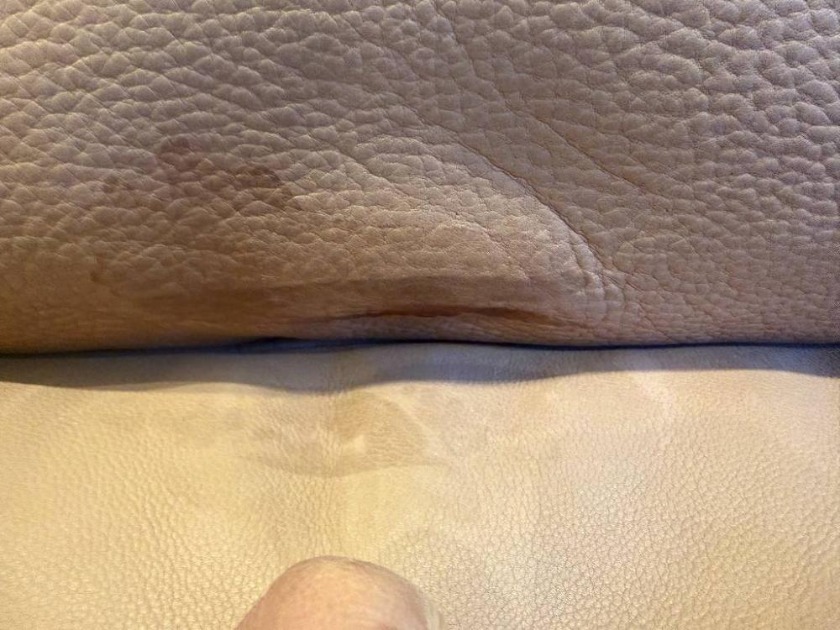
Can Pre-Urine Cleaner 7.5 be used to Clean Aged, Old Urine that Smells of Ammonia?
- No, Pre-Urine Cleaner 7.5 will not be practical for pre-cleaning aged, fermented urine that heavily smells of ammonia.
- When urine sits long enough to ferment, bacteria break down the urea, releasing gaseous ammonia and shifting the chemical stain from its initially mild state into a highly alkaline powerhouse (often reaching a pH of 9.0 to 10.0) .
- Using a Pre-UrineCleaner that sits at pH 7.5 adds more alkaline-leaning properties to an already alkaline problem.
| Chemical & Physical Bottlenecks | What Happens to Your Leather |
|---|---|
| Ammonia Volatilization | Introducing a slightly alkaline cleaner (pH 7.5) to an already alkaline stain will actually accelerate the release of ammonia gas. It will immediately cause the sharp, acrid odor to off-gas violently into the room. |
| Inability to Dissolve Crystals | Old urine leaves behind hard, insoluble uric acid crystals and ammonium salts bound tightly to the leather fibers. These crystals require a distinctly acidic pH to be broken down and dissolved. A pH 7.5 solution lacks the hydrogen ion concentration needed to crack them. |
| Severe Leather Damage | Leather's natural pH is acidic, sitting between 3.0 and 5.0. The long-standing alkaline ammonia has already "etched" and weakened the leather fibers. Adding another alkaline solution further compromises the protein matrix, increasing the risk of cracking, color bleeding, or permanent hardening. |
- To tackle aged, fermented urine on leather, you must invert your workflow.
- You cannot use a mild alkaline pre-cleaner first.
- Instead, you must lead with an acidic solution to drop the pH, collapse the ammonia gas, and dissolve the crystallized salts safely.
- Skip Pre-Urine Cleaner 7.5
- Apply Pre-Urine Rinse 3.2 first.
- The Pre-Urine Rinse 3.2 instantly bonds with the volatile alkaline ammonia, neutralizing the sharp odor at a molecular level and beginning the dissolution of the uric acid crystals.
The Pre-Urine Cleaner 7.5 Step (Second):
- Once the ammonia is chemically subdued by Pre-Urine Rinse 3.2,
- Use Absorbent Leather Post-Urine Wash 5.5 a purely slightly acidic surfactant wash to pull up the emulsified lipids and surface pigments.
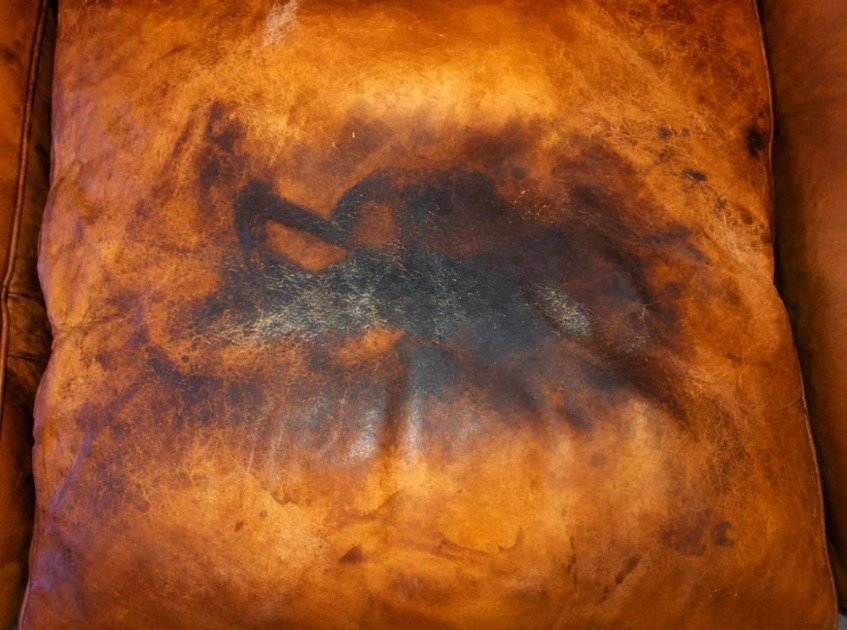
How to Remove the Darkening Effect from Aging Urine Stain?
- A severe, deeply set, aged urine stain that has structurally altered the leather.
- The dark coloring is not just a surface pigment;
- It is a combination of chemical burning from long-term alkaline ammonia exposure,
- Deeply embedded organic lipids/salts, and potential rotting of the leather fibers.
- Because the urine has thoroughly saturated the porous hide and oxidized over a long period,
- Standard surface cleaners alone will not reverse this darkening effect and could cause the dried, weakened leather to crack or tear.
- To safely strip out the deep darkening agents and restore the leather matrix, you must follow a specialized heavy-recovery protocol:
Step 1: The Acidic De-Crystallization (Salt Release)
Aged ammonia builds hard, dark crystalline structures inside the leather fibers that lock the discoloration in place.
It must be dissolved before attempting to lift any pigments.
-
What to use:
-
Absorbent Leather Urine Salt Release 2.7.
-
The Technique:
-
Dampen a clean Microfiber Towel 3 until it is moist but not dripping.
-
Place the damp towel directly flat over the dark center of the stain.
-
Leave it to rest for 3 to 5 minutes to let the Urine Salt Release 2.7 vapor travel deep into the pores and break down the alkaline salts.
-
The Extraction:
-
Remove the cloth and immediately use a fresh, dry microfiber towel to firmly press, roll, and pull the released contaminants vertically upwards out of the cushion.
Step 2: The Deep Grease-Pull Extraction (Lipid Removal)
The dark appearance is heavily exacerbated by rancid animal lipids and lipids from the urine that have deeply saturated the inner foam cushion and the underside of the leather hide.
Water cannot dissolve these oils.
-
What to Use:
-
A dedicated Absorbent Leather Urine Extractor 4.4
-
How it works:
-
These products are engineered to be applied as a thick paste.
-
As the gel base dries, it physically draws sub-surface oils and dark urine pigments upwards out of the leather pores,
-
Drying into the gel that traps the contaminants.
2. Dwell (Controlled Evaporation):
- Allow the gel layer to dry completely at room temperature (usually 1 to 2 hours).
- As the water phase evaporates, the concentration of Gel surges,
- Pulling lipids upward from the leather's core into the polymeric matrix.
3. Remove (Film Extraction)
- Once fully dry, the gel matrix collapses into a dense, peelable film.
- Gently brush the residue away using a soft-bristled horsehair Brush 1.
- Avoid using stiff nylon brushes or scraping tools that could abrade raw absorbent leather surfaces.
4. Repeat (Visual Color Evaluation)
- Inspect the extracted residue.
- Repeat this step by applying a fresh layer of gel until the dried film remains pristine white and no longer turns brown or yellow,
- Confirming that lipid extraction from the leather substrate is complete.
| Process Phase | Physical Mechanism & Chemistry | Visual Result |
|---|---|---|
| Active Extraction | Brown or Yellow Film (Indicates heavy presence of trapped soil, oxidized sebum, and old leather fats). | |
| Exhaustion Phase |
|
Off-White / Light Cream (Indicates trace remnants of oil or surrounding tannin migration).
|
| Complete Depletion |
|
Pristine White Film (Signals absolute chemical purity; no further extraction is possible). |
What a “Pristine White” Finish Confirms:
- The Absorbent Leather Urine Extractor 4.4 are Unbound:
- The Absorbent Leather Urine Extractor 4.4 have no more target lipids to emulsify,
- Meaning you are no longer leaving a sticky, oil-laden surfactant residue on the leather surface.
- Once the deep oils are drawn out, wash away the remaining surface debris using Absorbent Leather Post-Urine Wash 5.5.
- Apply a small amount to a sponge, work it into a very minimal foam, and dab using the outside-in spiral method to lift any residual topical tracking.
- Wipe clean with a damp, water-only cloth and let it air dry completely.
Ready for Re-Fatliquoring:
- Because you have pulled out the rancid, dark grease without destroying the underlying leather structure,
- The raw fibers are now clean, porous, and perfectly prepared to evenly absorb your fresh, balanced Step-3 Hydrator 3.5 and Step-4 Fatliquor emulsion.
- ⚠️ The Color Loss Risk:
- The ammonia has likely already destroyed the original dyes underneath.
- When you successfully draw out the dark urine stain,
- You may reveal a lightened, bleached, or completely raw leather patch underneath.
- Prepare for the reality that the cushion may require a matching leather color dye restoration kit after it is thoroughly cleaned.
- ⚠️ Do Not Use Heat:
- Never use a hair dryer or heat gun to speed up the drying process on an ammonia-burned stain.
- Heat will bake any remaining proteins permanently into the leather fibers, turning the dark patch into a hard, brittle, irreversible crust.