


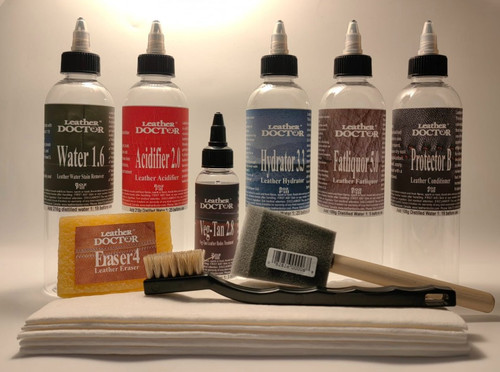
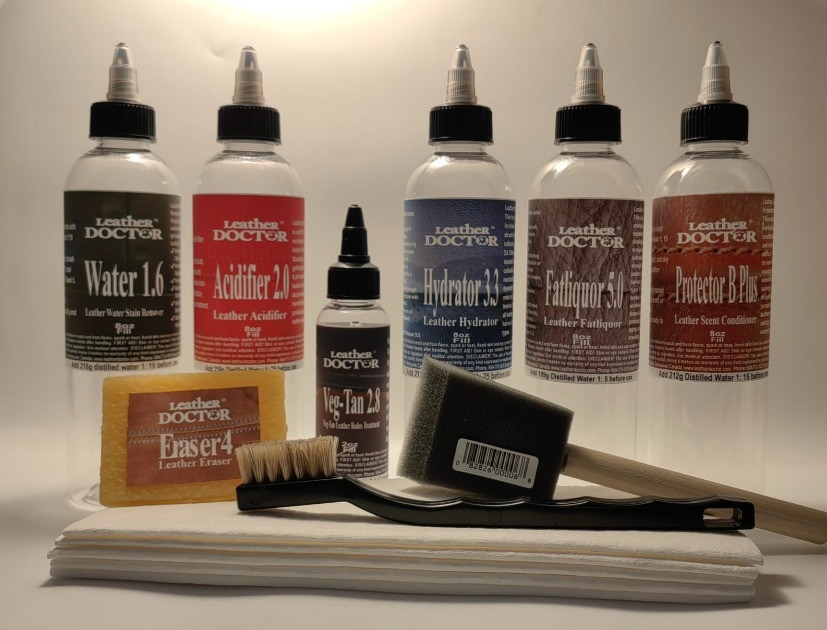
 Veg-Tan Leather Water Stain Remover Kit L3.ws by Leather Doctor® Effectively removes water spots, rings, and discoloration from leather using a safe, pH-balanced system with no side effects.
What is Veg-Tan Leather?
Vegetable-tanned leather (often called Veg-Tan) is a type of leather produced using natural tannins extracted from organic matter like tree bark (oak, chestnut, mimosa), leaves, and roots.
- This leather is famous for changing over time.
- It darkens and develops a rich luster (patina) when exposed to sunlight, moisture, and oils from your skin.
High Porosity:
- Veg-tan leather is a natural, breathable material with open pores.
- When water hits the surface, it is quickly absorbed into the internal fiber structure rather than beading off.
Tannin and Oil Migration:
- As water evaporates from the leather, it binds to and draws out the natural oils and water-soluble tanning agents (tannins) within the fibers.
- These substances migrate toward the edges of the wet spot, leaving behind dark, concentrated rings or "tide marks".
Surface Disruption:
- Water can cause the collagen fibers to swell and then shrink as they dry.
- This mechanical shift can permanently alter the surface texture and light reflection of that specific spot.
Mineral and Contaminant Deposits:
- When water penetrates the leather, it can carry minerals (like iron from hard water) or environmental salts into the hide.
- Once the water dries, these minerals remain trapped, causing discoloration or white salt streaks.
pH Difference:
- Leather is naturally acidic due to the tanning agents and processes used to preserve it.
- Typically has a lower pH, ranging between 3.0 and 4.0.
Why pH Balance Matters:
- Leather acts like litmus paper:
- exposure to substances outside its ideal range causes a chemical reaction that can lead to a darken effect with permanent damage.
- Alkaline Exposure (pH > 7):
- Common household cleaners, saddle soaps (pH 9-10), and even tap water (pH ~7) are more alkaline than leather.
- This causes the leather to "denature," leading to tackiness, color bleeding, stiffness, and eventually dry rot.
- Excessive Acidity (pH < 3):
- While leather is acidic, extremely strong acids (like sulfuric acid from pollution) cause "red rot," where the leather becomes powdery, red, and physically weak.
| Action | Immediate Result | Long-term Damage |
|---|---|---|
| Alkaline Shock | Dark "tide marks" (tannin bleed) | Permanent discoloration |
| Fiber Sticking | Extreme stiffness | Surface cracking/peeling |
| Oil Stripping | Loss of suppleness | Dry rot |
| Crystallization | White powdery residue | Structural fiber tearing |
- Neutralize: Use Acidifier 2.0 (pH 2.0) to bring the pH back down to 4.0 and dissolve the salt.
- Hydrate: Use Hydrator 3.3 to relax the stuck fibers and move the bled tannins back into the leather.
- Refatliquor: Use Fatliquor 5.0 to replace the oils that were emulsified and lost.

- Leather is a pH-sensitive material, behaving much like litmus paper—its color and texture can change on contact with liquids.
- Even rainwater or tap water, which often contains alkaline minerals, can cause visible ring marks, discoloration, and stiffness once dry.
- As an amphoteric protein fiber, absorbent leather responds dramatically to pH shifts.
- Alkalinity causes leather’s protein fibers to shift from an ionic positive (+ve) to ionic negative (-ve) state.
- In this negative state, the fiber repels the leather’s ionic negative (-ve) constituents—such as tanning agents, dyestuff, and fatliquor—breaking their hydrogen bonds.
- These displaced constituents migrate and concentrate at the ring edges, causing visible outlines and fiber stiffness.


- Brushing with Brush 1 and erasing with Eraser 4 removes surface residue.

- Water 1.6 gently cleanses without disrupting the fiber’s pH integrity.
- Acidifier 2.0 acts as a rinse while restoring the ionic positive (+ve) charge to the leather fiber.

- Hydrator 3.3 penetrates deep to relax and separate stuck fibers, redistribute displaced leather constituents, and purge contaminants.
- Proper hydration and dwell time are key for optimum effect.

- Fatliquor 5.0 restores natural fats and oils, imparting softness and strength to the leather.

- Veg-Tan 2.8 oxidation-reduction reaction treatment lightens, browning leather water discoloration.

- Conditioner B creates a non-stick surface with a buttery feel that resists soiling and reduces friction wear.
- Each product’s suffix (e.g., 1.6, 2.0, etc.) denotes its pH level, which is critical in this restoration method.
- Leather averages a natural pH of 4
- Water averages pH 7
- Between pH 4 and 7, the ionic difference is 1,000-fold, significantly impacting the suede’s chemistry.
- Above its pH, suede fibers become negatively charged, weakening their bond with the leather’s essential constituents and leading to denaturation—effectively turning suede toward dry rotting if left unchecked.


- Kit L3.ws products come in concentrated form and must be diluted with 1.2 quarts (1058g) of distilled water before use.

✅ Leather Water Stain Remover 1.6
✅ Leather Acidifier 2.0
✅ Leather Hydrator 3.3
✅ Leather Fatliquor 5.0
✅ Veg Tan Leather Redox Treatment 2.8
✅ Leather Protector B
✅ Leather Eraser 4
✅ Leather Brush 1
✅ Foam 2
✅ Towel 5
Experience the Science of Leather care!
- Removes Water Stains – Eliminates rain and water marks by rebalancing leather’s pH.
- Prevents Mold Growth – Maintains leather’s natural acidic protection against mold.
- Balances pH Scientifically – Leather is pH-sensitive and reacts like litmus paper; exposure to water causes stains and damage.
- Stops Leather Deterioration – Water breaks down tanning agents, dyes, and natural oils, leading to tackiness, stiffness, and discoloration.
- Safe & Effective Formula – Scientifically designed to rebalance pH and protect leather without harsh chemicals.
Precision Science-Based Professional Grade, pH 1.6, Water Damage Restoration for pH sensitive Leathers:
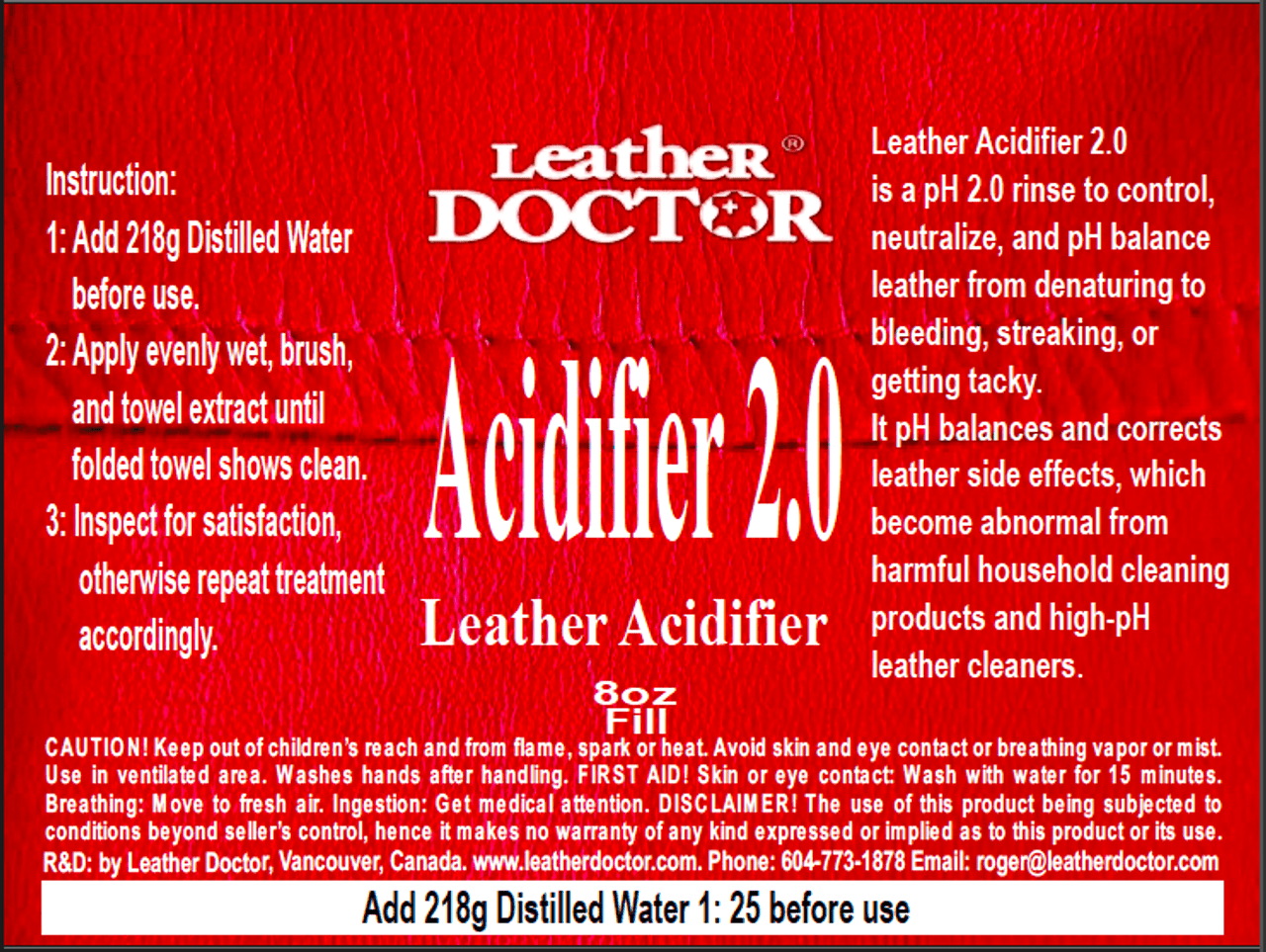
Acidifier 2.0 prevents leather from denaturing, which can lead to bleeding, streaking, tackiness, and structural weakness due to alkaline overexposure.
- Neutralizes alkaline contamination from cleaners, sweat, and body oils
- Prevents dye bleeding and color streaking
- Reduces leather tackiness and improves texture
- Strengthens leather fibers and enhances structural integrity
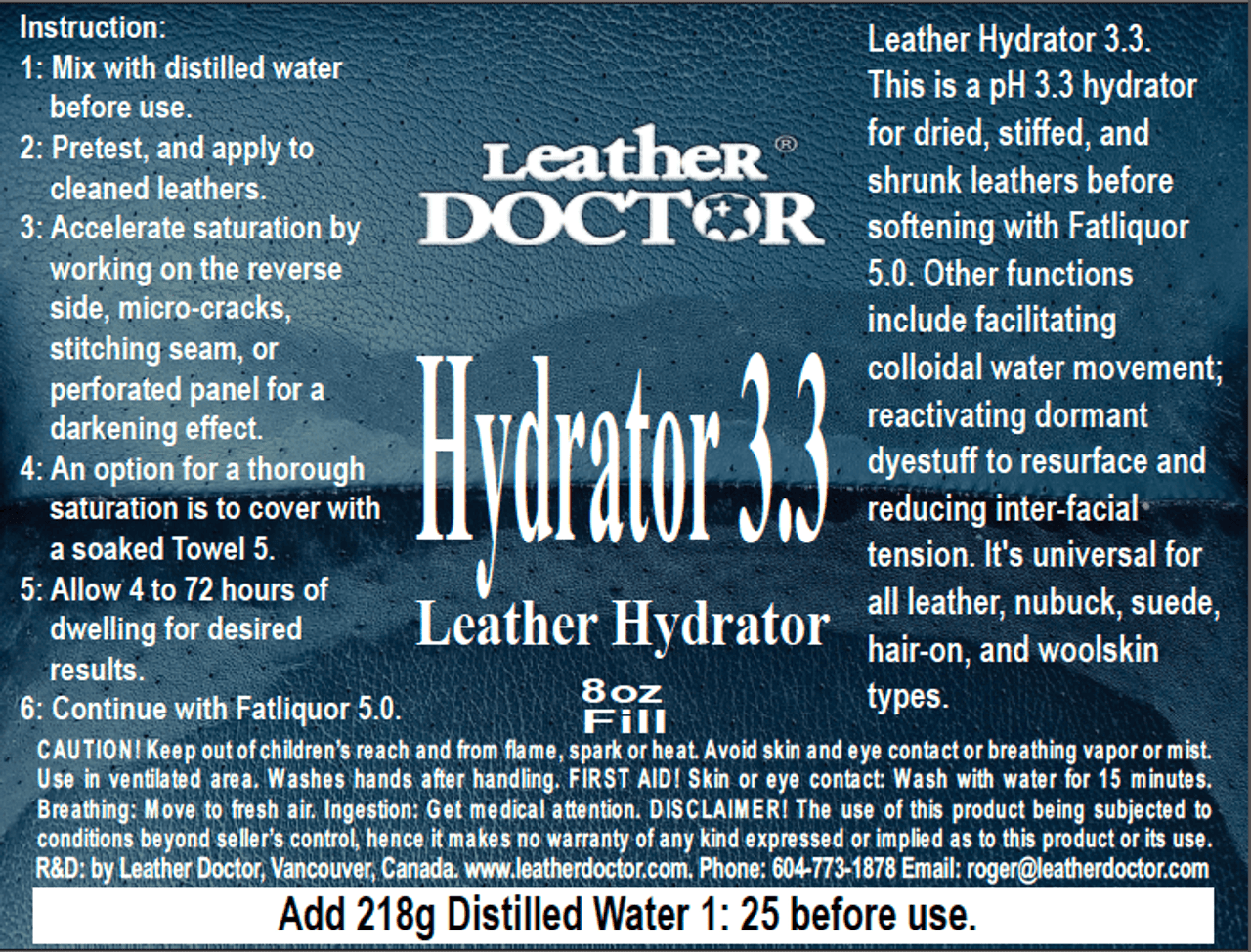
- It mimics the hydration stage of tannery pre-conditioning to prepare leather for deeper structural rejuvenation.
Hydrator 3.3 Key Benefits:
- Rehydrates dried, stiff, or collapsed fiber structure
- Restores moisture to the leather’s protein fibers, relaxing them so they can regain flexibility.
- Essential before fatliquoring (with Fatliquor 5.0) so fats and oils can penetrate deeply and bond properly.
- Displaces and flushes out impuritie
- Helps suspend and wick out residual body oils, sweat, soiling, or alkaline contamination that may have penetrated the leather.
- Balances pH and readies leather for further treatments
- The mild acidic pH of 3.3 re-aligns the ionic charges of the leather structure, making it receptive to fatliquor and protecting against pH damage.
- Helps reduce stiffness and restore suppleness
- When used alone or in conjunction with fatliquor, Hydrator 3.3 is critical for achieving uniform softness, without patchiness.
Tannery science basis
- In professional tanning and retanning, hides are hydrated before fatliquoring to ensure that treatments penetrate evenly and bond effectively.
- Hydrator 3.3 replicates this essential tannery hydration step at the restoration stage, particularly for dried-out, stiff, or aged leather.
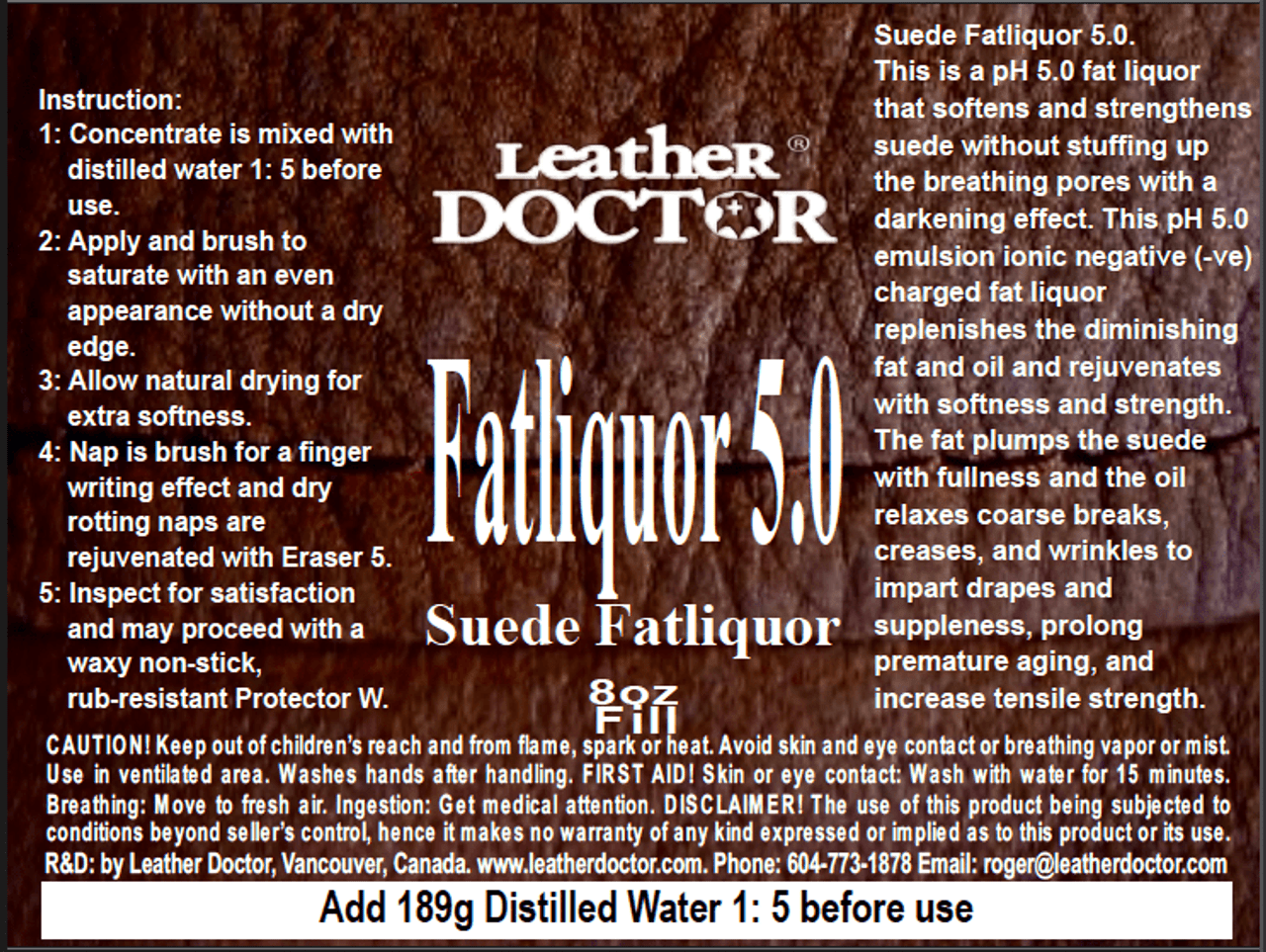
- It restores leather’s internal lubrication, flexibility, strength, and resilience—mimicking the essential fatliquoring stage in professional tanning and retanning processes.
Fatliquor 5.0 Key Benefits:
- Lubricates and nourishes the leather structure
- Fatliquor 5.0 deposits fat and oil molecules that bond to the amphoteric protein fibers.
- These lubricate the fibrils, allowing them to slide over each other without stiffness, brittleness, or cracking.
- Reinforces tensile strength and elasticity
- Proper fatliquoring prevents fiber embrittlement and maintains leather’s natural strength and softness.
- Restores suppleness and prevents future damage
- Leather loses fatliquor over time due to aging, heat, sunlight, alkaline exposure, or cleaning.
- Replenishing it prevents shrinkage, stiffness, and cracks.
- Provides long-term structural protection
- Maintains leather’s dimensional stability and ability to flex without damage.
Tannery science basis:
- In the tannery, fatliquoring is one of the final and most critical stages after tanning and dyeing.
- It ensures that leather stays soft, strong, and flexible as it dries.
- The fats and oils form a molecular film around the protein fibers, acting as internal lubricants.
Fatliquor 5.0 brings this same process to leather restoration.
It ensures the leather is not just “looking good on the surface” but structurally rejuvenated from within.
Typical uses:
- Restoring dried, stiff, or shriveled leather.
- Rejuvenating leather after mold removal, alkaline contamination, or heat exposure.
- Conditioning leather during or after restoration, repairs, or refinishing.
Important note on process:
- Fatliquor 5.0 works only when the leather is properly hydrated first (with Hydrator 3.3) to relax the fiber structure and open it up for fatliquor absorption.
- Without hydration, fatliquor can’t penetrate deeply or bond uniformly — leading to incomplete restoration.
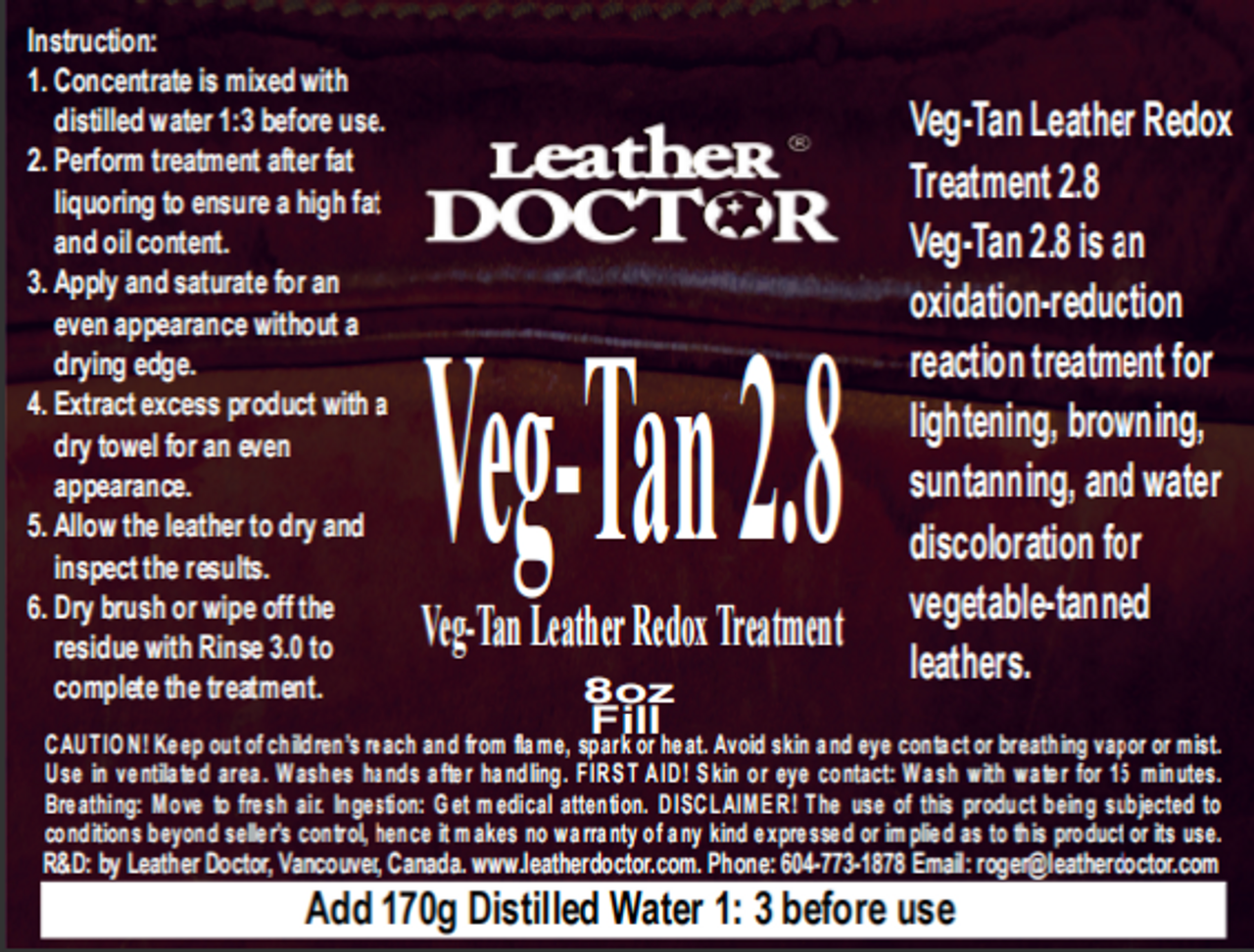
- Veg-Tan 2.8 is a specialized leather-safe product developed to reverse oxidation discoloration in vegetable-tanned leather, particularly when it darkens from water damage, sweat, or aging. This treatment helps restore the leather’s original pale, neutral tone without harsh bleaching or damage.
Why Use Veg-Tan 2.8?
- Oxidation Stain Removal:
- Veg-tan leather contains natural tannins that are highly reactive to alkalinity in sweat and unknown water.
- Over time, these reactions cause permanent-looking dark stains.
- Redox Treatment 2.8 breaks these bonds, chemically reducing the oxidized compounds and lightening the stains.
- Restoring Original Appearance:
- Maintains the natural pale, nude, or biscuit tone of unfinished veg-tan leather—crucial for saddle-makers, luxury crafters, and restoration professionals.
- Prevents the need for sanding or bleaching, which can degrade the grain structure.
- Leather-Safe Chemistry:
- Maintains the amphoteric pH-sensitive nature of leather (ideal pH between 3-5).
- Works synergistically with Leather Doctor’s Acidifier 2.0 and Hydrator 3.3 - Fatliquor 5.0 systems to prevent structural damage and preserve suppleness.
 Leather Protector B by Leather Doctor® is a pH 3.2 non-stick, rub-resistant conditioner that enhances smooth leather’s durability while providing a soft, buttery feel.
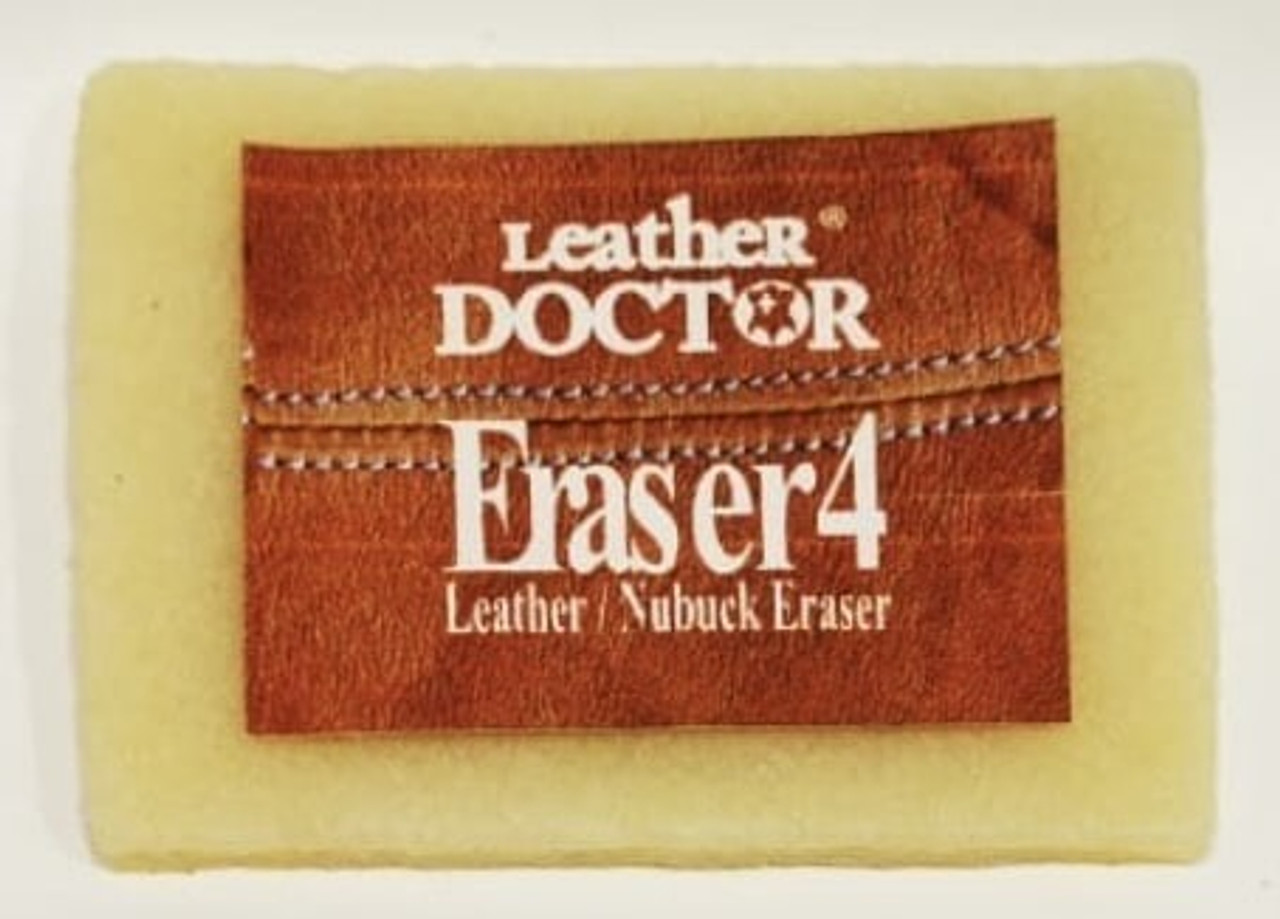
- It is also used in conjunction with Stripper 2.3 to strip off old and deteriorating finishes during refinishing.
- Dimensions: (L: 2.8 inches x H: 2 inches x W: 0.2 inches)
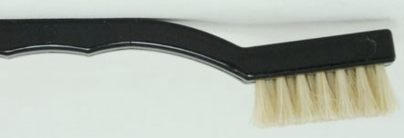
- Soft Horsehair Bristles – Ensures safe cleaning without scratching or damaging leather surfaces
- Ergonomic Grooved Grip – Provides comfort and control for effortless detailing
- Sturdy & Durable Design – Built for long-term use in leather maintenance
- Ideal for Deep Pore Cleaning – Effectively loosens embedded dirt and grime without harming the finish.
- Specifications: (Length: 7 inches. Bristle Head: Three-row 1½-inch horsehair bristles.)
- High-Density Polyfoam – Resists tearing and shredding for long-lasting use
- Even Product Distribution – Ensures smooth, streak-free application
- Controlled Absorption – Holds and releases product efficiently for optimal coverage
- Versatile Use – Ideal for applying dyes, finishes, and conditioners on leather and suede
- Specifications: (Width: 2 inches. Material: High-density polyfoam).
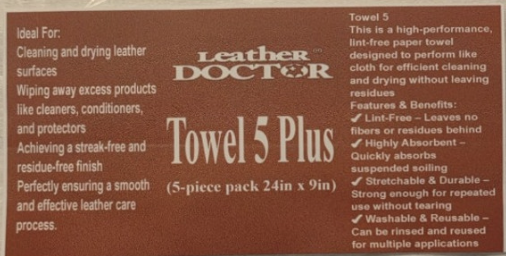
- Lint-Free – Leaves no fibers or residues behind
- Highly Absorbent – Quickly absorbed suspended soiling
- Stretchable & Durable – Strong enough for repeated use without tearing
- Washable & Reusable – Can be rinsed and reused for multiple applications


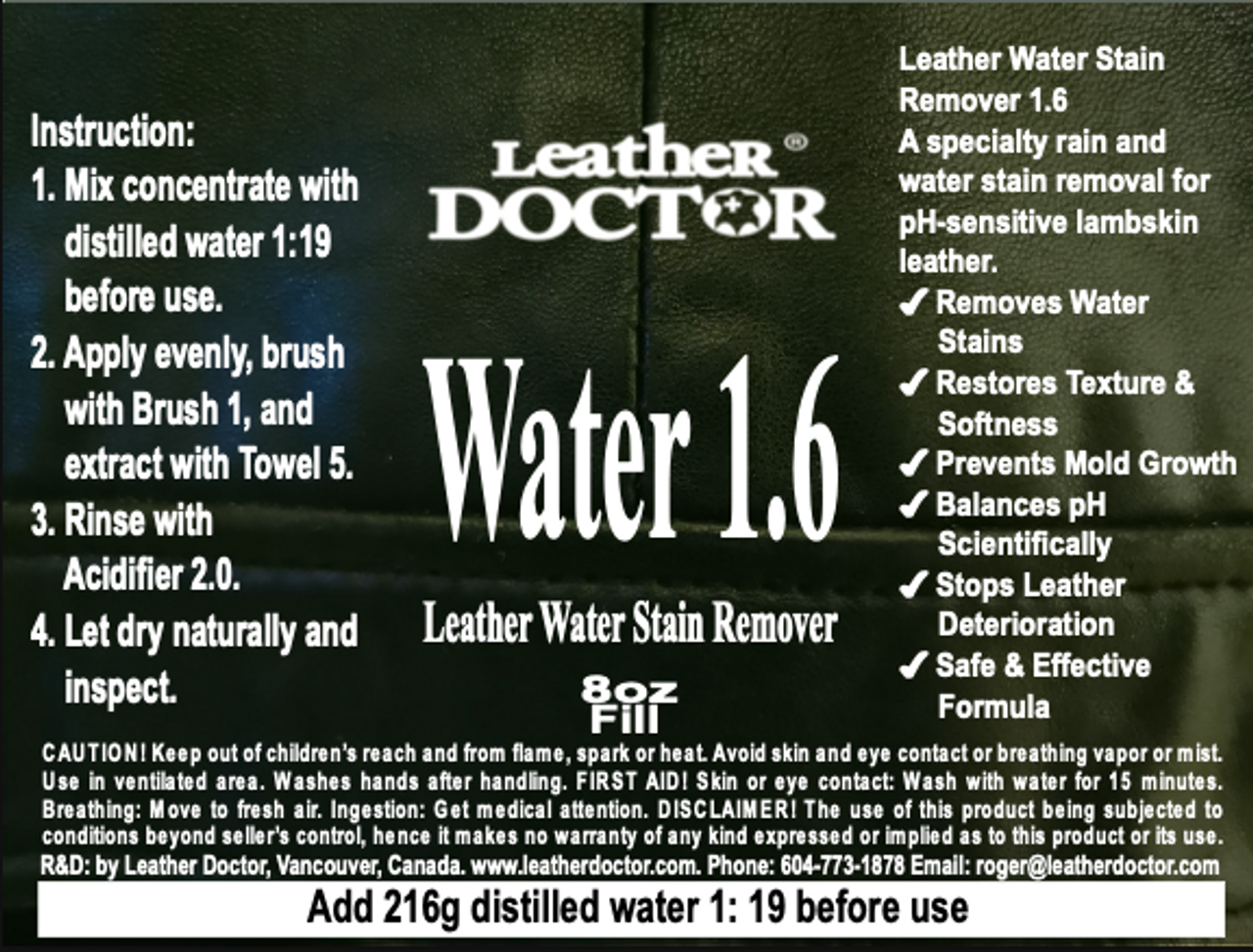
- Water 1.6 concentrate is mixed with distilled water at a ratio of 1: 19 before use.
- Apply evenly, clean with Brush 1 for a deep darkening effect.
- Excess and suspended soiling is extracted with Towel 5 or equivalent for an even appearance.
- Continue with an acidifying rinse to neutralize the water pH damage.

- Acidifier 2.0 concentrate is mixed with distilled water 1: 25 before use.
- Apply evenly, rinse with Brush 1 for a deep darkening effect.
- Excess and suspended soiling is extracted with Towel 1 or equivalent for an even appearance.
- Continue with hydrating.

- Hydrator 3.3 concentrates is mixed with distilled water 1: 25 before use.
- Apply evenly, rinse with Brush 1 for a deep darkening effect.
- Excess and suspended soiling is extracted with Towel 5 or equivalent for an even appearance.
- Massage, stretch to relax creases and wrinkles.
- Continue with Fatliquoring.

- Fatliquor 5.0 concentrate is mixed with warm distilled water 1: 5 before use.
- Apply and redistribute with Brush 1 or pads until structure is evenly saturated.
- Repeat each cycle water contents evaporate leaving behind only the fat and oil content.
- Allow natural drying for extra softness.
- The desired suppleness is further staked and massaged, accordingly with a little wet back with Hydrator 3.3 until dry.

- Veg-Tan 2.8 is applied over the dried surface and towel padded saturating evenly without a dry edge to avoid blotchiness or drying marks and left to dry for an oxidation-reduction reaction to take effect.
- The appearance is inspected during treatment or after drying and may be repeated accordingly.
- After dry inspection, any surface residue is wiped away with Hydrator 3.3 and let to dry again for a satisfactory inspection, otherwise repeat.

- Protector B concentrate is mixed with distilled water 1: 19 before use.
- Shake well, apply, and spread with a lint-free towel or sponge.
- Its ready to use when dry.

Updated: April 5, 2025 | July 12 2025 by Roger Koh