


Semi-Aniline Leather Color Refinishing Kit SA7.cl by Leather Doctor® is a professional Leather-Safe™ system designed for refinishing, restoring, recoloring, and protecting semi-aniline leather using pH-balanced, tannery-grade products.
Kit SA7.cl follows modern tannery science principles, allowing restorers to replicate the finishing procedures used during original leather manufacturing while preserving the natural character of semi-aniline leather.
 Why Kit SA7.cl is Ideal for Semi-Aniline Leather
Semi-aniline leather represents a fusion of two finishing worlds.
It combines the natural beauty of aniline leather with the practical durability of light pigment protection.
Semi-aniline leather characteristics
✅ Fully dyed through with transparent aniline dyes
✅ Light micro-pigment coating for color consistency
✅ Protective topcoat for mild stain resistance
✅ Enhanced UV and water repellency
✅ Maintains visible natural grain and depth
Over time, normal use can cause:
✅ Micro-crazing of the topcoat
✅ Uneven fading
✅ Abrasion of the pigment layer
✅ Drying and structural stiffness
✅ Surface contamination from body oils and cleaners
The SA7.cl system restores leather by recreating the original tannery finishing sequence, ensuring both structural rejuvenation and aesthetic restoration.
Each product works in harmony with the pH-sensitive amphoteric nature of leather, preventing over-processing while maintaining the leather’s natural appearance and flexibility.
 How to Identify Semi-Aniline Leather
Front Surface
✅ Mostly uniform color
✅ Soft satin or low-sheen finish
✅ Natural grain still visible
Reverse (Suede) Side
✅ Shows similar color tone range
✅ Indicates full through-dye penetration
Surface Behavior
✅ Light moisture may bead slightly
✅ Color depth remains visible beneath finish
Aging Characteristics
✅ Mild fading
✅ Micro-crazing of the finish
✅ Slight absorption in high-use areas
 Why Leather Color Refinishing Becomes Necessary
Leather refinishing is commonly required when surfaces show:
✅ Peeling or deteriorating finishes
✅ Split, worn, or abraded grain
✅ Missing color coatings
✅ Uneven fading or discoloration
Surface contamination may include:
✅ Body oils and grease
✅ Sweat residues
✅ Incompatible conditioners or protectors
✅ Alkaline damage from harsh cleaners
These contaminants weaken finish adhesion and accelerate deterioration.
 Why a Holistic Leather Restoration System Is Necessary
A long-lasting refinishing result requires restoring both the internal leather structure and the external finish layer.
Leather Structure
Typical upholstery leather thickness ranges from:
0.9 – 1.2 mm
When leather dries internally it becomes stiff and prone to cracking.
Leather Finish Layer
The surface finish averages:
0.02 mm (20 microns)
This extremely thin layer must remain compressible and flexible during normal leather movement.
If the leather beneath becomes dry or contaminated, the finish will eventually crack, peel, or delaminate.
The SA7.cl system addresses both structural integrity and surface finishing, ensuring durable refinishing results.
 How Modern Tannery Science Influences Leather Restoration
Professional leather restoration works best when it follows the same scientific principles used in leather manufacturing.
In a tannery, leather finishing occurs in a precise sequence:
- Cleaning and neutralizing
- Hydrating the fiber structure
- Fatliquoring (fiber lubrication)
- Surface sealing
- Pigment coating
- Protective top finishing
Each stage prepares the leather for the next.
The Leather Doctor® SA7.cl system replicates this tannery sequence, ensuring that restoration addresses both the internal leather structure and the external finish layer.
Amphoteric Nature of Leather
- Leather is an amphoteric material, meaning it reacts differently depending on the surrounding pH environment.
- Improper cleaning products — especially alkaline cleaners — can disturb this balance and cause:
✅ fiber brittleness
✅ finish delamination
✅ color loss
✅ premature cracking
Leather Doctor® products are formulated with precise pH control, allowing leather to be restored safely without destabilizing the fiber structure.
 Quick Restoration Overview
Step 1 – Strip old finishes
Use Deglazer 2.3 to remove deteriorated coatings and contamination.
Step 2 – Degrease the leather
Apply Degreaser 2.2 to remove body oils and grease.
Step 3 – Rinse and balance pH
Use Rinse 3.0 followed by Acidifier 2.0 to restore leather’s natural acidity.
Step 4 – Hydrate the leather
Apply Hydrator 3.3 to relax the leather fiber structure.
Step 5 – Replenish oils
Use Fatliquor 5.0 to restore softness and flexibility.
Step 6 – Apply adhesion primer
Primer 73 prepares the surface for new color coatings.
Step 7 – Apply color coating
Pigment 54 restores the leather’s original color.
Step 8 – Apply protective finish
Topcoat Satin 54 seals the color with a flexible protective layer.
Step 9 – Apply final protector
Conditioner B Plus enhances feel, durability, and friction resistance.
Kit SA7.cl – Product Contents
Available Fill Sizes
✅ 4 oz concentrate
✅ 8 oz concentrate
✅ 16 oz concentrate
(All concentrates require dilution with distilled water.)
Required Water Per Kit Size
✅ 4 oz fill → 805 g (0.7 quart)
✅ 8 oz fill → 1609 g (1.8 quarts)
✅ 16 oz fill → 3218 g (3.5 quarts)
Shake thoroughly after dilution.
Included Products:
(Click the link for details)
✅ Leather pH Balanced Degreaser 2.2
✅ Leather Rinsing Conditioner 3.0
✅ Leather Acidifying Conditioner 2.0
✅ Aniline Staining Dye 21
✅ Leather Hydrating Conditioner 3.3
✅ Leather Fatliquoring Conditioner 5.0
✅ Leather Adhesion Primer 73
✅ Leather Pigment 54
✅ Leather Finish Topcoat Satin 54
✅ Leather Scent Buttery Feel Conditioner B Plus
Tools Included:
✅ Leather Brush 1
✅ Foam 2
✅ Towel 5
✅ Leather Eraser 4
✅ Sandpaper 2000
 What Is a Holistic Leather Refinishing System?
A holistic refinishing system follows a progressive sequence, where each stage prepares the leather for the next process.
The steps include:
- Stripping
- Degreasing
- Hydrating
- Fatliquoring
- Adhesion coating
- Color coating
- Protective top finishing
- Rub-resistant conditioning
Each step dovetails into the next to produce maximum durability and professional results.
Step-by-Step Refinishing Procedure
1️⃣ Step 1 – Stripping
Leather Stripping Deglazer 2.3
A pH-balanced finish remover used to eliminate:
✅ deteriorating finishes
✅ waxes and conditioners
✅ grease contamination
✅ inks or paints
Tools may include:
✅ Brush 9
✅ Leather Eraser 4
✅ Razor 60
✅ Sandpaper feathering
✅ Towel extraction
2️⃣ Step 2 – Degreasing
Leather Degreaser 2.2
✅ Removes body oils, sweat, and grease contamination.
✅ Degreasing is comparable to shampooing hair — soil is suspended and then removed during rinsing.
✅ Agitate using Brush 1 or Eraser 4, then extract suspended soil with a towel until clean.
3️⃣ Step 3 – Rinsing
Leather Rinse 3.0
A pH-balanced rinsing conditioner that:
✅ removes suspended soils
✅ restores leather pH balance
✅ prevents residue buildup
Continue rinsing until the surface produces a clean, healthy squeak.
4️⃣ Step 4 – pH Balancing
Acidifier 2.0
✅ Neutralizes alkaline contamination and restores proper leather acidity.
✅ Apply, brush, and extract until the surface feels clean and balanced.
5️⃣ Step 5 – Hydrating
Hydrator 3.3
Hydrates and relaxes the leather fiber structure.
Functions:
✅ loosens embedded contaminants
✅ relaxes stiff fibers
✅ restores internal moisture balance
6️⃣ Step 6 – Fatliquoring
Fatliquor 5.0
✅ A tannery-grade emulsion of fats and oils that replenishes lubricants between leather fibers.
✅ Application continues until the leather becomes fully saturated and supple.
✅ Allow slow natural drying for proper fiber bonding.
7️⃣ Step 7 – Adhesion Coating
Adhesion Primer 73
A compact resin primer that:
✅ smooths the surface
✅ seals the grain
✅ promotes strong color coat adhesion
Apply with a 3M white pad, then towel extract.
8️⃣ Step 8 – Color Coating
Leather Pigment 54
A fine micro-pigment resin coating used to restore leather color.
Pigment 54 concentrate must be diluted with distilled water.
Typical mixing ratio:
1 : 0.5 – 1
Application methods:
✅ Foam padding
✅ Roller brush
✅ Soft varnish brush
✅ Airbrush (professional results)
Recommended spray pressure:
80–100 PSI
Apply light coats with drying between layers.
9️⃣ Step 9 – Top Coating
Satin Topcoat 54
A flexible polyurethane finish that provides:
✅ abrasion resistance
✅ water protection
✅ natural satin appearance
Apply with a soft brush or airbrush.
Light sanding with 2000 grit between coats may improve finish smoothness.
 Step 10 – Final Protection
Conditioner B Plus
A buttery-feel leathery scent protector that:
✅ reduces friction wear
✅ enhances softness
✅ provides rub resistance
Apply evenly with foam or towel and allow to dry before use.
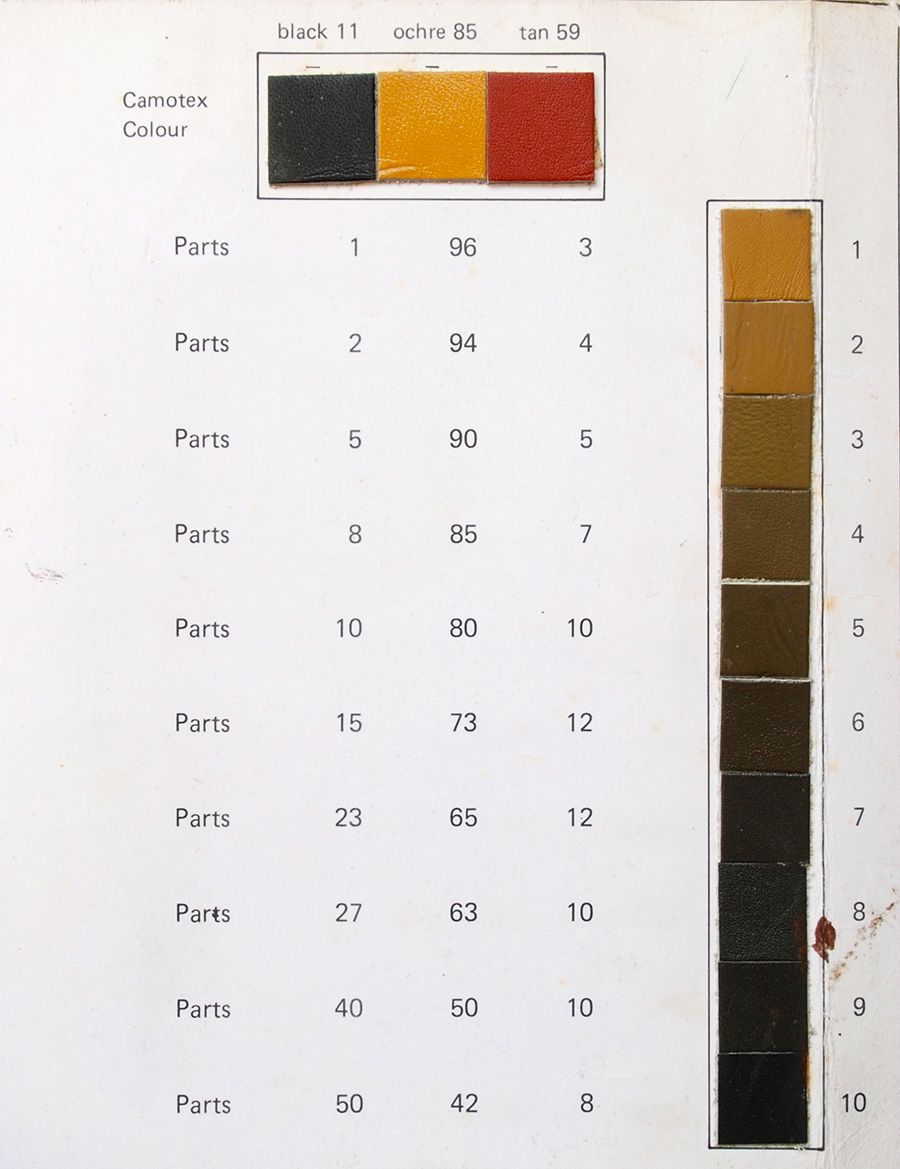
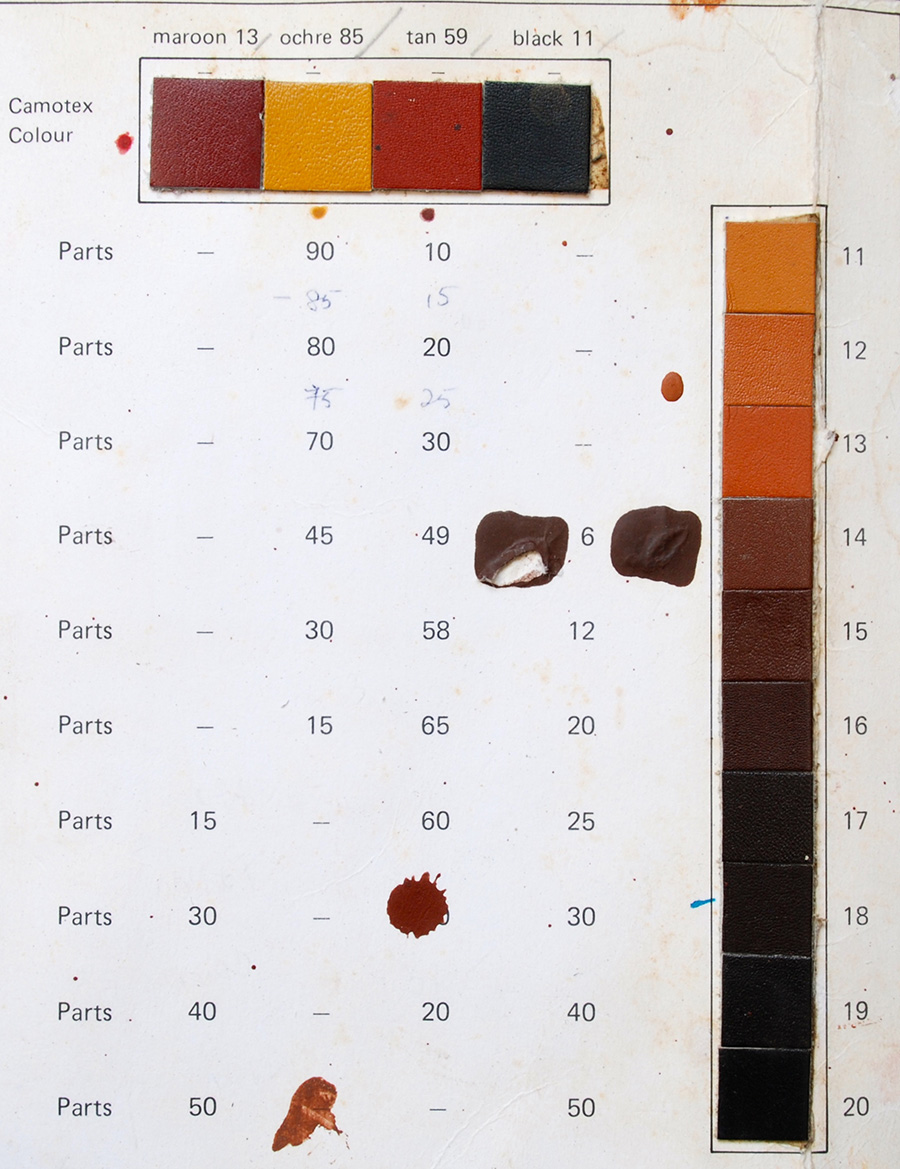
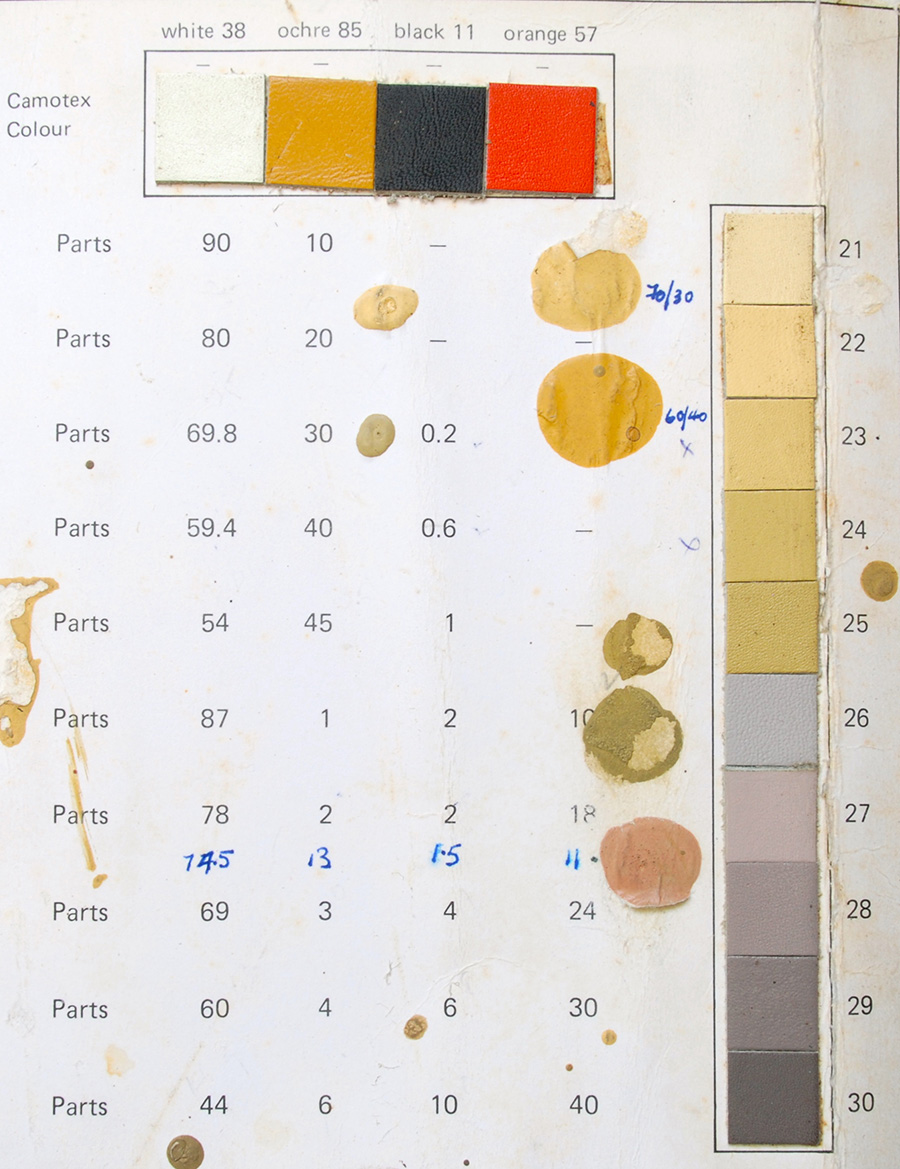
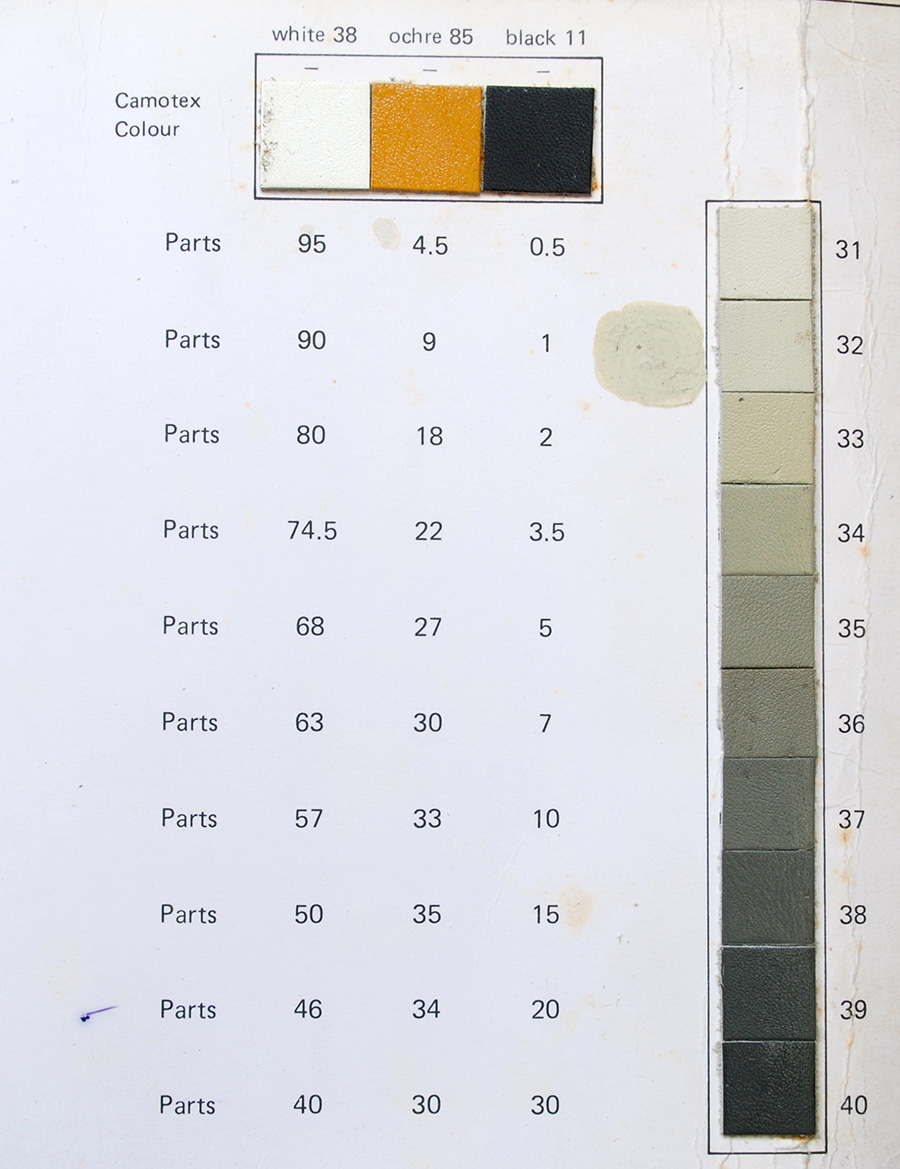
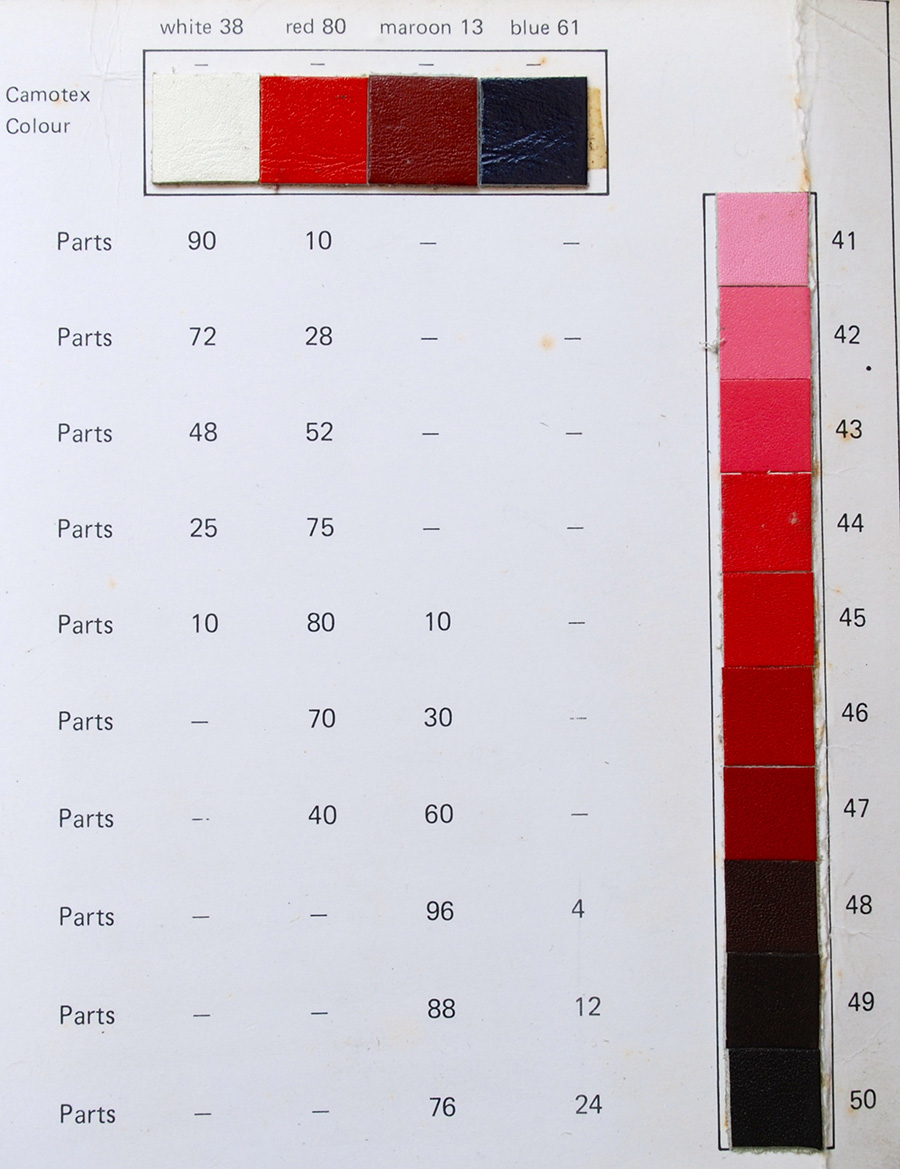
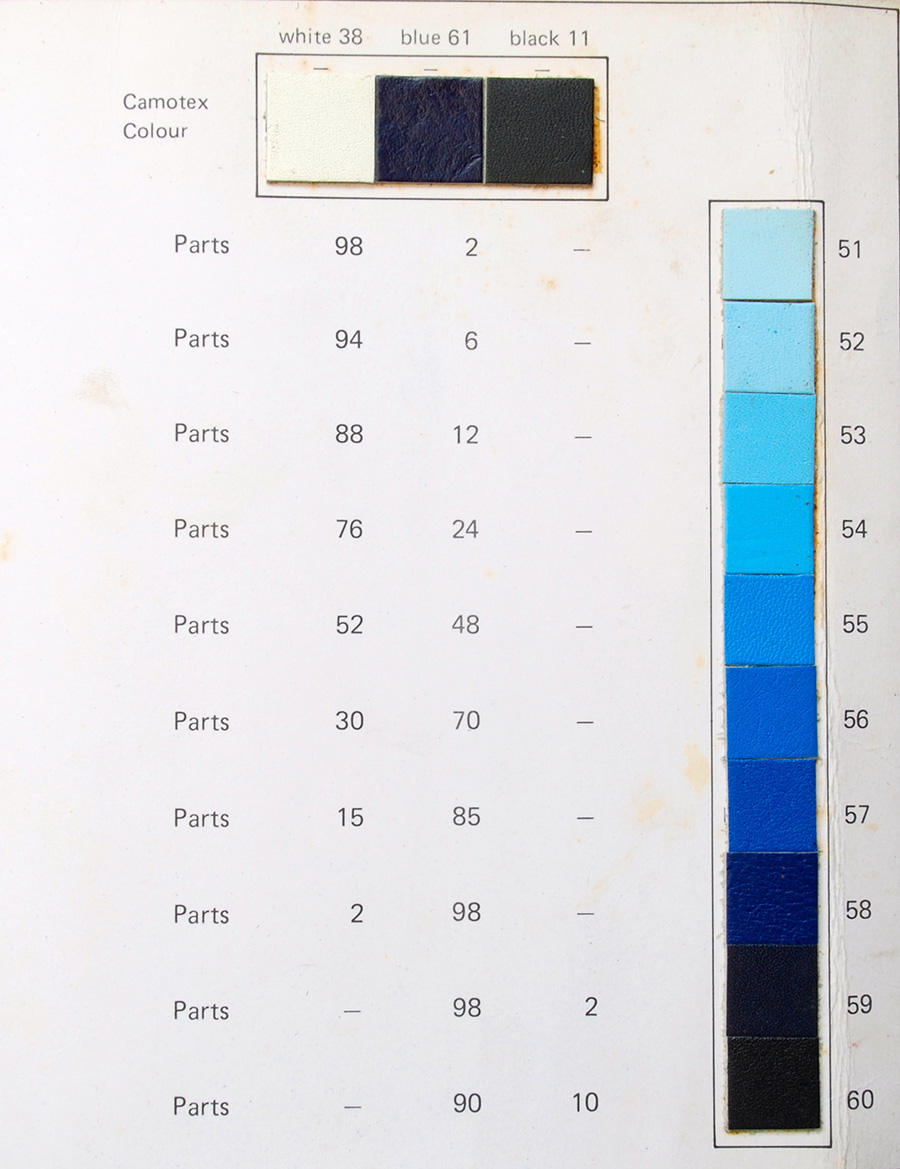
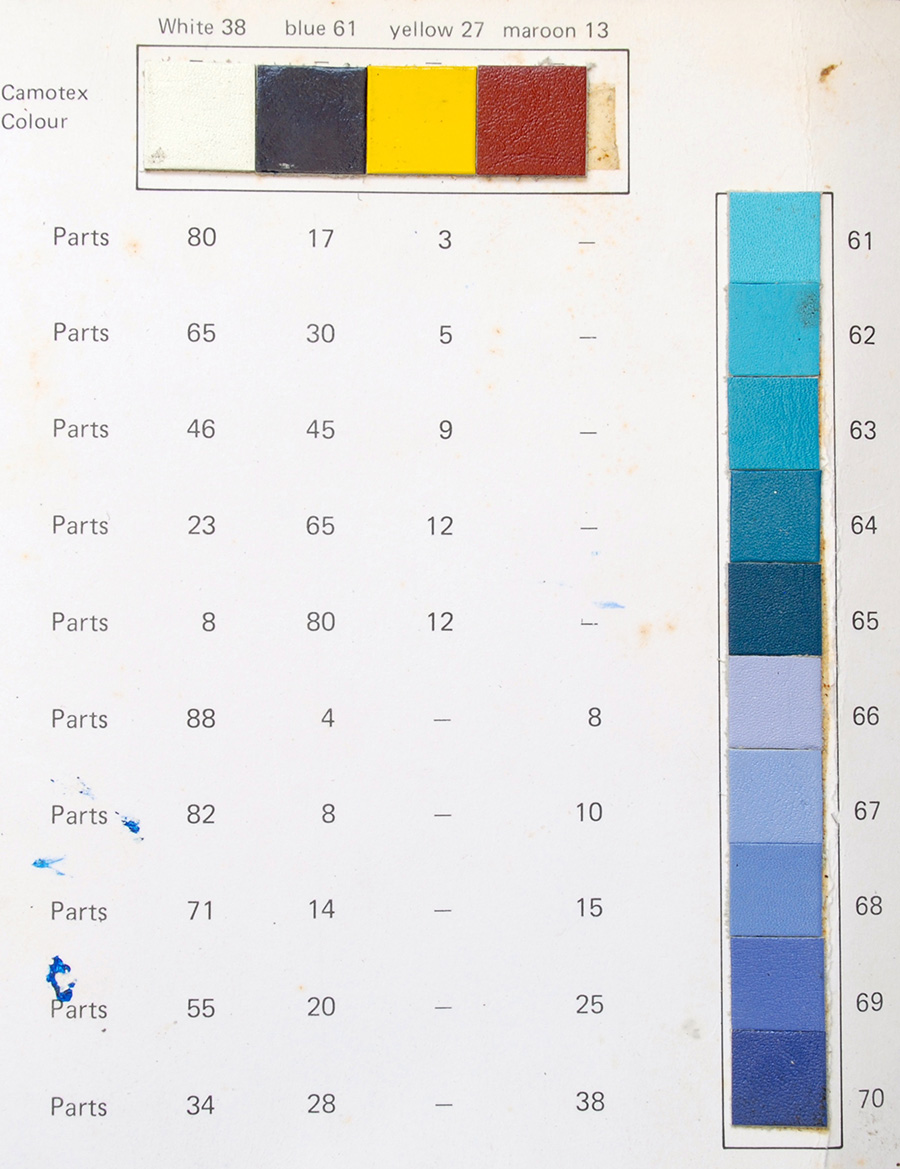
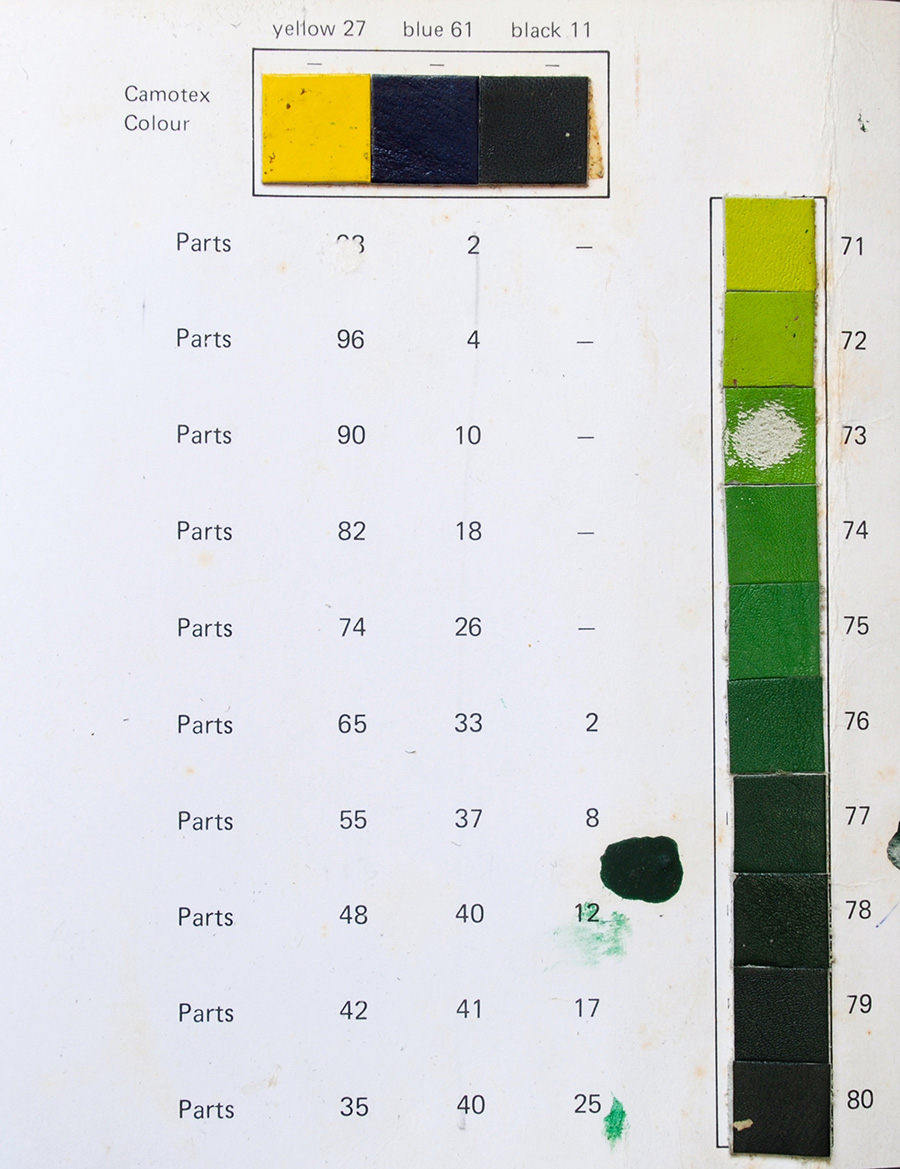
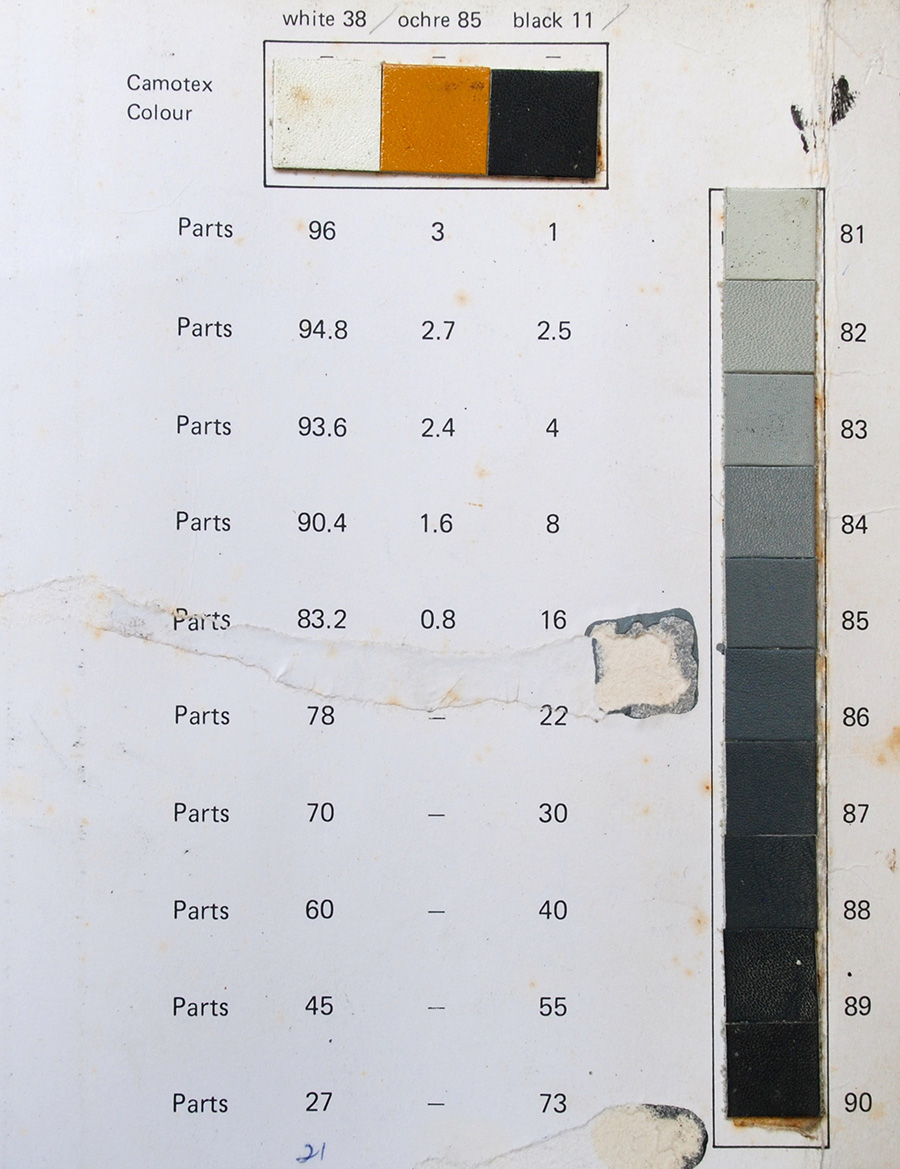
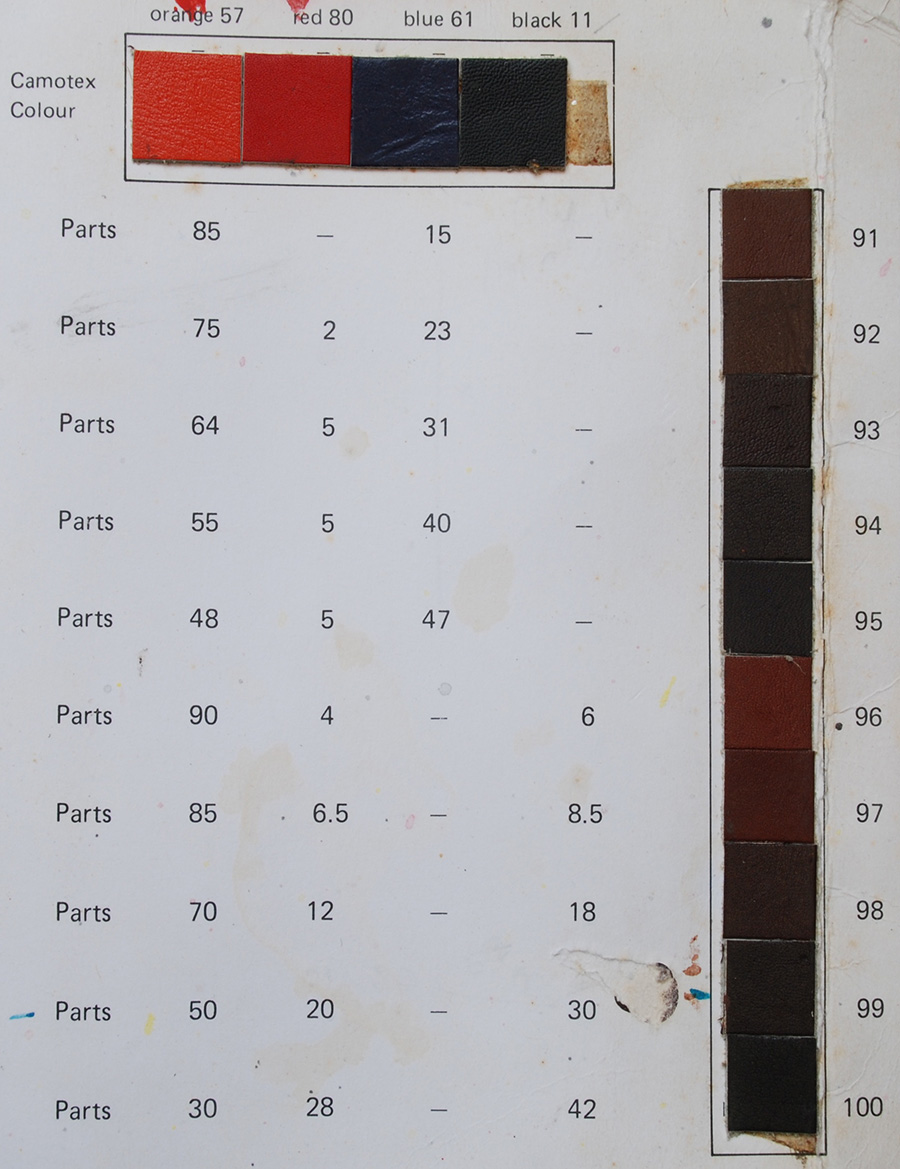
Color Matching with Leather Pigment 54
Color matching is performed by weight-based mixing of pigment components.
The Camotex color reference system shown above provides 100 calibrated shade formulas, enabling precise color matching using combinations of pigments such as:
✅ Black 11
✅ Ochre 85
✅ Tan 59
✅ White 38
✅ Red 80
✅ Maroon 13
✅ Blue 61
✅ Yellow 27
✅ Orange 57
Each shade formula specifies exact parts by weight, ensuring consistent reproduction of leather colors.

Updated: Aug 19, 2024 | April 10 2025|May 13, 2025 | June 8, 2025 | July 3, 2025 |July 27, 2025 by Roger Koh.