

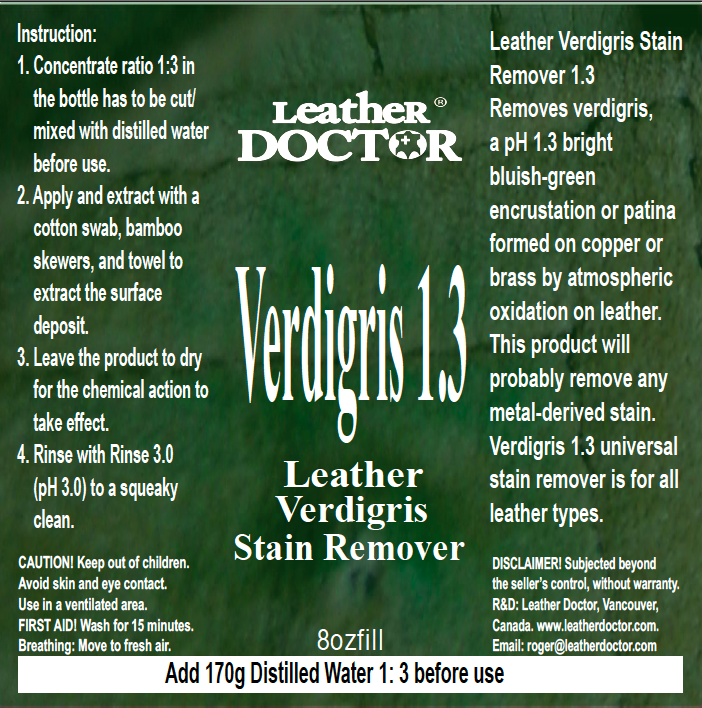
 Leather Verdigris Stain Remover 1.3 (Verdigris 1.3) by Leather Doctor® is a professional pH 1.3 oxidation–reduction (redox) stain remover formulated to eliminate verdigris stains — the bluish-green patina produced when copper or brass hardware oxidizes and transfers onto leather surfaces.
- This powerful water-based acidic treatment safely dissolves metal-derived oxidation stains embedded in leather fibers.
- It is designed for precision stain removal, especially around metal hardware such as rivets, buckles, zippers, and decorative fittings.
- For safe leather structural care, the treatment is followed by pH stabilization using Rinse 4.0 (pH 4.0) to return the leather to its natural acidic range.
 Why Verdigris Forms on Leather?
- Verdigris forms when copper or brass hardware oxidizes and produces copper salts that migrate into leather fibers.
- Moisture, humidity, and acidic tanning agents accelerate the reaction.
- These salts create the characteristic blue-green staining often seen around rivets, studs, buckles, and zipper fittings.
- Professional redox treatments break down these oxidation compounds and safely remove them without harming the leather structure.
 Verdigris Stain Removal FAQ
What is verdigris on leather?
- Verdigris is a bluish-green stain caused by oxidation from copper or brass hardware.
- When metal fittings such as rivets, buckles, or zippers react with moisture and air,
- They produce copper salts that migrate into leather fibers and create green discoloration.
Can verdigris permanently damage leather?
- Yes.
- Verdigris contains acidic copper salts that can slowly weaken leather fibers if left untreated.
- Early removal helps prevent structural deterioration and permanent staining.
How do you remove green verdigris stains from leather?
- Verdigris stains are removed using an acidic oxidation-reduction (redox) treatment such as Leather Doctor® Verdigris Stain Remover 1.3,
- Followed by a pH stabilization rinse like Rinse 4.0 to restore the leather's natural acidity.
Why must leather be rinsed after using Verdigris 1.3?
- Verdigris 1.3 operates at pH 1.3, which dissolves metal oxidation.
- After the stain is removed, Rinse 4.0 rebalances the leather to its natural pH range (3–5)
- To maintain fiber strength and prevent long-term damage.
What types of leather can develop verdigris stains?
Verdigris stains commonly appear on:
- Vachetta leather
- Vegetable-tanned leather
- Nubuck
- Suede
- Aniline leather
- Pigmented leather
- Hair-on-hide
- Woolskin
The stains usually occur near metal hardware or decorative fittings.
Can household cleaners remove verdigris from leather?
- No.
- Household cleaners often contain alkaline detergents or solvents that can damage leather finishes or cause discoloration.
- Specialized pH-controlled leather treatments are recommended.
 Preparation
- Before use, dilute Verdigris 1.3 with distilled water at a ratio of 1:3 inside the bottle.
- Shake gently to mix.
 Step-by-Step Instructions
1️⃣ Step 1 — Verdigris Removal
- Product: Verdigris 1.3
- pH: 1.3
- Recommended Dwell Time: 3–5 minutes
- Maximum Dwell Time: 10 minutes
Procedure:
- Apply the solution precisely to the stain using a cotton swab, bamboo skewer, or soft towel.
- Repeatedly work gently and precisely to lift surface deposits.
- Blot and extract residues with a clean towel.
- Observe the stain response as discoloration begins to lighten.
- Once improvement is visible, proceed immediately to stabilization.
 Important:
- Do not exceed the recommended dwell time.
- Excessive acidity may weaken collagen fibers if left too long.
2️⃣ Step 2 — pH Stabilization
- Product: Rinse 4.0
- pH: 4.0
- Dwell Time: 1–2 minutes
Procedure:
- Thoroughly rinse the treated area with Rinse 4.0.
- Gently towel extract excess moisture.
- Allow the leather to dry naturally at room temperature.
This step restores leather closer to its stable pH range of 3.0–5.0, helping maintain structural integrity and preventing long-term fiber damage.
 Professional Notes
- Verdigris stains are caused by metal oxidation migrating from copper or brass hardware into leather fibers.
- If left untreated, the acidic metal salts may continue reacting with leather tannins, worsening discoloration over time.
- Leather Doctor® Verdigris 1.3 removes these oxidized deposits through controlled redox action,
- While the follow-up Rinse 4.0 neutralizes excess acidity and stabilizes the leather structure.
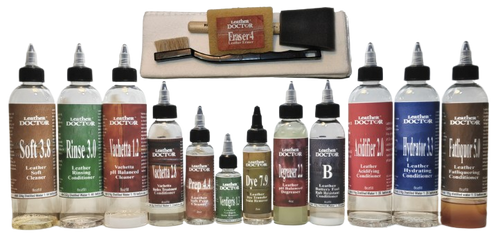
 Part of the Leather Doctor® Redox Leather Restoration System
- Verdigris Stain Remover 1.3 (Verdigris 1.3) works within the Leather Doctor® pH-controlled restoration system,
- Where each product performs a specific stage of leather chemistry correction.
Related Leather Doctor® Treatments
Acidic Redox Treatments
pH Stabilization
Structural Hydrating
Structural Conditioning
- Leather Fatliquoring Conditioner 5.0 (Fatliquor 5.0)
- Leather Scent Fatliquoring Conditioner 5.0 Plus (Fatliquor 5.0 Plus)
Typical Leather Restoration Sequence
- Leather pH Balanced Degreaser 2. 2 (Degreaser 2.2)
- Leather Rinsing Conditioner 3.0 (Rinse 3.0)
- Leather Verdigris Stain Remover 1.3 (Verdigris 1.3)
- Leather pH Stabilizing Rinse Conditioner pH 4.0 (Rinse 4.0)
- Leather Fatliquoring Conditioner 5.0 (Fatliquor 5.0)
- Drying and finishing
Updated: April 14, 2025 | March 15, 2026 | March 16, 2026 by Roger Koh.