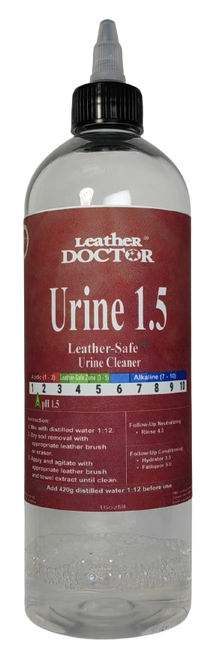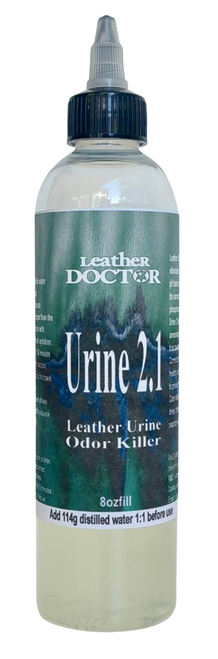

Leather Urine Burned Stain Remover pH 1.0 (Urine 1.0) by Leather Doctor® is a Leather-Safe™ system to neutralize accumulated urine that burned stain leather appearing black or in dark coloration.
 Why call "Urine Burned"?
The chemical effect:
- The term "burned" illustrates the irreversible degradation of leather fibers caused by the pH shift (the leather becomes alkaline instead of acidic).
The visual result:
- This perfectly describes the leather turning black, brittle and stiff , losing all its original elasticity.
- It's a veritable "chemical burn".
 Why Leather Urine Stains Appears Black or in Dark Coloration?
The reasons are:
1. The Iron-Tannin Reaction (The most common)
- The result:
- It is exactly the same component as the iron-gall ink used in the Middle Ages.
2. Oxidation and Urea (Urine)
Urine contains urea and mineral salts.
- The effect:
- Urea acts as a solvent that loosens tannin's bound to the leather fibers.
- Once brought to the surface, these tannin are exposed to oxygen in the air.
- The result:
- Oxidation of concentrated tannin creates a dark crust, ranging from dark brown to black,
- As they polymerize on the surface.
3. The pH change
Tanning agents are stable in an acidic environment (pH 3-5).
- The effect:
- Urine is often alkaline or contains ammonia (after decomposition).
- This change to a higher (basic) pH breaks the bonds between tannin and leather fiber.
- The result:
- The released tannin migrates to the surface and visually "burns" the grain of the leather,
- Giving it this blackened and sometimes hardened appearance.
4. Degradation of the Tanning complex
- The action of ammonia:
- Old urine releases ammonia (alkaline pH).
- The reaction:
- This pH change can break the bond between tanning agent and leather fiber.
- Without its stabilizing agent, the leather "perishes."
- It loses its original color and turns dark gray or black, a sign of chemical decomposition .
 Why is Urine 1.0 the best choice for leather sweat burned?
1. It is an Iron Stain removing Agent
- The result:
- It chemically breaks down the black ink molecule embedded in the fibers and
- Restores the color without bleaching the leather.
- Why this strength?
- To dissolve the mineral deposits of sweat (salts, calcium, magnesium) and
- Break the urea-tannin bonds, a strong acidity is needed.
- Safety:
- At pH 1.0, it is powerful enough to deep clean, but
- Not concentrated enough to instantly destroy collagen leather fiber.
- The action:
- Urine 1.0 dissolves these salt crystals much more effectively than soapy water .
- It frees the fibers that were "bonded" together by the salt,
- Allowing the leather to regain some mechanical suppleness right from the cleaning stage.
 In summary:
Urine 1.0 is the best choice because it is specifically selective:
- It attacks the black stain (iron tannate) and urine deposits
- While respecting the protein structure of the leather,
- Provided it is neutralized afterward.
 Why Precision "Counter-Neutralization"?
- The Rinse 4.0 (pH 4.0):
- Instantly restoring the leather to its natural acid balance.
- Tightening Component Fixing of the fibers
- The leather is designed to be stable within a pH range of 3 to 5 .
- Tannin fixation:
- A Rinse 4.0 (pH 4.0) "locks" the tanning agents onto the fibers.
- If the pH remains too low (close to 1), the tanning agents can detach, weakening the leather.
- Preparation for Fatliquoring:
- Hydrating at pH 3.3 and Fatliquoring at 5.0 afterwards penetrate and adhere much better to leather whose pH is stabilized around 3.0-5.0.
 Instruction:
- Action:
- Use a horsehair detailing Brush 1 and leather Eraser 4
- Objective:
- To eliminate dust, crystallized salts and dried urea residue.
- Technique:
- Brush vigorously in the direction of the grain, then against the grain.
- Action:
- Use very fine grit sandpaper (1000 to 2000).
- Objective:
- To very slightly "open" the pores of the leather without scratching the grain.
- This allows the Urine 1.0 to reach the oxidized tannins located just below the surface.
- Caution:
- Do not sand until the leather becomes fuzzy.
- A light pass is enough to break down the film of salt.
- Action:
- Before applying Urine 1.0, wipe the entire surface evenly damp with Hydrator 3.3.
- Why?
- Leather that is already slightly damp accepts Urine 1.0 treatment better and avoids drying "halos."
- The acidic solution will diffuse more evenly into the fibers.
- Brushing
 Light sanding (if hard)
 Humidification

- Control:
- It allows for precise measurement of the liquid quantity.
- It must be wrung out (damp, not dripping).
- Action:
- By gently dabbing or rubbing in circular motions,
- The sponge helps the acid penetrate the fibers without saturating the core of the leather.
- Advantage:
- It avoids drips that could create new dark spots on healthy areas.
- Seams:
- Sweat and salts often accumulate in seam holes.
- The brush allows the Urine 1.0 to penetrate them.
- Note:
- If the urine stain is very well defined,
- The brush allows you to work only on the black area without touching the rest.
- Risk:
- Be careful not to "foam" the solution too much,
- As the bubbles can leave micro-marks when drying.
- Disadvantages:
- It creates a fine mist that can be inhaled unnecessary.
- Furthermore, it leaves droplets that can dry,
- Creating light-colored "spots" on the leather.
- Single use:
- It is only used to lightly dampen a large surface before wiping with a sponge.
- Even if the urine stain is small, always treat the entire leather panel (from one seam to the next) with the sponge.
- This ensures the leather dries evenly, preventing the appearance of halos (outline marks).
- Moisten the entire panel with Hydrator 3.3 using Foam 2 brush or sponge .
- Apply Urine 1.0 with the wrung-out foam brush or sponge to the sweat stain, then wipe over the entire panel.
- Use a soft hair Brush 1 on the seams if they remain black.
- Leave for a few minutes (the black should lighten) before proceeding to neutralization .
Time Management Rules:
Visual observation:
The action of Urine 1.0 on black stain.
- Safety limit:
- Never exceed 10 minutes of continuous contact.
- Beyond that, the extreme acidity begins to hydrolyze the collagen,
- Which will irreversibly weaken the leather once dry (cardboard effect).
- Work in sections:
- If you are treating a large item (such as a seat or jacket), work panel by panel.
- Apply the product, wait 3 minutes, then neutralize that panel before moving on to the next.
- This ensures complete control over the drying time.
Signs that it's time to neutralize
- The black stain has disappeared or become noticeably lighter.
- The leather is starting to take on a slightly pinkish tint.
- Neutralize immediately if this happens.
- The surface begins to become sticky or "tacky".
Transition procedure
As soon as the time is up or the stain has disappeared:
- Wipe with a dry cloth to absorb any excess solution.
- Immediately follow with Rinse 4.0 (pH 4.0) to restore proper leather acidity
Pro tip:
If the urine stain is very old and deep, it's better to do two short 3-minute applications (with neutralization in between) rather than one long 10-minute application.
This is much safer for the integrity of the leather.
Edited May 31, 2024|March 25 2026 by Roger Koh.