

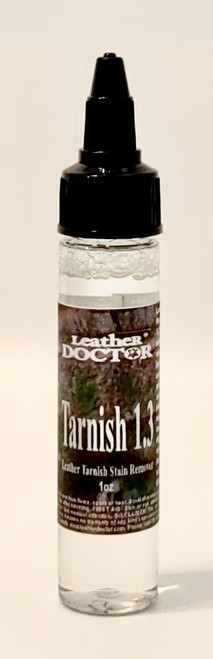
Leather Sweat Burned Stain Remover pH 1.0 | Sweat 1.0 by Leather Doctor® is a Leather-Safe™ system to neutralize accumulated sweat that burned stain leather appearing black or in Dark Coloration.
Why call "Sweat Burned"?
- The chemical effect:
- The term "burned" illustrates the irreversible degradation of leather fibers caused by the pH shift (the leather becomes alkaline instead of acidic).
- The visual result:
- This perfectly describes the leather turning black, brittle and stiff , losing all its original elasticity.
- It's a veritable "chemical burn".
Why Leather Sweat Stains Appears Black or in Dark Coloration?
The reasons are:
1. The Iron-Tannin Reaction (The most common)
The result: It is exactly the same component as the iron-gall ink used in the Middle Ages.
2. Oxidation and Urea (Sweat)
Sweat contains urea and mineral salts.
- The effect:
- Urea acts as a solvent that loosens tannin's bound to the leather fibers. Once brought to the surface, these tannin are exposed to oxygen in the air.
- The result:
- Oxidation of concentrated tannin creates a dark crust, ranging from dark brown to black, as they polymerize on the surface.
3. The pH change
Tanning agents are stable in an acidic environment (pH 3-5).
- The effect:
- Sweat is often alkaline or contains ammonia (after decomposition).
- This change to a higher (basic) pH breaks the bonds between tannin and leather fiber.
- The result:
- The released tannin migrates to the surface and visually "burns" the grain of the leather, giving it this blackened and sometimes hardened appearance.
4. The accumulation of Body Oils
Sweat is almost always accompanied by sebum (body oils).
- The effect:
- Leather is often treated with fat liquors.
- Sebum penetrates and replaces these tannery oils, but it oxidizes and turns rancid over time.
- The result:
- These oxidized oils trap dirt and dust, creating a sticky black patina that eventually soaks into the grain of the leather.
5. Degradation of the Tanning complex
- The action of ammonia:
- Old sweat releases ammonia (alkaline pH).
- The reaction:
- This pH change can break the bond between tanning agent and leather fiber.
- Without its stabilizing agent, the leather "perishes."
- It loses its original color and turns dark gray or black, a sign of chemical decomposition .
- The result:
- It chemically breaks down the black ink molecule embedded in the fibers and restores the color without bleaching the leather.
- Why this strength?
- To dissolve the mineral deposits of sweat (salts, calcium, magnesium) and break the urea-tannin bonds, a strong acidity is needed.
- Safety:
- At pH 1.0, it is powerful enough to deep clean, but not concentrated enough to instantly destroy collagen leather fiber.
- The action:
- Sweat 1.0 dissolves these salt crystals much more effectively than soapy water .
- It frees the fibers that were "bonded" together by the salt, allowing the leather to regain some mechanical suppleness right from the cleaning stage.
In summary:
Sweat 1.0 is the best choice because it is specifically selective:
It attacks the black stain (iron tannate) and perspiration deposits while respecting the protein structure of the leather, provided it is neutralized afterward.
Why Precision "Counter-Neutralization"?
- Water alone (pH 7):
- Rinses the surface, but does not chemically neutralize the encrusted alkalinity.
- The Rinse 4.0 (pH 4.0):
- Actively cancels out traces of Basifier 8.0 through a gentle acid-base reaction, instantly restoring the leather to its natural acid balance.
- Tightening Component Fixing of the fibers
- The leather is designed to be stable within a pH range of 3 to 5 .
- Tannin fixation:
- A Rinse 4.0 (pH 4.0) "locks" the tanning agents onto the fibers.
- If the pH remains too high (close to 7 or 8), the tanning agents can detach, weakening the leather.
- Preparation for Fatliquoring:
- Fatliquoring afterwards penetrate and adhere much better to leather whose pH is stabilized around 3.0-5.0.
 Instruction:
- Action:
- Use a horsehair detailing Brush 1 and leather Eraser 4
- Objective:
- To eliminate dust, crystallized salts and dried sebum residue.
- Technique:
- Brush vigorously in the direction of the grain, then against the grain.
- Action:
- Use very fine grit sandpaper (1000 to 2000).
- Objective:
- To very slightly "open" the pores of the leather without scratching the grain.
- This allows the Sweat 1.0 to reach the oxidized tannins located just below the surface.
- Caution:
- Do not sand until the leather becomes fuzzy.
- A light pass is enough to break down the film of sebum and salt.
- Action:
- Use Degreaser 2.2 (pH 2.2) and brush with horsehair Brush 1, then wipe with a cloth until it shows clean.
- Rinse with Rinse 3.0 and brush with horsehair Brush 1, then wipe with a cloth until it shows clean.
- Why?
- Fat repels water.
- Since Sweat 1.0 is water-based, it would bead on oily leather instead of working.
- Action:
- Before applying Sweat 1.0, wipe the entire surface evenly damp with Hydrator 3.3.
- Why?
- Leather that is already slightly damp accepts Sweat 1.0 treatment better and avoids drying "halos."
- The acidic solution will diffuse more evenly into the fibers.
- Brushing
 Light sanding (if hard)
 Degreasing (if greasy)
 Humidification

- Control:
- It allows for precise measurement of the liquid quantity.
- It must be wrung out (damp, not dripping).
- Action:
- By gently dabbing or rubbing in circular motions, the sponge helps the acid penetrate the fibers without saturating the core of the leather.
- Advantage:
- It avoids drips that could create new dark spots on healthy areas.
- Seams:
- Sweat and salts often accumulate in seam holes.
- The brush allows the Sweat 1.0 to penetrate them.
- Note:
- If the sweat stain is very well defined, the brush allows you to work only on the black area without touching the rest.
- Risk:
- Be careful not to "foam" the solution too much, as the bubbles can leave micro-marks when drying.
- Disadvantages:
- It creates a fine mist that can be inhaled unnecessary.
- Furthermore, it leaves droplets that can dry, creating light-colored "spots" on the leather.
- Single use:
- It is only used to lightly dampen a large surface before wiping with a sponge.
- Even if the sweat stain is small, always treat the entire leather panel (from one seam to the next) with the sponge.
- This ensures the leather dries evenly, preventing the appearance of halos (outline marks).
- Moisten the entire panel with Hydrator 3.3 using Foam 2 brush or sponge .
- Apply Sweat 1.0 with the wrung-out foam brush or sponge to the sweat stain, then wipe over the entire panel.
- Use a soft hair Brush 1 on the seams if they remain black.
- Leave for a few minutes (the black should lighten) before proceeding to neutralization .
Time Management Rules:
Visual observation:
The action of Sweat 1.0 on black stain.
- Safety limit:
- Never exceed 10 minutes of continuous contact.
- Beyond that, the extreme acidity begins to hydrolyze the collagen, which will irreversibly weaken the leather once dry (cardboard effect).
- Work in sections:
- If you are treating a large item (such as a seat or jacket), work panel by panel.
- Apply the product, wait 3 minutes, then neutralize that panel before moving on to the next.
- This ensures complete control over the drying time.
Signs that it's time to neutralize
- The black stain has disappeared or become noticeably lighter.
- The leather is starting to take on a slightly pinkish tint.
- Neutralize immediately if this happens.
- The surface begins to become sticky or "tacky".
Transition procedure
As soon as the time is up or the stain has disappeared:
- Wipe with a dry cloth to absorb any excess solution.
- Immediately apply your Basifier 8.0 (pH 8.0) to stop the reaction.
Pro tip:
If the sweat stain is very old and deep, it's better to do two short 3-minute applications (with neutralization in between) rather than one long 10-minute application.
This is much safer for the integrity of the leather.
Edited May 31, 2024 by Roger Koh.