
 Leather Surfactant Inspector pH 4.0 (Surfactant 4.0) - Surface Tension Inspection Before Refinishing.
 What Surfactant 4.0 Really Does
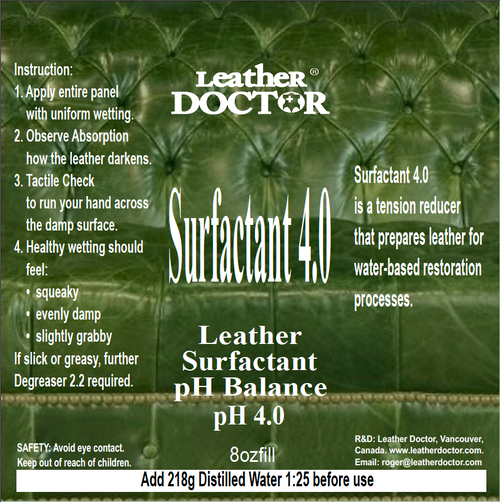
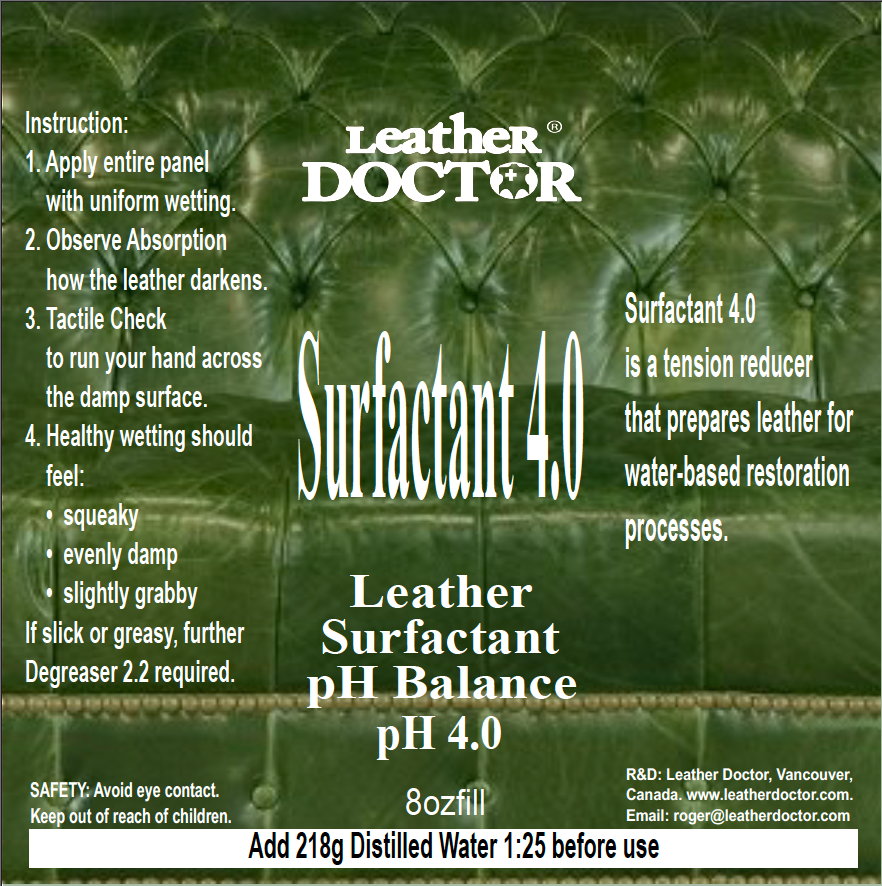
Leather Surfactant Inspector pH 4.0 (Surfactant 4.0) is a Leather-Safe™ pH 4.0 surface tension inspection solution designed to evaluate whether leather is properly prepared for water-based restoration and refinishing.
It does not correct contamination.
It reveals whether contamination and hydrophobic barriers are still present.
 Core Function
Surfactant 4.0 reveals the truth about surface readiness.
It allows you to see:
- how evenly moisture wets the surface
- whether absorption is uniform
- whether hidden contamination still interferes
 Important Clarification
Surfactant 4.0 is not a cleaning or corrective product.
It does not:
- remove grease
- break contamination
- flush suspended soil
These functions belong to:
- Degreaser 2.2
- Rinse 3.0
- Hydrator 3.3
 What Problem It Identifies
Leather may appear clean but still be:
- hydrophobic
- unevenly absorbent
- contaminated below the surface
This results in:
- dye beading after spraying
- streaking when wiped
- patchy tone and clouding
- poor primer adhesion
 Surface Tension Inspection (Water-Wetting Test)
Apply Surfactant 4.0 and observe how the leather responds.
✅ Even Darkening
- Surface is uniformly receptive
- Ready for dry preparation and refinishing
⚠️ Uneven Absorption
- Light spots
- Patchy wetting
- Hesitation or beading
 Indicates:
Residual contamination still present
 Corrective Loop (If Inspection Fails)
Do not proceed to refinishing.
Repeat corrective cleaning:
1️⃣ Step 1 — Re-clean
-
Degreaser 2.2 → Rinse 3.0
2️⃣ Step 2 — Deep Extraction (if required)
- Hydrator 3.3 → Leather Eraser 4
- Hydrator 3.3 uses colloidal water movement
- Brings suspended soiling back to the surface
- Leather Eraser removes it
3️⃣ Step 3 — Dry
4️⃣ Step 4 — Re-inspect
-
Apply Surfactant 4.0 again
 Repeat until:
✅ wetting becomes uniform
 Dry Preparation Before Coating
Once inspection passes:
✅ Fine Sanding (1000–2000 grit)
Purpose:
- level micro-unevenness
- create mechanical key (bite)
- ensure uniform coating adhesion
⚠️ Sand lightly — refine, do not remove structure
 Ready for Refinishing
Only proceed when surface passes inspection:
Primer 73 → Dye 50/76 → Topcoat 50/76
 Why pH 4.0 Matters
Leather naturally exists within a pH range of 3–5.
Surfactant 4.0:
- maintains ionic stability
- prevents dye destabilization
- ensures Leather-Safe™ inspection conditions
 Signs This Step Was Skipped
- dye forms droplets after spraying
- streaks appear when wiped
- uneven tone or clouding
- primer anchors inconsistently
 These are surface readiness failures, not product failures.
 System Insight
Leather Doctor® restoration follows a structured logic:
 Inspection
Surfactant 4.0 → reveals condition
 Correction
Degreaser 2.2 / Rinse 3.0 / Hydrator 3.3 → remove contamination
 Preparation
Fine sanding → ensures adhesion
 Coating
Primer → Dye → Topcoat
 Key Takeaway
Only properly inspected and verified leather is ready for refinishing.
 When to Use Surfactant 4.0
Use before refinishing when leather shows:
- history of body oil or conditioner exposure
- uneven absorption
- prior restoration attempts
- risk of blotching or streaking
 Final Positioning
Surfactant 4.0 is not optional.
It is the decision point that determines whether refinishing will succeed or fail.
Updated: March 8, 2026 | March 26, 2026 by Roger Koh