

- Professional Grease-Phase Ink Removal for Non-Absorbent Leather
- Ballpoint ink contains two components:
- Grease (oil-based carrier)
- Dye (colorant residue)
- Ink 7.7 targets and removes the grease phase first.
- Once released, the remaining dye residue is treated with Dye 7.9 for complete ink removal — all within the controlled Leather-Safe™ System.
Unlike harsh solvent-based removers, Ink 7.7 relies on controlled dwell time and reverse transfer technology to protect the leather finish.
 How Ink 7.7 Works
Ink 7.7 performs through:
- Controlled dwell time
- Deep penetration
- Lubrication of ink particles
- Suspension of contaminants
- Reverse-transfer wicking
This method safely lifts ink without softening, swelling, or damaging leather topcoats, which commonly occurs with aggressive solvents.
 Reverse Transfer Technique
(For Ink 7.7 and Dye 7.9 Applications)
1️⃣ Step 1 – Surface Preparation
- Place a stretchable Towel 5 directly over the ink stain.
- The towel acts as an extension of the leather surface and serves as the absorbent transfer medium.
2️⃣ Step 2 – Application
- Apply Ink 7.7 onto the towel using Brush 1.
- Work the solution through the towel while squeezing out air bubbles to ensure tight surface contact.
3️⃣ Step 3 – Dwell & Suspension
- Allow sufficient dwell time.
- Ink 7.7 penetrates through the finish, lubricates the grease phase, and suspends it.
4️⃣ Step 4 – Reverse Transfer
- The suspended ink is wicked upward into the towel.
- Replace towel sections and repeat until no further transfer is visible.
Repeat until:
- The towel remains clean
- No additional ink transfers
- The stain is fully removed
 Removing the Remaining Dye Component
(Using Dye 7.9)
Once the grease phase is eliminated, a faint dye shadow may remain.
Follow the same Reverse Transfer Technique using Dye 7.9:
- Place fresh stretchable Towel 5 over the stain.
- Apply Dye 7.9 with Brush 1.
- Remove air pockets for tight contact.
- Allow dwell time.
- Repeat until the towel lifts all remaining dye residue.
This staged approach ensures controlled, finish-safe ink removal.
 Final Cleaning & Residue Removal
Removing Sticky Residue
After stain removal:
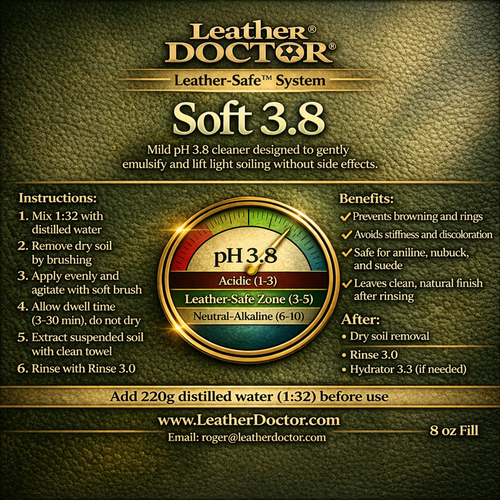
- Clean the area with Soft Cleaner 3.8
- Rinse with Rinse 3.0
This removes any remaining treatment residue and prevents surface tackiness.
 pH Balancing & Neutralization
Ink 7.7 operates at an alkaline level during treatment. After successful stain removal, the leather must be rebalanced.
Acidifier 2.0 (pH 2.0)
Acidifier 2.0 functions as:
- Neutralizer
- pH balancer
- Final rinse
It restores leather from alkaline exposure (pH 7.7 range) back to its healthy natural range of pH 3–5.
You will physically notice the difference:
- Sticky → Neutralized
- Tacky → Squeaky clean
- Disturbed → Restored balance
This critical step prevents long-term damage, stiffness, or finish instability.
 Protection – Preventing Future Ink Stains
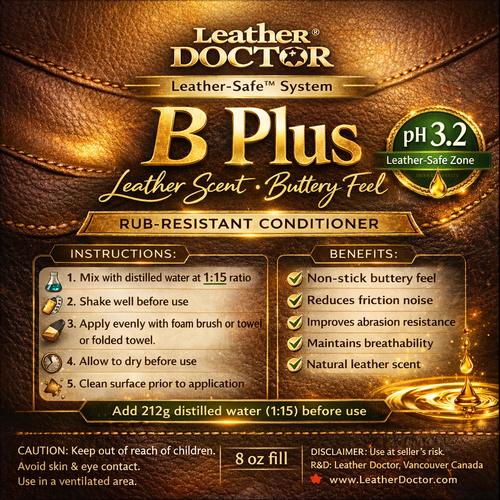
After the leather is fully dry, apply Conditioner B.
Benefits:
- Creates a micro non-stick protection
- Controls ball point ink dispersion
- Makes future cleanup significantly easier
- Maintains supple buttery feel
 Summary Workflow
- Break down grease component → Ink 7.7
- Remove remaining dye shadow → Dye 7.9
- Clean residue → Soft Cleaner 3.8 + Rinse 3.0
- Neutralize & pH balance → Acidifier 2.0
- Protect → Conditioner B
 Why This System Works
✅ Targets ink in its two-phase structure
✅ Avoids aggressive solvent damage
✅ Uses reverse-transfer technology
✅ Maintains leather’s structural integrity
✅ Restores proper pH balance
✅ Leaves leather clean, balanced, and protected

 We welcome your feedback to continuously improve this manual and better address your leather care concerns.
Updated: March 29, 2025 | June 5, 2025 | February 15, 2026 by Roger Koh