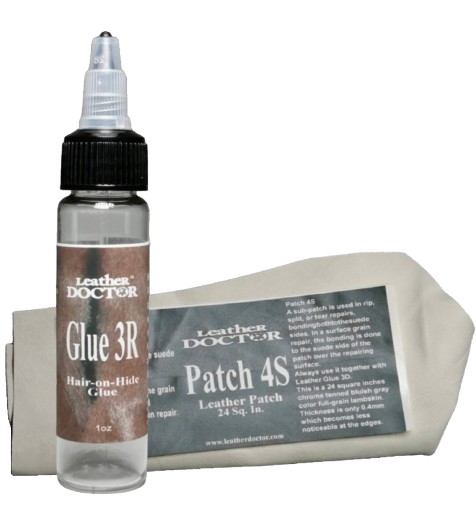
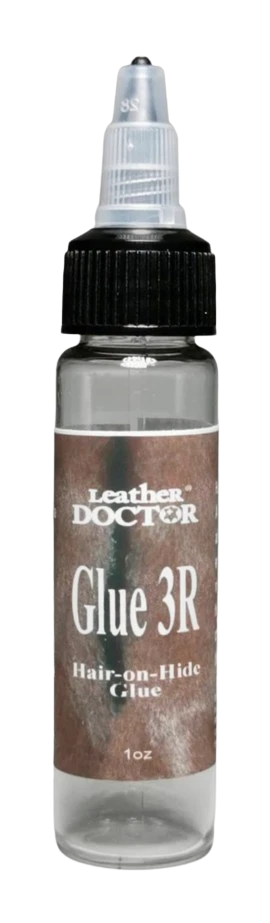


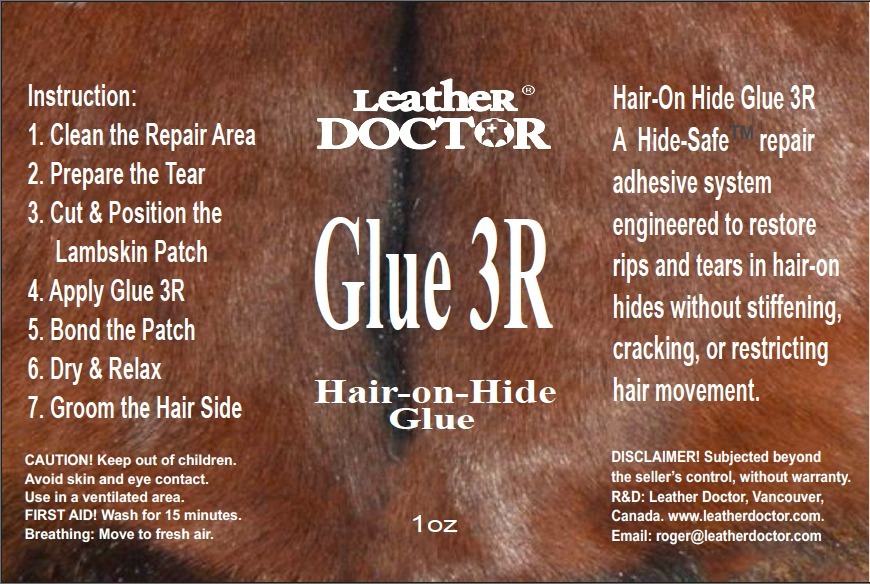
 Hair-On Hide Glue 3R by Leather Doctor® is a Hide-Safe™ repair adhesive system engineered to restore rips and tears in hair-on hides without stiffening, cracking, or restricting hair movement.
- Hair-On Hide Glue 3R - Hide-Safe™ Rip & Tear Repair Adhesive for Hair-On Hides
Formulated as a water-based, flexible soft-compact resin, Glue 3R is designed to be paired with a thin genuine lambskin sub-patch, reinforcing damaged areas from the suede/flesh side only.
Once cured, the bond remains elastic, allowing the hide to drape naturally while maintaining structural integrity.
Developed specifically for hair-on cowhide rugs, sheepskin, and natural hide décor, Glue 3R bonds securely while preserving the hide’s soft hand feel, flexibility, and natural hair flow.
 Key Features & Benefits
-
Hide-Safe™ Adhesive Technology
Water-based resin glue that dries soft, flexible, and natural—never brittle. -
No Stiffening, No Hair Disruption
Preserves natural suppleness, elasticity, and hair movement with no visible glue lines. -
Designed for Hair-On Hides
Ideal for cowhide rugs, sheepskin, hair-on leather, and natural hide furnishings. -
Sub-Patch Reinforcement System
Works with thin lambskin patches to strengthen tears invisibly from underneath.
 Typical Uses
-
Repairing rips, tears, and splits in hair-on hide rugs
-
Reinforcing weakened or stressed hide areas without altering appearance
-
Restoring structural strength while maintaining original look and feel
 Glue 3R vs. Standard Adhesives - Why Hair-On Hides Require a Hide-Safe™ Adhesive
| Feature / Performance | Leather Doctor® Glue 3R (Hide-Safe™) | Standard Craft / General Adhesives |
|---|---|---|
| Designed for Hair-On Hides | Yes – engineered specifically for cowhide rugs, sheepskin, and hair-on décor | No – formulated for flat crafts, vinyl, fabric, or rigid materials |
| Flexibility After Drying | Remains soft, elastic, and pliable | Dries hard, rubbery, or brittle |
| Hide Stiffening Risk | None – preserves natural drape and hand feel | High – commonly stiffens and boards the hide |
| Hair Movement & Flow | Fully preserved – no hair lock-down or matting | Often restricts hair movement or causes clumping |
| Application Method | Sub-patch reinforcement from the suede/flesh side only | Often surface-applied or misused on the hair side |
| Bonding Behavior | Soft-compact resin forms a flexible structural bond | Rigid or overly aggressive bond that stresses fibers |
| Telegraphing Through Hair Side | Minimal to none when paired with thin lambskin patch | High – glue ridges and stiffness often show through |
| Cracking Over Time | No – moves with the hide during temperature and humidity changes | Common – hard films fracture as the hide flexes |
| Compatibility with Lambskin Patch | Optimized – bonds thin leather without bulk | Inconsistent – may soak, harden, or delaminate |
| Reversibility & Future Repairs | Hide-friendly – allows future reinforcement if needed | Difficult – hardened glue damages fibers permanently |
| Long-Term Hide Health | Preserves structural integrity and longevity | Accelerates fiber fatigue and failure |
 Why Standard Adhesives Fail on Hair-On Hides
Hair-on hides are organic, fibrous, and constantly moving. Standard glues are designed to lock materials rigidly, which works against the hide’s natural behavior. This mismatch leads to:
- Stiff patches
- Cracked glue lines
- Restricted hair flow
- Premature re-tearing around the repair
 The Glue 3R Advantage
Glue 3R is not a “stronger glue”—it is a smarter adhesive system.
When combined with a thin lambskin sub-patch, it reinforces the hide without fighting its natural flexibility, ensuring the repair remains:
- Invisible from the hair side
- Soft to the touch
- Structurally sound over time
 Hair-On Hide Rip & Tear Repair Instructions:
Before You Begin
- Perform all repairs from the suede/flesh/hide side only
- Never apply adhesive to the hair side
- Work on a clean, dry, flat surface
1️⃣ Step 1 – Clean the Repair Area (If Needed)
- Lightly clean the suede/flesh/hide side surrounding the tear to remove dust, oils, or residues that may interfere with adhesion.
- Allow the area to dry completely.
- Leather Doctor® Principle: Clean bonding surfaces ensure maximum adhesive performance.
2️⃣ Step 2 – Prepare the Tear
- Gently align the torn edges so they meet naturally without overlapping or tension.
- Trim loose fibers on the suede side only if necessary.
- Tip: Proper alignment ensures the repair remains invisible from the hair side.
3️⃣ Step 3 – Cut & Position the Lambskin Patch
- Cut the 0.4 mm lambskin patch so it extends at least ½ inch (12 mm) beyond the tear on all sides.
- Dry-fit the patch beneath the tear to confirm flat, full coverage.
- Leather Doctor® Principle: Thin, flexible sub-patching prevents ridges, stiffness, and telegraphing.
4️⃣ Step 4 – Apply Glue 3R
Apply an even coat of Glue 3R to:
- The suede side of the lambskin patch
- The suede/flesh side edges of the tear
Allow the adhesive to become tacky (partially dry) before bonding.
5️⃣ Step 5 – Bond the Patch
- Insert the lambskin patch beneath the tear.
- Press firmly so the torn edges meet naturally.
- Work from the center outward to eliminate air pockets and ensure full contact.
- Hold with light pressure until the bond sets.
6️⃣ Step 6 – Dry & Relax
Allow the repair to dry naturally.
Do not stretch, fold, or stress the area during curing.
- Gentle airflow is acceptable
- Avoid heat
7️⃣ Step 7 – Groom the Hair Side
- Once fully dry, gently brush or hand-separate the hair fibers on the grain side to restore natural hair flow and conceal the repair.
- Result: A soft, flexible, structurally reinforced repair with no visible glue lines.
8️⃣ After-Care Notes
- Avoid vacuuming or aggressive handling over the repaired area for 24 hours
- Normal use may resume once the adhesive has fully cured
- For weakened or aging hides, preventive sub-patch reinforcement from the flesh side is recommended
9️⃣ The Leather Doctor® System Advantage
Glue 3R preserves what matters most:
- Natural hide flexibility
- Original hair movement and texture
- Soft hand feel—without stiffening or surface alteration
January 24, 2026 by Roger Koh