
Fatliquoring vs Oiling Leather
Posted by Roger Koh on 26th Feb 2026
Fatliquoring vs Oiling Leather
Why Most Conditioners Only Soften — But Do Not Restore
Leather that feels stiff, dry, or brittle is often treated with “conditioning oils.” Neatsfoot oil, mink oil, lanolin creams — they all promise softness.
But softness and structural restoration are not the same thing.
To understand the difference, we must look inside the leather fiber structure.
Visual 1: How Tannery Fatliquoring Works
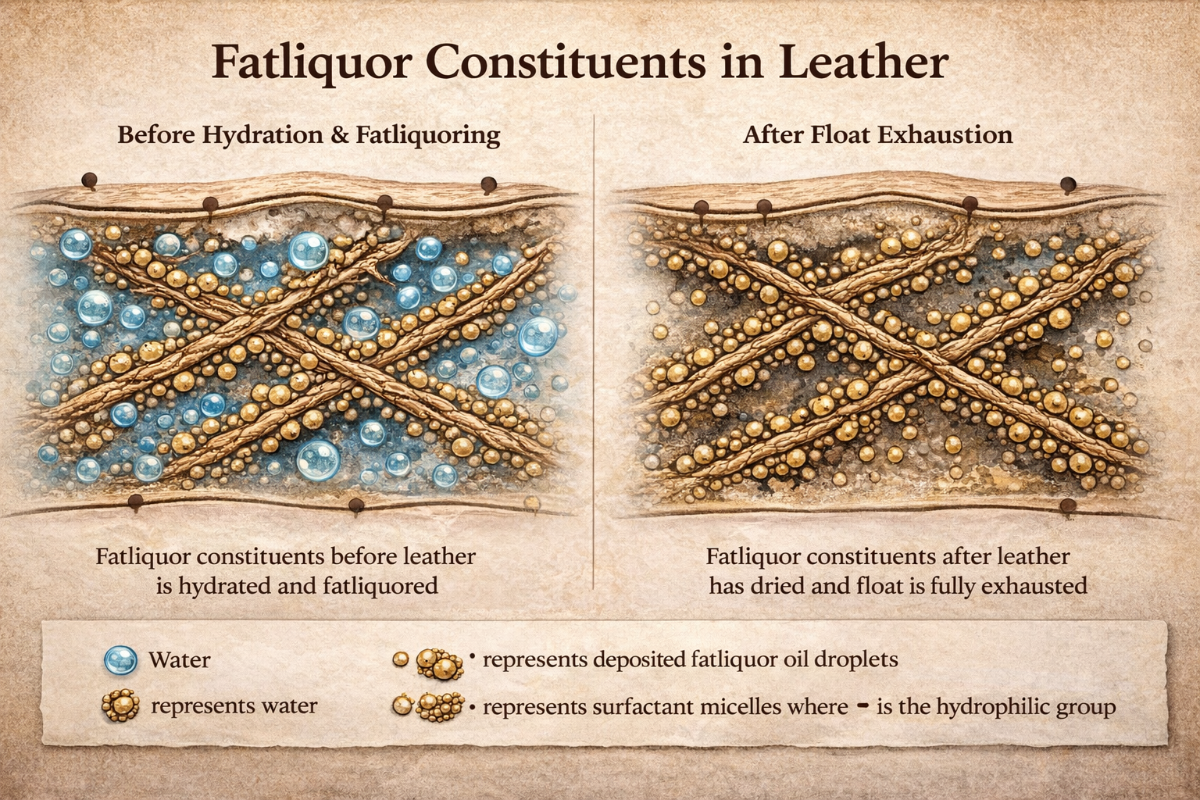
(Insert Image: Fatliquor Constituents in Leather – Before & After Float Exhaustion)
This illustration reflects classic tannery immersion fatliquoring principles described in leather chemistry literature.
Before Exhaustion
-
Water surrounds collagen fibers
-
Fatliquor droplets are emulsified in suspension
-
Surfactant micelles carry lubricating oils
After Exhaustion
-
Water phase largely removed
-
Fatliquor constituents deposited internally
-
Lubricants distributed between collagen fibrils
This is not surface greasing.
This is internal fiber lubrication engineered during tanning.
The purpose of fatliquoring is to:
-
Prevent fiber-to-fiber friction
-
Maintain flexibility under bending stress
-
Preserve tensile strength
-
Stabilize long-term resilience
The Leather Doctor® Non-Immersion Equivalent
In traditional tanneries, fatliquoring happens in immersion drums.
The Leather Doctor system replicates the same principle — without immersion.
Instead of water float:
-
Hydrator 3.3 performs controlled rehydration
-
At pH 3.3, collagen fibers carry a positive ionic charge
Then:
-
Fatliquor 5.0, carrying a compatible negative ionic charge
-
Bonds electrostatically through hydrogen bonding
As drying occurs:
-
Lubricants anchor within the collagen matrix
-
Structural softness is restored
This is charge-controlled structural restoration.
Visual 2: Random Oil Saturation vs Ionic Bonded Fatliquor
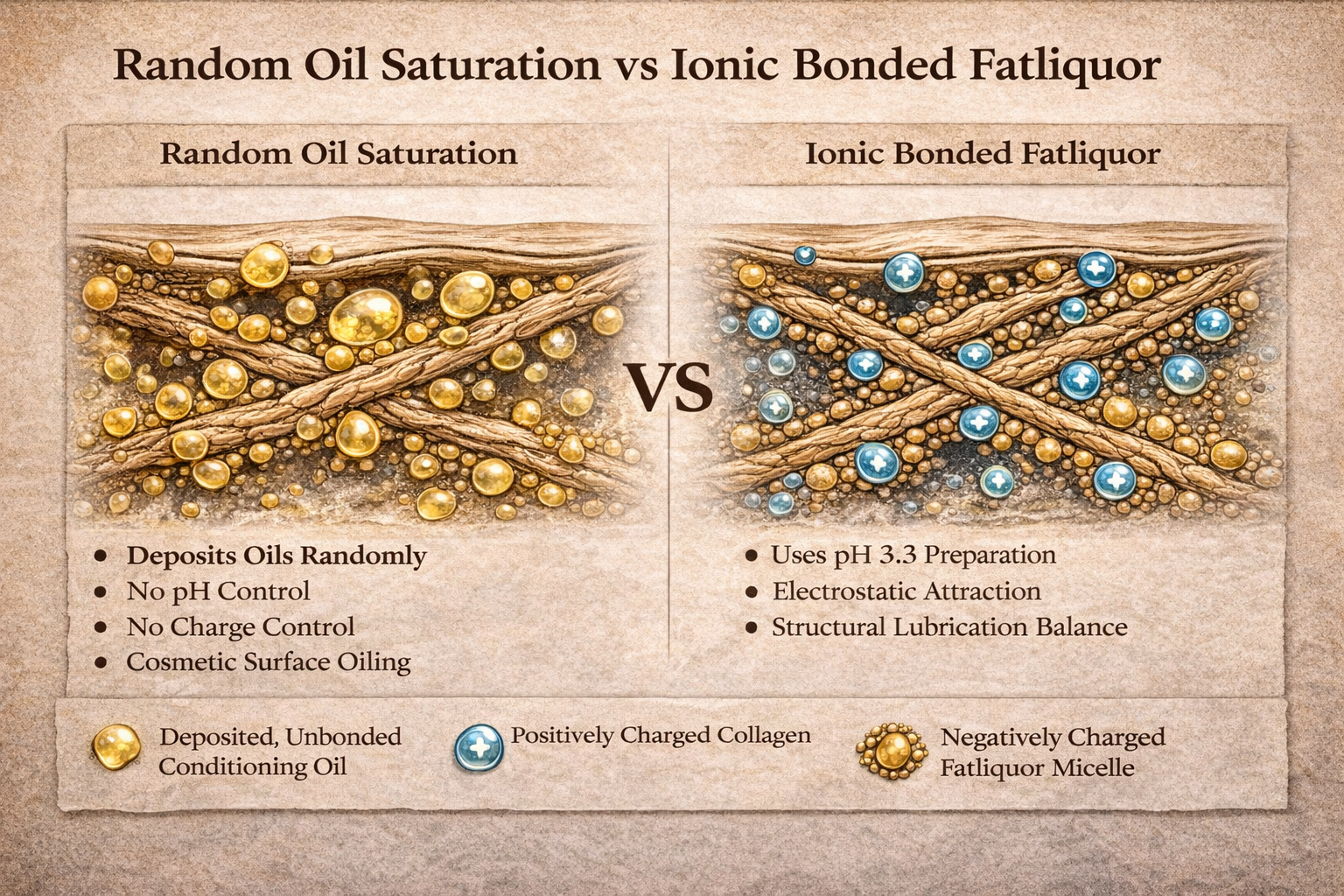
(Insert Image: Random Oil Saturation vs Ionic Bonded Fatliquor)
This comparison illustrates the critical difference.
Left: Random Oil Saturation
Common conditioners:
-
Deposit oils without pH preparation
-
Have no ionic control
-
Do not rely on electrostatic attraction
-
May temporarily soften leather
Risks:
-
Uneven penetration
-
Surface oiliness
-
Fiber swelling
-
Long-term oxidation
-
Weakening over time
These oils lubricate — but without structural anchoring.
Right: Ionic Bonded Fatliquor
The Leather Doctor® System:
-
Uses Hydrator 3.3 for acidic ionic preparation
-
Positions collagen below its isoelectric point
-
Creates net positive fiber charge
-
Fatliquor 5.0 (anionic) is electrostatically attracted
-
Lubricants anchor during drying
Result:
-
Even internal distribution
-
Stable structural lubrication
-
Restored resilience
-
No surface grease
Why This Matters for Restoration
Leather becomes stiff primarily because it has lost:
-
Moisture balance
-
Internal lubricating fatlior
-
Fiber flexibility
Applying oil to dry leather without rebalancing ionic charge is like applying grease to dry rope. It may soften briefly — but the internal fiber network is not properly restored.
True restoration requires:
Hydration → Ionic Preparation → Fatliquoring → Controlled Drying
This is how tanneries engineer flexibility.
This is how professional restoration should be performed.
Surface Conditioning vs Structural Engineering
| Cosmetic Conditioning | Structural Fatliquoring |
|---|---|
| Surface lubrication | Internal fiber lubrication |
| No pH control | Controlled acidic preparation |
| No charge management | Ionic attraction & hydrogen bonding |
| Temporary softness | Long-term resilience |
| Risk of over-oiling | Progressive, controlled cycles |
When Oils May Still Have a Role
Surface oils may:
-
Enhance sheen temporarily
-
Darken appearance
-
Reduce minor surface friction
But they are not substitutes for tannery-equivalent fatliquoring when structural dryness is present.
Final Perspective
Leather was engineered during tanning to flex through internal lubrication — not surface greasing.
When leather loses that lubrication, restoration should follow tannery science, not household oiling tradition.
Fatliquoring is not a product category.
It is a controlled chemical process.
And that distinction is the foundation of structural leather restoration.