

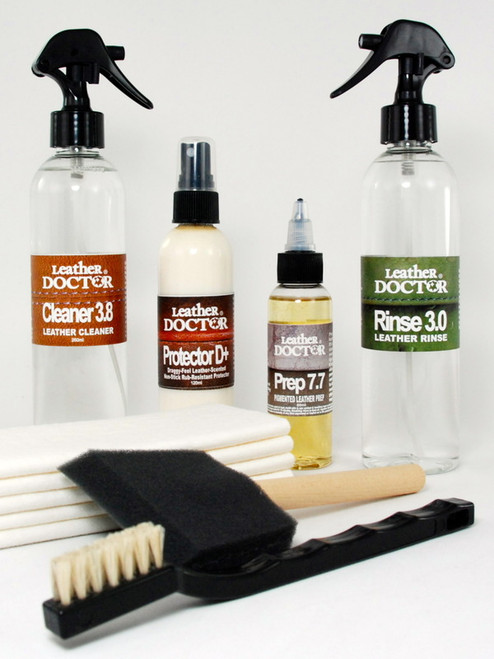
 Bicast Leather Sticky Care System™ (B2 → B3 → B7)
Bicast leather stickiness is a progressive condition, not a one-time problem.
Leather Doctor® solves it through a 3-level modular system, based on severity:
Level 1 – Prevention & Early Stickiness
 B2 Cleaning System
Level 2 – Active Deterioration
 B3 Degreasing System
Level 3 – Structural Breakdown (Hydrolysis)
 B7 Refinishing System
 How the System Works (Cycle of Care)
B2 maintains → prevents buildup
B3 corrects → stops deterioration
B7 restores → rebuilds structure
Then returns to:
 B2 for maintenance
 Key Understanding (Very Important Positioning)
Sticky Bicast is not dirt — it is polyurethane failure.
Each system targets a different stage:
| Condition | Feel | Required System |
|---|---|---|
| Light tackiness | Slight drag | B2 |
| Noticeable stickiness | Grippy / dull | B3 |
| Soft / spongy / gummy | Surface deforms | B7 |
Bicast Leather Sticky Problem Guide
- 1️⃣ Which Kit Do I Need?
- 2️⃣ How to Choose the Right Bicast Leather Repair Kit?
- 3️⃣ Why Some Sticky Leather Repairs Fail (And How to Avoid It)?
Bicast Leather Sticky Preventive Cleaning Kit B2
B2 is designed to prevent and control early-stage stickiness before topcoat damage occurs.
✅ When to Use:
- Slight tackiness
- Early residue buildup
- Routine maintenance
✅ What It Does:
- Removes sweat, oils, and residues
- Restores healthy pH balance
- Maintains a dry, non-sticky feel
 3-Step System
Step 1 – Sticky 1.5
Removes surface contamination and alkalinity
Step 2 – Acidifier 2.0
Restores pH balance and stabilizes PU surface
Step 3 – Conditioner B
Reduces friction and prevents future stickiness
 Upgrade Trigger
If stickiness:
- Returns quickly
- Feels heavier or uneven
 Upgrade to B3 Degreasing System
✅ 1. VISUAL DECISION CHART
Which Kit Do I Need?
(Bicast Leather Sticky Problem Guide)
START HERE ↓
Is the surface slightly tacky or dragging?
│
├── YES → Use B2 Cleaning System
│ (Early-stage residue buildup)
│
└── NO ↓
Does the surface feel sticky, dull, or uneven?
│
├── YES → Use B3 Degreasing System
│ (Oils have penetrated and deterioration has started)
│
└── NO ↓
Does the surface feel soft, spongy, or “melting”?
│
├── YES → Use B7 Refinishing System
│ (Polyurethane structure has broken down)
│
└── NOT SURE?
→ Start with B2 → escalate if needed
✅ 2. “WHICH KIT DO I NEED?”
How to Choose the Right Bicast Leather Kit
Bicast leather stickiness develops in stages.
Choosing the correct system ensures success.
 Choose B2 Cleaning System if:
- Surface feels slightly tacky
- Stickiness is recent
- No soft or spongy feel
- Happens mainly in high-contact areas
✅ This is preventive and early correction
 Choose B3 Degreasing System if:
- Stickiness is obvious and persistent
- Surface looks dull or uneven
- Cleaning no longer solves the issue
- Oils and sweat have likely penetrated
✅ This is active correction
 Choose B7 Refinishing System if:
- Surface feels soft, spongy, or rubbery
- Leather feels like it is “melting”
- Sticky even after degreasing
- Finish looks worn or degraded
✅ This is structural restoration
 Still Unsure?
Start with B2 Cleaning System.
If the problem remains:
→ Upgrade to B3, then B7 if necessary
This ensures the safest and most effective approach.
✅ 3. B7 FAILURE PREVENTION (CRITICAL – BASED ON REAL CASES)
 Why Some Sticky Leather Repairs Fail (And How to Avoid It)
Sticky Bicast repair can fail — not because of the product, but due to process gaps.
Here are the most common causes and how to avoid them:
 1. Incomplete Removal of Deteriorated Topcoat
Problem:
Old polyurethane remains active underneath
Result:
New coating stays sticky or does not cure
✅ Solution:
Use Buffer 3 thoroughly
 Continue until residue becomes fine white powder
 This indicates unstable PU has been removed
 2. Applying Topcoat Too Thick
Problem:
Heavy layers trap moisture and prevent curing
✅ Solution:
Apply thin, even coats only
Allow proper drying between layers
 3. Skipping Proper Drying Time
Problem:
Moisture interferes with crosslinking
✅ Solution:
Allow 2–3 hours between coats
Cure 24–48 hours before use
 4. Low Temperature or High Humidity
Problem:
Slows or prevents proper curing
✅ Solution:
Ideal temperature: 20–25°C
Ensure airflow (fan), avoid cold environment
 5. Insufficient Prep Application
Problem:
Contamination remains under coating
✅ Solution:
Ensure proper degreasing
Visible transfer to towel is expected
✅ Professional Insight
Sticky bicast is a surface failure problem, not just a cleaning issue.
Successful repair depends on: Removing instability
 Rebuilding with controlled thin layers
Bicast Leather Sticky Preventive Cleaning Kit B2 by Leather Doctor® is a Leather-Safe™ innovative system developed to keep Bicast leather from the potential stickiness problem.
 Why Bicast Leather Develops a Sticky Problem?
Polyurethane (PU) Degradation:
- It is the PU layer that is the problem.
- Unlike genuine leather, which breathes, this plastic layer traps substances on its surface.
Oils, Grease and Sweat Reaction:
- This is one of the most common factors.
- Oils, Grease and Sweat penetrate the protective film and trigger polymer degradation, which makes the finish sticky.
Alkaline Cleaners:
- This is a crucial point.
- Overly aggressive cleaners (often alkaline) can strip away the protective agents of the PU,
- Thus accelerating its oxidation.
Hydrolysis:
- The reaction of polyurethane with ambient humidity.
- Atmospheric moisture chemically breaks down the plastic molecules,
- Creating this irreversible "gummy" texture.
Plasticizers Migration:
- The stickiness is often due to softening agents (plasticizers) which "rise"
- To the surface of the plastic film over time or under the effect of heat, creating a sticky residue.
 What are the Solution to Sticky Bicast:
 1. How to Treat Bicast Leather that has Started to Become Sticky?
Step 1 Sticky 1.5:
- A pH-balanced Leather-Safe™ system,
- To remove sweat and alkalinity to prevent the leather from becoming sticky.
Step 2 Acidifier 2.0:
- A professional-grade, Leather-Safe™, pH balanced (2.0) acidifying rinse conditioner
- Scientifically designed to restore and maintain leather’s natural pH balance.
Step 3 Conditioner B:
- A Leather-Safe™ pH-balanced, (3.2) buttery feel, non-yellowing, non-stick, rub-resistant conditioner
- Scientifically formulated to enhance durability, prevent friction wear, and protect all smooth leather surfaces.
2. How to Correct Sticky Bicast Leather?
Advance Stickiness - B3 System
3. How to Restore Sticky Bicast Leather?
 Simplified Instruction Flow
- Apply Sticky 1.5 (1:12 dilution)
- Brush with horsehair Brush 1
- Remove surface soiling
- Towel extract until the towel shows clean
2️⃣ Rinsing
- Apply Acidifier 2.0 (1:25 dilution)
- Brush with horsehair Brush 1
- Remove surface soiling
- Towel extract until the towel shows clean
- Repeat and inspect until tackiness is gone.
- Otherwise upgrade to Degreasing B3 system
5️⃣ Conditioning
- Apply Conditioner B (1:19 dilution)
- Allow to dry to a smooth, non-stick finish
Updated July 3, 2024 | March 20, 2026 by Roger Koh