


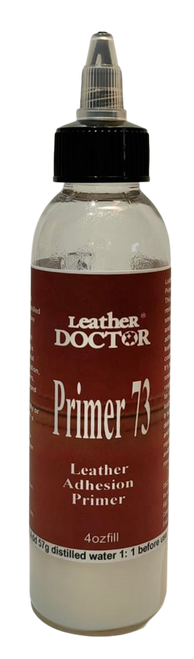
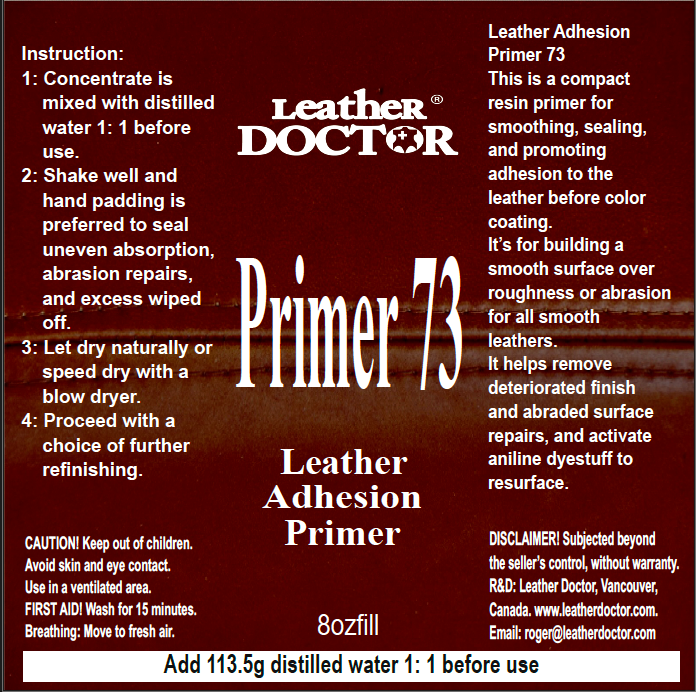
 Leather Adhesion Primer (Primer 73)
Control Layer for Uniform Dye Anchoring & Film Stability
 What Primer 73 Really Does
Primer 73 is a Leather-Safe™ adhesion control layer designed to stabilize the leather surface before dyeing.
It does not simply “help dye stick.”
It controls how dye behaves.
 Core Function
Primer 73 creates a uniform intermediary film that regulates absorption, spread, and anchoring of coating dye.
It ensures that:
- dye lays down evenly
- color builds consistently
- finishes do not streak, bead, or cloud
 Why Primer 73 Is Necessary
Even when leather appears clean:
- absorption may still be uneven
- surface energy may vary
- micro-porosity may be inconsistent
 Without a control layer:
- dye penetrates unpredictably
- or sits unevenly on the surface
⚠️ What Happens Without Primer 73
- dye forms droplets after spraying
- streaking appears when wiped
- uneven tone and patchiness
- cloudy or blotchy finish
- poor layer stacking
 These are not dye problems —
they are surface control failures
 Dependency (Critical System Requirement)
Primer 73 only performs correctly when the surface has been properly prepared.
✅ Required Before Application:
 Surface Inspection
Surfactant 4.0
- must show uniform wetting
 Correction (if needed)
- Degreaser 2.2 → Rinse 3.0
- Hydrator 3.3 → Leather Eraser 4
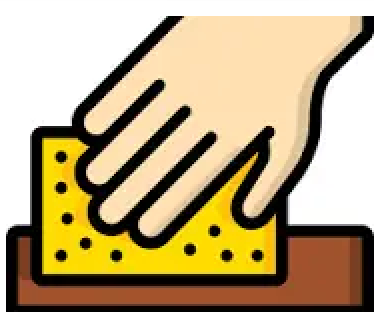 Mechanical Preparation
- Dry sanding (1000–2000 grit)
- creates uniform adhesion “bite”
 Important Principle
Primer cannot fix a contaminated or uneven surface.
It only stabilizes a properly prepared one.
 How Primer 73 Works
Primer 73 forms a micro-thin, uniform film layer that:
- evens out surface absorption
- balances surface energy
- provides consistent anchoring for dye
 Think of it as:
a bridge between leather and color
 Chemical vs Mechanical Reset
- How to Correct Streaks, Film Defects & Surface Instability Before Primer
- Before applying Primer 73, any existing streaks, uneven film, or surface instability must be properly corrected.
- This correction follows a decision-based approach:
Mechanical first — Chemical only when necessary
1️⃣ Step 1 — Identify the Type of Defect
✅ Light / Surface-Level Streaks
- faint streaking
- uneven reflection
- minor film irregularity
 These are typically:
mechanical defects (surface-level)
 Stubborn / Film-Bound Defects
- visible streak lines that resist sanding
- uneven coating buildup
- surface feels slightly sealed or draggy
 These indicate:
unstable or uneven film layers
 Mechanical Reset (Primary Method)
Dry sanding (1000–2000 grit)
Purpose:
- level uneven film thickness
- remove streak edges
- restore uniform surface reflection
- create consistent adhesion “bite”
✅ Always start here
✅ Blend outward for uniformity
 Chemical Reset (Conditional Use Only)
Deglazer 2.3 — controlled application
Use only when:
- sanding alone does not resolve streaks
- film remains uneven or resistant
- surface shows signs of coating buildup
 Application Method
- apply Deglazer 2.3 to a towel (not directly to leather)
- wipe lightly and selectively
- target only affected areas
Purpose:
- remove unstable primer or dye film
- reset the surface for proper leveling
 Important Control
- do NOT flood the surface
- avoid over-application
- prevent penetration into the fiber structure
 Overuse may:
- strip internal fatliquor
- cause stiffness
- reintroduce absorption imbalance
 After Chemical Reset
Because Deglazer may disturb internal balance:
✅ Re-stabilize (if required)
- light Hydrator 3.3 application
- allow to dry fully
 Re-Inspection (Mandatory)
Surfactant 4.0
✅ Confirm:
- uniform wetting
- no patchiness
 If uneven:
- return to corrective cleaning loop
 Final Preparation
Once surface is:
- level (mechanically)
- stable (chemically)
- uniform (inspection confirmed)
Proceed to:
Primer 73
 Key Principle
If sanding can correct the defect — do not use Deglazer.
If sanding cannot correct it — use Deglazer selectively.
 System Insight
This step ensures that Primer 73 is applied to a surface that is:
- structurally stable
- uniformly receptive
- mechanically prepared
 Only then can Primer 73 perform its role as a true control layer
 Application Guidelines
1️⃣ Apply Light Scrubbing with 3M White Nylon Pad
- do not saturate
- build thin even layers
2️⃣ Allow Proper Flash-Off
- avoid wet buildup
- maintain control
3️⃣ Inspect Surface Response
-
should appear:
- even
- consistent
- non-repelling
 Common Application Errors
- applying over uninspected surface
- skipping sanding step
- applying too wet
- using primer to “fix” uneven absorption
 Ready for Dye
Once Primer 73 is correctly applied:
Dye 76 → builds evenly, predictably, and controllably
 System Insight
Leather Doctor® restoration follows a controlled sequence:
 Inspection
- Surfactant 4.0
 Correction
- Degreaser / Rinse / Hydrator
 Preparation
- Fine sanding
 Control Layer
- Primer 73
 Color Coat
- Dye 50/76 or Pigment 54
 Top Coat
- Topcoat 50/76 or Topcoat 54 (Gloss, Satin or Matte)
 Rub-Resistant Protection
- Conditioner B/B Plus or W/W Plus
 Key Takeaway
Primer 73 determines whether dye behaves —
not just whether it adheres.
Edited: March 24, 2025 | July 3, 2025 | December 10, 2025 | March 26, 2026 by Roger Koh